Entries Tagged 'keywords' ↓
May 6th, 2013 — keywords, search engine optimisation, seo, SEO copywriter, seo website copywriter
What is it about the word ‘keywords’ that gets people so wound up?
Some go into a frenzy, others look blankly at you or there are those who try to devise cunning ways to cram as many of said words into everything they write.
This blog is going to look at what they are, how you work out good ones for you and what you should do with them.
What is a keyword?
The first thing to remember is that a keyword isn’t necessarily a word; it can also be a phrase.
In a nutshell, it is a word or phrase people use to search for a product, service or piece of information.
So if you sold designer leather dog collars, your keywords would be things like:
- Dog collars
- Leather dog collars
- Designer dog collars
- Leather designer dog collars
The other thing to remember is that every business will have more than one keyword. Which is just as well, because every page of your website should be optimised for a different keyword.
Your keywords can also include your geographical location to give your local search engine optimisation a boost.
The value of a good keyword
Before deciding on the keywords you want to use, it’s important you check out their competitiveness and impression frequency.
It is pointless going after keywords if they are:
- Hugely competitive with everyone chasing after them
- No competition because no one uses that term to search for things
You can use Google’s keyword tool to find out the number of searches (globally and locally) and whether the competition is high or low.
Long tail keywords (such as ‘leather designer dog collars’) will draw a lower search volume, but because it’s more targeted they are likely to bring in buying customers.
Single keywords, for example ‘copywriter’ are incredibly competitive and will take a very long time to rank well for, but if you opt for something such as ‘email copywriter’ or ‘copywriting services’ you’ll stand a better chance of getting quicker results.
How to decide on keywords
The best way to come up with a list of keywords is to write down everything that relates to your business, including technical and non-technical terms (your customers are more likely to use the latter).
Then use tools such as Google’s keyword tool and Wordtracker to help work our which ones are the best to go for. You can also use Google Trends to see how certain keywords are performing.
Using your keywords
I mentioned earlier that every page of your website should be optimised for a different keyword, but that doesn’t mean cramming every inch of the page with it.
Firstly, work out which words are to be included on which page and create your navigation bar (each page should have its keyword in its title).
Then create a keyword rich title tag (that actually makes sense) to show Google what your page is about.
When it comes to your content, make sure your keyword is in your H1 heading (main heading) and any other subheadings you use and then write naturally. You will find that your keywords will appear without you having to shoe horn them in.
That last point is vital – write naturally. Your website is there to attract people not search engine spiders because it’s the people who’ll be buying from you.
That’s basically all you need to know about keywords. If you have any questions leave a comment below and I’ll get back to you as soon as I can.
Author:
Sally Ormond, copywriter, blogger, tweeter, cyclist and lover of Aspalls cider.
September 14th, 2012 — copywriting tips, keywords, search engine optimisation, seo, SEO copywriter, seo website copywriter
If you look back through this blog’s archives, you’ll find a number of posts on SEO copywriting such as:
Writing good SEO copy
The importance of off screen SEO
Simple SEO checks any small business can make
But what I want to concentrate on in this post is the use of your keywords.
Going right back to basics, keywords are the words and phrases your customers type in to Google’s search box when looking for your products and services.
In the bad old days, ‘SEO experts’ would have you believe that to be highly ranked, you had to cram as many of those keywords/phrases into your copy.
The result…well, you can imagine; page after page of complete drivel.
Thankfully, those days are gone (but be warned, there are one or two dinosaurs still around touting keyword density as the Holy Gail of SEO copywriting) and marketers are far savvier.
Be natural
Natural writing is the key to good rankings.
By keeping your copy focused on your reader and the benefits you can offer them, your writing will engage and naturally contain your keywords and phrases.
But there is one caveat here: your key phrases do not have to be used in their entirety throughout your web page.
What do I mean by that?
For example, let’s say you sell “designer leather dog collars”, rather than using that phrase in its entirety everywhere in your site, you can break it down using single words such as “designer” and “leather” or combinations “dog collars” “designer leather” “leather collars” etc.
You get the idea.
You see Google looks at your page for synonyms too, so splitting your phrase down will really help your rankings.
Of course, you still need to use it in its entirety somewhere to show Google exactly what your page is about, perhaps in your:
- Headline
- Sub headings
- Alt text
- Anchor text links
Remember, writing SEO copy is an art form when it comes to understanding Google’s likes and dislikes, but the overwhelming aspect of it is to write naturally and always for your reader.
Keep them firmly in your mind when writing your copy. If you start to think about the search engines your content won’t do its job.
April 25th, 2012 — effective copy, keywords, search engine optimisation, seo, SEO copywriter, seo website copywriter
Keyword density is one of those phrases from the past that should be buried.
In the bad old days of SEO (search engine optimisation), it was thought to be the best on-screen method of boosting your search rankings.
The problem behind this thinking was that if you had 10 instances of your keyword or phrase on your web page, but a competitor had 15, they would rank higher than you.
Can you see where this is going?
That’s right – the end result was a list of search results that took you to unreadable, unimaginative and very uninteresting content.
SEO the right way
Thankfully, most SEO copywriters today understand the value of natural copy that is written for the reader and not the search engines.
You see, if you write in a natural style about a particular subject, the keywords will appear and at a level that you would expect. The result is great information that is easy to read and that will help your on-screen SEO strategy.
If you think this is all stuff and nonsense and that having a certain percentage of keywords is still the way to go, have a read of this from Google’s very own Matt Cutts (speaking at SXSW earlier this year):
“What about the people optimizing really hard and doing a lot of SEO. We don’t normally pre-announce changes but there is something we are working in the last few months and hope to release it in the next months or few weeks. We are trying to level the playing field a bit. All those people doing, for lack of a better word, over optimization or overly SEO – versus those making great content and great site. We are trying to make GoogleBot smarter, make our relevance better, and we are also looking for those who abuse it, like too many keywords on a page, or exchange way too many links or go well beyond what you normally expect. We have several engineers on my team working on this right now.”
Be natural
So there you go, if you continue to over stuff your content with keywords it will damage your website in the long run as well as having an immediate effect on your conversion rate.
Good SEO copy is:
- Natural
- Written for your reader
- Simple to understand
- Well laid out
It really is as easy as that.
December 19th, 2011 — Google, keywords
This infographic on SEObook.com caught my eye today.
It’s all about how Google killed the long tail keywords because, over the years, they’ve moved to consolidate search volume against fewer keywords, making it easier for them to match ads against them – take a look, ’tis rather interesting.
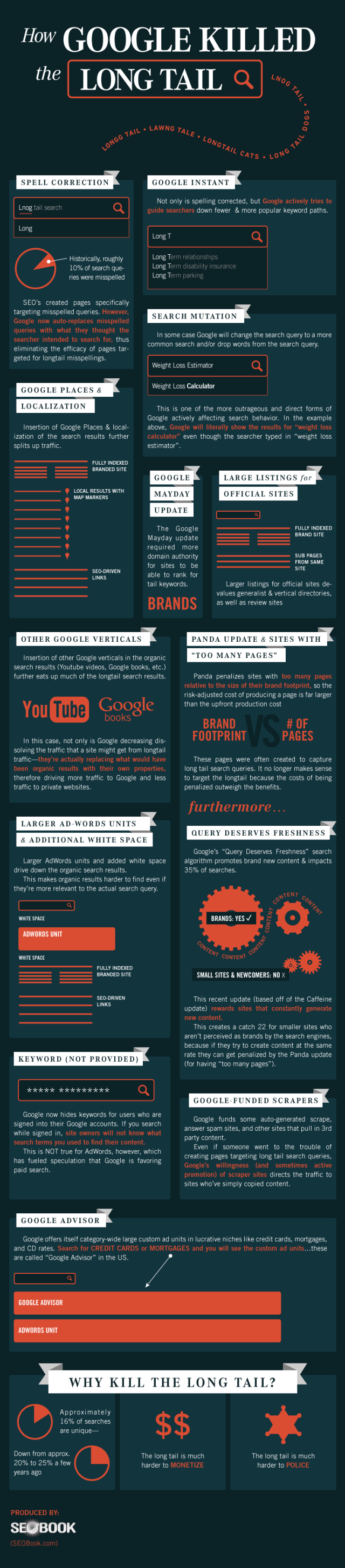
Infographic by SEO Book
November 23rd, 2011 — copywriting tips, keywords, search engine optimisation, seo, SEO copywriter

Are you fed up with unsolicited emails from SEO companies?
Barely a day goes by without at least one of their (often) brightly coloured emails popping into my inbox.
Every single one promises the earth in return for a small fortune.
But surely, if they are as good as they say they are they wouldn’t have to resort to cold emailing every business owner under the sun – would they?
A while back I wrote a post about simple SEO checks anyone can make. So, don’t respond to anyone who contacts you out of the blue, instead, grab a coffee and have a read of these posts. They should give you enough pointers to check the effectiveness of your site yourself (and tell you what to do to improve it).
Here goes – take a look at:
Simple SEO checks any small business can make
SEO copywriting – how it’s done
Page titles and SEO
The importance of off screen SEO
You can do basic SEO yourself – go on, give it a try.