Entries Tagged 'sales writing' ↓
April 15th, 2015 — Call to Action, Digital marketing, marketing, Sales Letters, sales writing
Is there a definitive template that will guarantee a successful sales letter?
No.
The only reason I say “no” is because there are far more factors that have to be taken into consideration when it comes to successful sales letters.
Yes, you can include all the elements that draw your reader in (I’ll talk more about that in a minute), but you must remember that there are external factors that could scupper your chances of a sale, including:
- Your audience
- How they’re feeling when they get your letter
- What you’re offering them
- When you send your letter
Now I’ve got that out the way, let’s take a look at the humble sales letter.
Once the bread and butter of your marketing department, they have been usurped by email marketing because it’s faster and cheaper. The problem is that now so many companies are doing email marketing, its effectiveness is being watered down. So, a well crafted letter could be more effective.
Earlier I mentioned there are certain elements in a sales letter that will draw your reader in. So, without further ado, here they are.
1. Powerful start
If you want someone to read your letter it has to grab them from the start.
Think carefully about your headline (if you’re using one), or first sentence. Either must tell the reader instantly why they should continue reading – that means outlining the main benefit you are offering.
Some companies will try to be clever and write something that’s so creative it completely misses the point. The best advice I can give is always go for clarity over creativity.
2. Problem/solution
There are lots of different ways to structure a sales letter, but the problem-solution approach is the most powerful.
Empathise with the reader and then show them how your product or service will get rid of their pain and enhance their life.
There’s no need for paragraphs of elaborate prose. Just get straight to the point.
3. Benefits
Always, always focus on the benefits not the features. The number of colours or sizes your widget comes in isn’t going to sell. The fact that it will make the reader the envy of their friends will.
4. Offer
Your audience would much rather accept your offer than buy from you any day.
Eh?
When you go to the opticians you don’t buy a pair of glasses, you go for the buy one get one free offer.
It’s the deal people want more than the price.
5. Guarantee
If someone is thinking about buying from you for the first time they will want to know that they can get their money back if they want to.
Providing a no quibble guarantee not only puts their mind at rest it also shows your confidence in your product or service.
6. What’s next?
Once your reader has stuck with you and got to the end of your letter they’ll want to know what to do next. That’s where your call to action comes in to play.
Make it as simple as possible to buy from you. Let them do it through email, over the phone, even snail mail (always include a stamped addressed envelope) and give clear instructions.
That’s as close to a sales letter template as you’ll get. Just remember by making sure you include each of these you’ll give your sales letter the best possible chance of success. Even though there are several factors you can’t anticipate, if the content of your letter is focused on the needs and wants of your audience you won’t go too far wrong.
December 10th, 2014 — copywriting tips, Sales Letters, sales writing
Sales letters are still widely used despite the growing popularity of email marketing.
In some cases a letter can make more of an impact because people are becoming immune to emails and are more likely to delete it if it doesn’t immediately pique their interest.
Snail mail may be old hat, but there’s still something comforting about receiving a letter, something that makes us want to open it (especially if it comes in a hand addressed envelope).
I would love to tell you that this blog contains a free template for the most successful sales letter on the planet, but in truth there are too many variables for their to be a “one size fits all” template, such as:
- The audience you are addressing
- What they’re doing and how they are feeling when they get your letter
- The offer you are making
- What the weather is like
- How their journey into work went
I could list more, but you’re getting the picture.
Having said there is no winning formula, there are a few things you can do.
1. Grab their attention
This shouldn’t need to be said as it’s true for all your marketing.
You have to grab their attention the minute they open your letter. That means a compelling headline and an awesome first line.
Make sure you draw attention to the benefits they’ll get if they do business with you and always go for clarity over creativity.
2. Problem and solution
This format always works well.
Your product/service is going to solve their problem, you just have to make sure you convince them of that.
There’s no need to lead them in gently, get straight to the point and empathise with them.
3. Benefits
The benefits must always be the focus of your letter.
Your reader wants to know how you’re going to help them so make sure you tell them. Everything you say about what you’re selling must be related back to your reader – how it will save them time, money, make them more successful etc.
4. Offer
People always opt for offers over purchases.
If you need glasses you’ll always go for a 2 for 1 offer, so make sure you offer a great deal and emphasis it.
5. Guarantee
One of the easiest ways to over come cold feet when you’re trying to sell to someone is to offer them a cast iron guarantee. If they know they can come back to you if they change their mind, they’re far more likely to take the plunge and buy.
6. Tell them what to do
If you do all the hard work listed above. but forget to tell them how to buy, you’ve just shot yourself in the foot.
Make the buying process as simple as possible and offer several different ways to buy – by email, phone or by using a reply card and stamp addressed envelope.
This may not have been the template you were hoping for, but it’s as close as you’ll get to one.
All you have to do is make sure each one of the elements above are included in your letter if you want to give it the best possible chance for success. Another tip is to follow it up with a phone call (depending on the size of your mailing).
December 30th, 2013 — Sales Letters, sales writing
Technology may well be moving at a mind-boggling pace, but there will always be room for the humble sales letter within your marketing armoury.
These staples of the marketing world haven’t really changed. Other fads come and go, but your sales letter will always follow the same recipe.
This article looks at how you can make your sales letters stronger and boost their effectiveness.
1. Strong start
If you don’t capture your reader’s attention from the outset, there’s only once place your letter will end up – in the bin.
A great way to make an impact is by using a headline above the salutation in your letter. But make sure it is relevant to the rest of the letter and makes a big impact.
If you decide not to use a headline, all the pressure is on your first sentence.
2. Problems
One of the most powerful ways to structure a sales letter is the ‘problem/solution’ format.
Start out by identifying the problem your reader has and then go on to solve it with your product or service.
Using this method highlights the issue they are facing, shows that you care (that’s where a bit of empathy helps) and that you can make their problem go away – you’re great.
3. Benefits
Your reader doesn’t care what features your product has, all they want to know is how it’s going to make their life easier. Think about what’s important to them; do they want more time, to save money, be more popular? Whatever it is, focus on that as the main benefit of your product.
4. Strong offer
Although the benefits are crucial, your reader is going to buy your offer, not your product. For example, if you and a competing opticians were sending out sales letters and you just told them about your latest range of designer specs, but your competitor did the same but with a ‘buy one get one free’ offer, you can bet your Granny that the reader will go for their offer and not your glasses.
5. Guarantee
It’s also important that you back up your offer with a strong guarantee.
People want to be given peace of mind and a money back guarantee (or something along those lines) will give them the warm and fuzzy feeing they need to be persuaded to part with their hard earned cash.
6. Call to action
Just as any good sales man will ask a customer for an order, your sales letter has to do the same.
Tell them to buy and make it clear how they can do so. Make sure your phone number is displayed prominently so they can easily get in touch.
7. Easy to respond
If your call to action involves them sending off an order form, make sure it’s easy to complete and that you enclose a stamped addressed envelope. If they are to phone through an order, make sure your phone number is easy to find. If you want them to order online, give them clear instructions.
These 7 tips will help you create strong sales letters. Don’t forget, everything your customer needs to know must be in the letter because they can’t ask you questions. Give them an offer they can’t refuse and then make it easy for them to buy. That’s really all there is to it.
Author: Sally Ormond
March 28th, 2011 — copywriter, copywriting, copywriting tips, marketing, sales writing, UK copywriter
Can you really tell whether copy is good or bad just by looking at it?
The answer is yes and no.
It rather depends on what the copy is, what it’s meant to do and what form it takes.
For example if it’s SEO copywriting and it’s very obvious what the targeted keyword is, like in the example below…
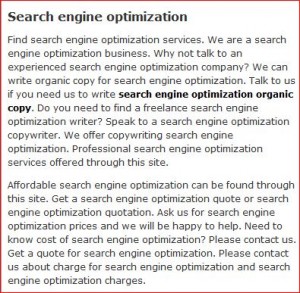
…then it’s pretty safe to say it’s bad copy.
The problem is a section of text can be very well written (grammatically correct and no spelling errors) and yet, from a sales perspective, it’s about as useful as a chocolate teapot.
That’s why it’s not always easy to spot bad copy.
It’s probably easier to look at this from a different angle and think about what makes good copy.
The traits of good copy
Luckily there are 5 characteristics that good copy has. No matter which format it’s written for or what it’s trying to sell, good copy will always:
- Grab the readers’ attention immediately
- Be clear and unambiguous
- Answer all the readers’ questions and so counter any buying objections they may have
- Build trust and rapport with the reader
- Motivate the reader into taking a specific action through a strong call to action
What it comes down to is this – copy is written for a purpose (generally to sell something) but if it doesn’t fulfil that purpose it’s not doing its job.
Selling through text alone is difficult. You don’t have the personal contact with the customer; you can’t think on your feet to counter their buying objections and you can’t shake their hands.
Your copywriting has to do every thing:
- Inform
- Build trust
- Convince
- Convert into a sale
That’s not an easy thing to achieve.
What are your thoughts? Can you think of any more traits you find in good copy? Why not share them here along with any shocking examples of copy you’ve come across.
January 28th, 2011 — copywriter, copywriting tips, email copywriting, landing pages, marketing, online copywriting, sales writing

What do I mean by calm copywriting?
Well let me first tell you about what prompted me to write this post.
I took my eldest son to the Orthodontist this morning. The Orthodontist is a lovely chap and comes from Eastern Europe…somewhere. Anyway, after making my son’s next appointment we got in my car to head back to school when I mentioned that I might get his father to take him in for the next appointment as I might not have my car that day.
My son looked at me in horror and said “no, you can’t do that. You know what dad’s like, he’ll try and talk in his European English so the Orthodontist understands. It will be soooo embarrassing!”
The ‘European English’ my son is referring to is the good old fashioned British way of communicating abroad – s-p-e-a-k-i-n-g v-e-r-y s-l-o-w-l-y a-n-d l-o-u-d-l-y to make sure our European cousins can understand us perfectly.
Admittedly it usually ends up either offending or reducing people to hysterical laughter.
So how is all this related to copywriting?
Well there’s a lot of ‘European’ copywriting about too.
We’ve all seen the landing pages which comprise of different sized fonts, bold colourful words and truly awful graphics. And this isn’t just confined to landing pages you can also come across it in emails, sales letters and websites.
Does it give the reader confidence?
No.
Does it engage, enthral and sell?
No.
Instead it annoys, switches the reader off and encourages them not to buy.
Rather than relying in brash sales techniques like these, use your words carefully and let them do the selling.
Keep your text uniform (other than your sub headings), calm and persuasive. It will have a great effect; make you appear more professional and approachable.
Remember your reader isn’t an idiot. They will see through all the frills, fonts and colours. If you want to be taken seriously, write seriously.