Entries Tagged 'social media' ↓
August 6th, 2014 — Call to Action, social media, social media marketing
Any marketer worth his or her salt knows the power of the call to action, but some feel it too much to include them in their social media marketing.
Really?
Surely the addition of a ‘share’, ‘like’ or ‘comment’ gives the subtle nudge needed by your readers to…well…share, like or comment.
Whilst ambling through the web recently, I came across this infographic from Dan Zarrella that looks at power of social media calls to action.

Find it useful?
Please share, like or comment below and help spread the word.
July 23rd, 2014 — Branding, Customer service, small business web marketing, social media, social media marketing
The Power of the Human Brand
Have you noticed the “them and us” of business?
Whether it is networking, general chit-chat or trade fairs, the “big boys” make all the noise whilst looking down their noses at the small businesses.
Just because they’re bigger than you doesn’t mean they’re better. To be honest, they’re way worse than you.
How do I know that?
Because you have the benefit of a human brand.
What is a human brand?
Large corporations have oodles of cash to chuck at their market place. They can afford the biggest marketing campaigns, sign up celebrities and bankroll peak time TV advertising.
You can’t do that, but you can do something else.
Being a small business, you have the ability to reach out and touch your audience. Not in a creepy way, but in a way that leads to trusting relationships. Your customers can get to know you – the face behind the brand. That’s something that doesn’t happen with large corporations.
That’s why it’s important to make the most of your human brand.
If you have staff, it’s also important to make sure they’re involved with the business and share your passion. Investing in them will turn them into brand advocates, so when customers interact with them, they’ll receive the kind of personal service they want.
Making the most of your human brand is essential, but there are also a few other ways you can out do the big boys.
Passion
The chances are, because you started up your business, you love what you do (otherwise you wouldn’t be doing it). That passion is infectious and will shine through in every interaction you have with your customers.
Large businesses don’t have that; they just have executives that are simply there for their fat pay check. Their main concern is that sales targets are hit and shareholders are kept happy. They have no emotional investment in the business.
Agility
If you’ve ever worked for a large company you’ll know how slowly they move.
There are so many levels of management and rigid procedures; any change in policy can take months or even years to happen.
For the small business change is easy. You have no red tape to dodge and no board of directors to appease. Decisions can be made quickly and changes implemented instantly helping you react to you market’s needs.
Service
There are only a few large companies out there that give exceptional service, the obvious ones being John Lewis and Apple (from my experience).
The people that work for large companies, especially at the lower end of the pay scale, are just there to do a job. They are unlikely to go out of their way to help you because it’s no skin off their nose if you go elsewhere. But when it’s your own business, every customer is like family. If they’re unhappy, you’re unhappy so you’ll do everything in your power to make sure they fall in love with your company and come back.
After all, even if you’re a little more expensive, they’ll happily pay a premium for excellent personal service.
Getting your human brand out there
To make an impact, your online presence has to be every bit as chatty and warm as the service your customers receive.
That means one thing – getting social.
Although you must have a stonking website that’s full of useful copy that tells the reader the benefits of dealing with you, it’s also important you have an active presence on social media.
Facebook, Twitter, Pinterest, LinkedIn etc., must be used regularly and actively. Don’t just use them as a soap box from which you can promote your business; talk to your customers, build relationships with them and give them useful information.
This openness is what will set you apart from other businesses. Be yourself; if your avatar is your logo, make sure you sign off your update with your name to let your customers know whom they’re talking to.
When you’re competing with big companies you’ll never be able to beat them on cost. That’s why it’s important you concentrate on the level of service you provide because that’s an area they’ll never be able to beat at.
Treat your customers and staff like family and you’ll build loyal, trusting relationships that last.
Author: Sally Ormond, Briar Copywriting
June 18th, 2014 — social media, social media marketing
Do you think you understand the mechanics of social sharing?
Well, you probably don’t. A recent article in The Drum caught my eye as it contained a very interesting infographic that takes a look at the myths of social sharing.
Rather than boring you with a round-up of what the research by RadiumOne found, here’s the infographic – you may find it surprising.

May 16th, 2014 — social media, social media marketing
What are social media headlines?
The whole point of social media updates is to engage with your followers. That could involve showing them a video, illustrating something through an infographic, asking them to click on a link for an offer and it’s this last point I want to concentrate on.
The headline in social media terms can, at times, be the whole update. This is simply because of the character limitation imposed on some platforms. But the aim is to get the reader to click your link.
If you measure your effectiveness by shares, likes, comments and retweets you are missing the bigger picture. When a link is involved, the sole purpose of your update is to get clicks, so how is it done?
1. Ask them to download
OK, technically speaking an update that says: “Our new app will help you keep a track of your cash. Click here to download” is more of a call to action, but it’s still relevant here.
According to Twitter, after analysing 20,000 promoted tweets the most effective call to action was the one asking people to download something.
To make the most of this, offer an incentive for signing up to your email marketing list such as a downloadable eBook or something along those lines and tweet about it using the simple “click here to download” call to action.
2. Facebook wins
On Facebook (as with most other social media platforms) shorter updates work better than long ones.
The name of the game here is tempting your audience by hinting at something and offering a link to find out more. If you’re sharing a blog post, just offer a teaser and link through to the whole post.
3. Images
Facebook posts with an image out perform those without.
Why?
They immediately attract attention and stand out in the newsfeed. OK, although technically not a headline, an image can work in the same way.
4. Be active with your keywords
Dan Zarella has done some research in this area. These are not keywords in terms of what your customers use to search for you, rather a list of the most retweetable words and phrases Dan identified in 10,000 of the most retweeted tweets:
- You
- Twitter
- Please
- Retweet
- Post
- Blog
- Social
- Free
- Media
- Help
- Please retweet
- Great
- Social media
- 10
- Follow
- How to
- Top
- Blog Post
- Check out
- New blog post
Listed in order of popularity, using them within your tweets would have a positive impact in your click through and retweet rates.
Where does the active bit come in?
Well, Dan’s research also showed that using more verbs and adverbs and less nouns and adjectives also helped. That’s not all that surprising considering copywriting in general is much more effective using an active vocabulary.
Some words and phrases you can use are ‘act now’, ‘launch’, ‘save’, ‘boost’ and ‘earn’.
Make sure very tweet, status update and message you send out asks the reader to do something. Using the tips above you’ll soon see your click rate increased and, quite possibly, your sharing rate too.
Author – Sally Ormond, Briar Copywriting Ltd
April 21st, 2014 — Content marketing, seo, social media, social media marketing, social networking
One strategy?
Surely they’re three different disciplines, aren’t they?
If you believe that, you may be experiencing issues with all three.
Taking content marketing first, how did you get started with that? I’m guessing it was a blog.
When you started out online, everyone and their dog were telling you that you had to have a blog. So, never one to turn down advice, you set one up and started churning out articles.
Probably, after a month or so of regular posting, you found your ideas drying up. Not only that, but you realised no one was really engaging with you. Perhaps one or two comments were posted and one or two people shared the odd post, but there certainly wasn’t the flood you’d expected. Demoralised, you gave up.
Sound familiar?
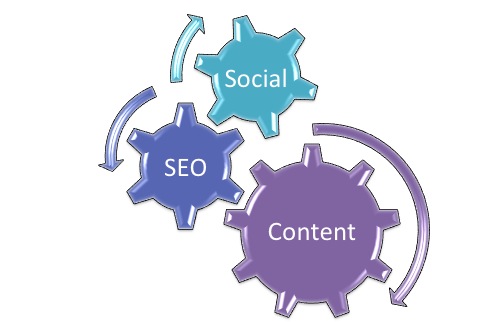
The mistake you made was viewing your content marketing, social and SEO strategies as three separate entities. They’re not. They must all work together if they are to survive.
Three cornered marketing
Have you noticed that old school SEO is no longer effective? Gone are the days when SEO companies could achieve fantastic rankings by building a few links here and there. Today, SEO is content driven. It’s all about feeding Google the high quality content it craves.
In the same way, your social media strategy is nothing without great content. If you don’t have anything to share people aren’t going to follow or engage with you.
Planning your content
With high quality content being the driving force behind your marketing strategy, it’s essential you plan what you’re writing carefully.
As with your web copy, brochures and other marketing materials it’s important you understand the audience you are reaching out to and, most importantly, what problem they want solving.
Only then can you be sure your content will resonate with them and lead to the sharing, engagement and traffic generation you want.
Of course, there are millions of blog posts published every day, so yours has to stand out.
A great way to make sure yours is head and shoulders above everyone else’s is to search the keywords you want to write about and see what your competitors are saying about the subject. Then all you have to do is write something that’s better than theirs.
But I’m not just talking about churning out a flurry of 500 word articles. You must produce linkable assets; content that people will see as authoritative work, that they’ll share and talk about.
A great way to do this is to create something longer than the average post that also cites other relevant work within your niche. Not only will this enhance your readers’ experience, it will also boost its chances of being shared.
How?
Well, take a note of all the experts and external material you’ve cited and email them (or contact via social media) to tell they you’ve included them in your piece, asking them to share it with their audiences.
Once published you’ve also got to do some promotion. Share it with your social audience through all the channels you use. Plus, if you’re part of any forums or groups (such as LinkedIn groups), push it out to them too.
It’s not enough just to write something, publish it and hope for the best. Your three-pronged content marketing strategy is something that must be worked at. If you want people to read what you’re putting out make sure it’s written well, it’s relevant to your audience and that you’ve done everything you can to encourage people to share it.
Only then will you have a strategy that drives your business forward.
Author: Sally Ormond, Copywriter at Briar Copywriting Ltd.