Entries Tagged 'email copywriting' ↓
May 27th, 2015 — copywriting tips, email copywriting, email marketing
This post first appeared on Briar Copywriting’s blog, but we thought you might be interested in it too.
Email marketing remains one of the most popular forms of marketing. When things get a bit slack, it doesn’t take long to put something together and send it out to the thousands of opt-in contacts in your customer database.
The only problem is most industries have an average open rate in the low 20 per cents and a click through rate that barely scrapes 4 per cent. Even if you hit those averages, it doesn’t matter how big your list is, your not really being effective.
There are numerous articles out there that claim to have the magic formula to higher open rates, but there’s nothing magic about email marketing. All you need to do is be yourself.
1. Be you
Even though you want your customers to buy from your company, it’s you they are really dealing with.
That’s why you should always write like a human. Even if you are in the B2B sector a human will be reading your email, so keep it conversational. If you’re not sure how to do that, picture yourself having a conversation about what you’re writing about and write as you talk. When done, read it out loud and if any parts start to sound wooden or business-like, cut them.
“Voice” is one of the most important parts of your marketing, but it’s a term that’s used liberally without much explanation. The best way to think about it is the “voice” you use is how your writing sounds when it’s read.
Another big part of conversational writing is asking questions, so make sure you use them in your email. They will make the reader stop and think about what you’re saying, increasing engagement.
Admittedly, this may not be your natural way of writing and it will take time to perfect, but persevere with it and you’ll see those open rates begin to rise (when used in conjunction with the other points I’m about to raise).
2. Important elements
What are the 3 most important elements of your email?
Give up?
OK, I’ll tell you:
- Your subject line
- The first line of your email
- Your “From” line
When your email arrives these are the first 3 things the recipient will see, so they have to make an impact if you want them to open it.
For the subject line and first line of your email, make sure they are short and to the point, personalised (definitely the first line, up to you about the subject line) and that they lead with a benefit.
What about the “From” line, I hear you say? How on earth can that have an effect on the open rate?
Well, it’s important it comes from a real person. If your customers get an email from sales@briarcopywriting.com they are more likely to ignore it than if it came from sally@briarcopywriting.com.
3. Responsive
Last, but not least is the responsiveness of your email.
Did you know that 65% of emails are opened on mobile devices these days? That’s why they need to be responsive so they open and display correctly on any device and any screen size.
Conclusion
Email marketing is great when it works well, but as with all marketing it takes time to refine the art and that means constant testing.
Try different styles of subject lines, when you send your mailing and the subjects that you cover. Over time you’ll gradually learn what your audience is looking for.
October 1st, 2014 — email copywriting, email marketing
The first rule to remember when indulging in a spot of email marketing is that it’s not as easy as you think.
No really, I’m not just saying that, it really is very tricky.
Just look at your recent results.
They don’t look pretty do they? Your open rate is disappointing and your click throughs virtually non-existent. So what went wrong?
Without seeing what you sent I can’t give you specific reasons, but here are the top 7 reasons why emails fail.
1. Bad first impression
You only get one chance to make a first impress and you just blew it.
Your subject line was pants. You used all capitals, exclamation marks, deceiving messages and prefixed it with the dreaded “FW:”, “RE:”, or “Warning”.
Be clear and honest in your subject line, don’t try and sell and make sure it reflects what your email is about. To hone your subject line writing skills do some A/B testing on them.
2. Yawn
Emails shouldn’t be long. They should get to the point quickly, perhaps with a touch of humour or personality, and end with a call to action.
That’s it; no extended flowery prose, just straight talking and simple language.
3. What do you look like?
The only way you’re going to know what your email will look like when it lands in your customers’ inbox is by testing it.
Make sure it renders properly across all mail clients, including mobile, to make sure it looks good everywhere.
4. Personal
If you have your customers’ first names, use them. Receiving a personalised email is far more preferable to one that says “Dear Customer”.
5. Buy now
Contrary to popular belief, an email is not the place to ask for a sale.
Your email is there to build a relationship, or to educate them. Do not ask them to open their wallets. If you’re offering a free trial or something along those lines that’s fine, but never ever mention price.
6. Don’t try and get one over on your competitors
Trying to sell your products by pointing out how bad or expensive your competitors are is bad form. It shows a lack of imagination on your part and, possibly, a lack of confidence in your own products and services.
Why?
Well it doesn’t say much for what you do if the only way you can think of selling it is by slagging off the competition.
Concentrate on selling the benefits of what you offer and your customers will make up their own minds that yours is better than anything else out there. You can read more of my thoughts on this particular issue here.
7. Relevant
Being relevant is essential. If you send email after email on subjects that your audience isn’t interested in they’ll leave in their droves.
Plus, don’t just reiterate information that’s already on your website because they’ve probably already seen it.
Come up with fresh information that’s going to be relevant to them.
There you go. How many of these 7 are you guilty of?
If you’re still not sure where you’re going wrong, feel free to drop me a line.
Author – Sally Ormond, Briar Copywriting Ltd
August 27th, 2014 — email copywriting, email marketing, Essential tools for small businesses

It’s time to let the world know your company exists.
What better way to do that than by email marketing?
In a few minutes, your sales email is ready and waiting to be unleashed on the world. You click send and stand back preparing yourself for when the phones start ringing.
Hold on a minute, you’re going about it all wrong.
The list
For starters, if you’ve bought a list you’re heading nowhere fast.
Think about it for a moment.
You’re about to send an email selling your products and services to a bunch of people who have never heard of you before and haven’t asked you to get in touch.
That’s a big problem.
If you’re not sure why let me ask you something – what do you do when you sift through your emails in the morning?
What happens when you come across one from a company you’ve never heard of before that’s trying to sell you something you haven’t asked for?
You delete it, right?
So why do you think the recipients of your email are going to do anything different?
That’s why buying in a list is never going to work.
Building your own opt-in list is a much better idea. For starters, the people on it would have heard of you and, secondly, they have given you their email because they are interested in what you have to offer, so your email is going to be relevant to them.
Yes, it takes time to build a list, but use every opportunity to get people to sign up: at trade fairs, during phone enquiries, when people visit your shop or showroom.
Your message
What is your email saying?
Is it telling them about your products and services?
Does it have a call to action directing them to your website or your phone ordering line?
Is it asking them to buy from you?
Stop right there. You’ve just committed the second most deadly email marketing sin.
The chances are, you’re fairly early on in your relationship with your email marketing list. If you dive in asking them to buy from you, you’re likely to be met with a lukewarm-bordering-on-frosty reception.
Why?
You’re asking them to buy without having gained their trust first.
You’re a new company to them (potentially a new supplier) so it’s important you spend time introducing yourself to them and offering them great information that will be of benefit to them.
Over time, they will get to recognise that your emails are packed with great insights, tips and hints and general warm and fuzziness.
The advice you offer them (completely free of charge) reflects well on you making you the go-to authority in your field.
Therefore, when they are ready to buy, whom do you think they’ll get in touch with first?
- The company that bombards them with sales or emails?
- Or, you who has been putting their needs first, giving them great information and advice without wanting anything in return?
I know who I’d put my money on.
Yes, you can include any offers or new products/service in your email, but make sure you also offer them useful information and advice first. The reference to your products should almost be an after thought.
Think like a customer
The best way to gauge how your email will be received is to think like a customer.
If it landed in your in box, what would you do?
Think about how it would come across to someone who doesn’t know your company that well – is it too salesy, too pushy?
Email marketing, although a fast way to reach thousands of customers in one hit, isn’t a ‘get rich quick’ marketing solution.
It’s all about building trusting relationships with your list.
Author – Sally Ormond, Briar Copywriting Ltd
February 28th, 2014 — email copywriting, email marketing
You may think it rather odd that I’m writing about the failure rate of spam emails.
Well, the reason for my madness is that you can learn a lot from the spammers about how not to do email marketing.
When you send out emails to potential clients, do you think carefully about your subject lines, presentation and content before hitting send?
I’m not going to go into detail about how to make your email marketing work, if you follow that link you’ll find a post that tells you all about that, instead I want to take an example of a spam email and highlight the areas the sender has got wrong.
You see if you get the same areas wrong your emails could end up looking like spam and that’s something you want to avoid at all costs.
Are you ready?
Here’s the email – I have blanked out names to save blushes.
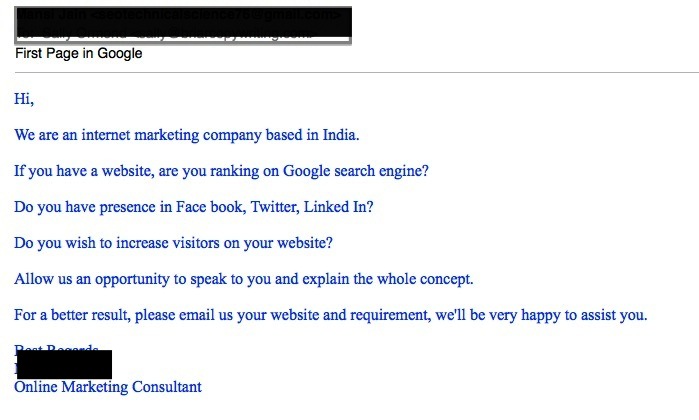
Before I talk about the areas you can see, I would like to point out that although this apparently came from a company, the email was a gmail.com address. If you are a legitimate company you should have a company specific email address, i.e. Joe@velocitylighting.com not velocitylighting@gmail.com.
Subject line
The first thing I want to look at is the subject line. This sender has used “First Page in Google”.
First off no one can guarantee a first page ranking in Google, so instantly, I can smell spam.
It’s not a descriptive subject line either; it doesn’t entice me to click on it to learn more. If you want people to open your emails your subject line must grab their attention.
Greetings
What about the salutation?
“Hi”.
That shows this is a blanket email they’ve sent to all and sundry. When sending out your email campaign make sure you address the recipient my name. This should be easy because you’ll be using your own list rather than a random one you’ve bought in (won’t you?).
It may seem a small thing, but addressing someone by his or her name will go a long way to build trust.
Email content
Then we get into the body of the email. Again, you can instantly see this email is a blanket mailing because it’s asking if I have a website, is it ranking, do I use Facebook, Twitter or LinkedIn? Again, if they knew me they’d already know the answers to those questions.
Yet another fail.
They then go on to ask for the opportunity to speak to me and explain the whole concept. What concept?
- Having a website?
- Ranking in Google?
- Using Facebook, Twitter and LinkedIn?
- Increasing visitors to my website?
There are so many issues it’s impossible to know exactly what they’re offering because there is no focus.
The most powerful emails (landing pages, web pages etc.) focus on one idea. Any more than that and you begin to dilute your message.
It’s also important to watch your English, spelling and grammar. Look at the last line:
“For a better result, please email us your website and requirements, we’ll be very happy to assist you.”
How can I email them my website? I can email the URL, but not the physical website. Plus, this again shows they have done no research whatsoever on my business, because if they had, they’d know my web address.
Signing off
Last, but not least, look at the signature at the bottom.
I know the sender is an Online Marketing Consultant, but I have no idea from which company – no branding – yet another epic fail.
Hopefully, looking at this obvious spam email has helped you understand more about how email communications should be written and the pitfalls you must avoid if you want to be taken seriously.
Author: Sally Ormond
January 29th, 2014 — email copywriting, email marketing
Email marketing can be a tricky exercise.
You must find the right words for your subject line to get your email opened then follow it up with a killer first paragraph to get them hooked and round it off with an offer they can’t refuse.
Mind you, before any of that can happen you’ve got to make sure you don’t trip any spam filters.
What a nightmare.
Before I go on about the 4 triggers I mentioned earlier, let’s take a look at the spam issue.
Spam filters look at a long list of criteria, such as spammy phrases like ‘Click here’, ‘Free’, ‘Buy now’, but also:
- Using loads of exclamation marks
- Using CAPITAL LETTERS FOR YOUR ENTIRE SUBJECT LINE
- Colouring of fonts
- Sloppy HTML
- Creating an HTML email that’s just one big image with little or no text
- Using the word ‘test’ in your subject line
- Sending a test to multiple recipients within the same company
- Designing an HTML email in Word and exporting the code to HTML
Source: Mail Chimp – How to Avoid Spam Filters PDF)
Getting back to the phrases and words that can trigger spam filters, HubSpot has put together a lengthy list of words that are known for triggering spam filters. You can see the list here. However, I would just like to point out that I can’t guarantee the quality of this list as no information source has been given.
4 Triggers to Get Your Email Opened
Right, back to those triggers that I promised you.
Basically, your readers have 4 buttons that, when pushed, will result in an emotional response. Therefore if you email presses 1 (or more), it stands a good chance of being opened, read and acted upon.
Your email should focus on 1 or more of these areas:
1. Gain
You, like your customers, enjoy getting something for nothing, so there should be a link in your email that, when followed, gives your reader something of value.
It could be information, a report, discount voucher, or something along those lines.
Offering something for nothing creates an emotional response.
2. Logic
Not everyone’s buying decisions are made emotionally, so what about appealing to your reader’s logical buying side?
Offering statistics and expert opinions will help push your reader further along the buying path. This practical information will appeal to them and give them reassurance about what they are about to buy.
3. Fear
Tread carefully with this one. Fear can be used effectively when talking about, for example, protecting your family’s future. Life assurance is a prime example of this. Who doesn’t want to make sure their loved ones are looked after?
Again, this one works on an emotional level.
4. Limited
By making your offer time limited, or limiting the supply of your product, you’ll make it irresistible to your reader. They won’t want to miss out, so will be more inclined to make an impulse purchase.
But those 4 triggers alone may not be enough.
In conjunction with them, your email’s subject line must also be:
- Actionable – using verbs to create a sense of urgency
- Personalised – segment your list to make sure your offer goes out to the right people
- Clear – don’t use an ambiguous subject line
- Brief – keep it relatively short and packed with benefits
- Consistent – make sure the promise in the subject line is backed up by the rest of your email
As you can see, there’s a lot to email marketing, but by keeping this information in mind, you should find it plain sailing.
Author: Sally Ormond