Entries Tagged 'keywords' ↓
November 21st, 2011 — Content marketing, copywriting tips, keywords, search engine optimisation, seo
Search engine optimisation copywriting isn’t just for websites.
If you want your content to be found, you have got to use keywords. However, over use of them is common, which is why you’ve probably come across numerous articles during your searches that are incomprehensible.
For many people, the strong desire to be found causes them to cram as many of their keywords into the articles and blog posts as possible. After all, surely the content is just there to build links – it’s not trying to sell like web copy, so it doesn’t matter – does it?
Of course it does.
Any content you put out on the web will reflect on you and your business.
The fact that you want to optimise your text is a given, so here’s how to do it.
The proper use of keywords in content marketing
Below are the 4 areas where you should concentrate your SEO efforts when producing content.
1. Title tags
Whatever phrase you want to rank for, make sure it’s here.
This is the tag that tells the search engines what your page is about, so make sure you tell them. If you‘re using a WordPress based website/blog, make sure you install the All in one SEO pack because it helps you automatically optimise your posts for the search engines.
2. URLs
In the search results, you will see the title tag (that’s the top part, which is underlined), the URL and then the META description.
You might think it unnecessary to optimise your URL, but because the search engines highlight the keywords that were searched for (in the example below I searched for ‘dog training courses UK’), it’s important your URL slug (that’s the part of the URL that identifies a page using human-readable keywords) contains your keywords.

3. META Descriptions
These have no value when it comes to SEO, but that doesn’t mean you should ignore them.
The META description is the 160 characters of text that appear below the name of the web page in the search results. This is the enticer that is used to attract the click from the user. Therefore, including your keywords within it will help draw them to your post and show its relevance.
4. Content
Of course, you also need to optimise your content. But a word of warning, don’t start thinking keyword density. Because as soon as you do, you will start writing for the search engines and not the reader.
Just write naturally. You will find that because you page is about your keyword, it will naturally appear in your text.
Now, the keen-eyed amongst you have noticed that I haven’t mentioned META keyword tags – and that’s for a very good reason.
They have absolutely no impact on your rankings whatsoever. In fact, back in 2009, Google clearly stated this fact in its webmaster central blog.
So, when you are next creating content, make sure you:
- Write primarily for your reader
- Be natural with your keywords
- Pay close attention to your title tags and URL slugs
- Write eye-catching META descriptions
September 23rd, 2011 — keywords, marketing, online marketing, search engine optimisation, seo
When you start working on your SEO strategy, the most important decision you’ll have to make is what keywords you will target.
The decisions you make will determine how effective your overall strategy is, which is why it is so important you get it right.
But time and time again, mistakes are made that cause frustration because the desired results are not seen.
The main thing to remember is that the keywords with the highest number of searches aren’t necessarily the best ones to target.
Mistake #1
The first mistake people make is going for glory – or at least the keyword that generates the most traffic. The problem is the competition for these words is very hot.
The problem with that is if you’re looking for short to medium term results, these highly competitive words will be beyond your reach.
When selecting your keywords, they must be specific. So rather than ‘camera’, go for the make and model because that’s what people will be searching for.
If you want to target a generic and highly competitive keyword, you just have to remember that it will take time, energy and money to get ranked for it. If you are looking for short term results, go for something less competitive:
Lower traffic & lower competition = quicker domination and an increase in traffic
Mistake #2
This mistake happens early on in the process. 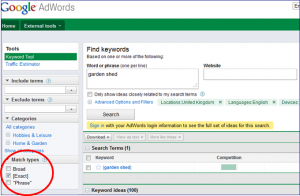
When using the Google Keyword Tool, people make the mistake of looking at the broad match rather than exact match. Broad match is selected by default, so it’s important you check the exact match box.
For example, when searching for ‘garden shed’, under broad it displays 135,000 local searches per month. But under an exact search, that figure drops to 6,600 – quite a difference.
If you get this wrong, it could have a serious effect on your predicted ROI and traffic.
Mistake #3
Many people target plural keywords, such as garden sheds. The problem here is that people tend to search for singular terms.
Let’s face it, if you were looking for a new lap top, you’re more likely to look for a lap top as opposed to lap tops.
Mistake #4
A lot of people already have preconceived ideas about what they are going to target. The problem here is that preconceived ideas are favoured rather than looking at the evidence of what people are really searching for.
This results in being listed for words that simply don’t convert because they are not the ones people use to search for your product. Sometimes, it may be better to target a set of keywords, rather than just one, to widen your chances of being found.
Mistake #5
Another problem is taking words out of context.
If you targeted the word ‘ink’ people could be searching for printer ink, pen ink, how to remove ink stains etc. So the chances are a high proportion of your traffic won’t actually be looking for what you’re offering.
That’s why it’s so important to be specific in your keyword choice.
Mistake #6
SEO isn’t static. Many people believe it’s a painful process they’ll only have to go through once. But the truth is you must continuously monitor and analyse the effectiveness of your keywords.
Just because one is performing well now, doesn’t mean that will still be the case in the months to come. SEO is about constant adjustment and refinement.
Researching and identifying your keywords is incredibly important. It’s vital you do it right and continue to monitor it. Your SEO strategy will constantly evolve so you have to be prepared for regular reviews and tweaks as and when necessary.
What has your experience of keyword research been?
Have you made any howlers or had any particular successes?
Leave a comment below and share your experiences.
July 20th, 2011 — article marketing, article writing, keywords, search engine optimisation
 Content drives the internet and therefore search results – that’s probably why many people are still writing articles for the search engines rather than for people.
If you fall within that category and believe strongly that your primary audience are the search engines because your articles are there purely to provide links to your website, let me ask you a few questions:
Why do you do article marketing?
- To generate links to my website
Why?
- So I can boost my rankings
Why?
- So more people visit my website
Why?
- So I can generate more sales of course
Aha! So you’re doing this to get more people to visit your website.
People.
So why exactly are you writing mainly for the search engines? You’ve just admitted you do article marketing to attract people – not search engines, people.
If your article is incomprehensible because you’ve stuffed it with loads of keywords do you really think someone’s going waste their time reading it?
Even if it is the number one search result, no one’s going to pay it any attention.
If someone does open your article and finds it unreadable are they really going to want to follow any links within it that will take them to your website?
I doubt it because they’ll think they are going to be faced with yet more incomprehensible drivel.
So the moral is, write for your reader first and the search engines second.
What to think about when writing your articles
Before you even touch your keyboard you must think about your reader.
- What’s important to them?
- How much do they know about your subject matter?
- What issues do they have that they’re looking for solutions to?
- What do they need to know?
It’s not until you have answered those questions can you start to create an informative and interesting article that someone will want to read.
But what about your keywords?
Just because you’re writing for your reader doesn’t mean you have to forget your keywords all together.
- Make sure they are in your eye-catching headline
- Break your article up into short paragraphs so it’s easy to read
- Create informative sub headings to help your reader scan your article
- Don’t fill it with links
To make sure it reads well forget about keyword density. When you write naturally about a subject you’ll automatically use your keywords and other words related to your subject.
Once you’ve written it read it out loud to check for rhythm, an easy flow and errors. If you find you are ‘tripping’ over your keywords you’ve probably included too many. Cut back within the body of your article but make sure they are present in your headings and sub headings.
At the end of the day, if you write with your reader in mind and not the search engines you can’t go far wrong.
Remember – when it comes to article marketing, your reader is king.
April 13th, 2011 — conversion, copywriter, copywriting tips, keywords, online marketing, search engine optimisation, seo, SEO copywriter, seo website copywriter, website copywriter, website copywriting
 I have been a copywriter for a while now and many of the projects I am commission to carry out involve search engine optimisation.
That’s hardly surprising considering the importance of online marketing to today’s businesses.
People’s attitudes to online search are changing. Companies are now recognising that if they want to open up their businesses to new markets they have got to get to grips with SEO and keyword identification.
Keyword research
Most people ‘get’ keyword research these days.
They understand that the words they have to target are the ones their customers are searching for. That list might include the particular product that they sell or their geographical location etc.
Usually the list of keywords I am given are pretty relevant – they cover the products/services and will drive targeted traffic to their website.
But the problems start when it comes to allotting keywords to the copy – how many should each web page target?
Common misconceptions
When investing in SEO most people want to maximise their ROI and use SEO to get found for every keyword or phrase they can think of.
For a start, initially, that’s not practical. Over time as they build links and relevant content, they will see rankings for most of their keywords (the level of their ranking will depend on the competitiveness of the term they are targeting). But from the outset, SEO takes time and the early results will be found with the least competitive words.
The second problem is that many people view their website as their Home Page. By that I mean they want to load their Home Page with all their keywords.
So, for example, if they sell silver jewellery, their keyword list may look something like:
- Silver jewellery
- Silver jewellery suppliers Suffolk
- Silver jewellery gifts
- Gifts in silver
- Silver necklace
- Silver bracelet
You get the idea.
Now, to try and include all of those words on one page is complete madness because the resultant text won’t encourage anyone to buy.
Using keywords the right way
For starters you must remember there is more than one page to your website. Plus, Google and the other search engines also recognise this as each page is indexed individually. Therefore you should be targeting different keywords on different pages. The keywords should also be reflected in your navigation and page titles.
With regards to the number of keywords per page, you should only look to target 2 (3 max) primary keywords. You can of course incorporate long tail keywords (i.e. your primary keywords plus modifiers) but trying to target more than 2 can create unwieldy text.
The main point of your website copy is that it should be relevant, interesting and compelling. The traffic your keywords attract must be drawn in by your text and encouraged to buy – otherwise what’s the point?
By researching your keywords, using them to structure your website and then target each page for different keywords will maximise your chances of SEO success.
March 16th, 2011 — copywriting tips, internet marketing, keywords, search engine optimisation, seo, SEO copywriter, seo website copywriter
 Keyword research (as opposed to keyword guessing) is vital if you want your search engine optimisation activities to bear fruit.
The words or phrases you decide to target will have a big effect on your website and its contents which is why it should be done before you begin the design process.
How can a few keywords affect your site?
Well quite easily. After all it’s not until you know what you’ll be targeting that you can:
- Create your on page text (SEO copywriting)
- Decide on your link building anchor text
- Work out your internet linking structure
- Decide on your site navigation
- Produce your page titles (title tags)
- Decide on your URLs
- Write your META tags
So as you can see it’s quite important that your keyword research comes first.
How to decide on your keywords
That’s all well and good but how do you begin the process of deciding on which words and phrases to target?
Here are 3 steps you can take to ensure you get the best possible match between your keywords and your target audience.
1. Be open to new ideas
Don’t go into the research blinkered to the ideas of others. You must remember that you are trying to find the words that other people search for to find your products and services, not necessarily the terms you would use.
The main thing is that the words you decide on must be relevant to your product or service. There’s no point in using a keyword that generates lots of traffic if it’s not pertinent to what you do. You’ll just end up with a lot of frustrated people.
2. Create word groups
Your starting point will be to generate a list of words that relate to your product/service.
Then, expand that list to incorporate names used in your industry for what you do. Expand this again with words used within the media for your product/service. Then, if you work in a specific locality, add in relevant geographical modifiers.
Then it’s time to use keyword research tools such as Google’s to further refine and expand your list.
3. Check competition and relevancy
The final step is to work out which are the best terms to go for.
Although you want to target terms that generate a lot of search traffic, you don’t want to pick something so competitive you won’t stand a chance of ranking for it.
This table below will help you determine which the best terms to try are:
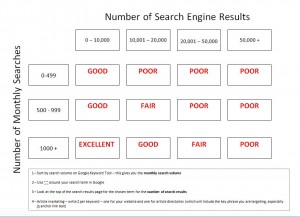
That’s why keyword research is so important. Make sure it’s the first think you do before starting your web design process.