I’m sure you’ve noticed by now that Google has been making a few changes to its search facility.
Google Instant is here!
Now, when you make a search, Google predicts what you’re searching for. Once you see your search term appear in the box (as you can see below Google predicted I was searching for a freelance copywriter) results are automatically shown and change instantly depending on how your search term develops:
There have been numerous posts and news articles written about this new phenomena and what it is going to mean to users.
Rather than going over old ground, I wanted to being one of the best posts to your attention to illustrate precisely what Google Instant is going to mean to search engine optimisation.
There are a couple of videos embeded within the post which are really good – one is quite long though so it may be best to save that one for your coffee break.
Are you one of the many businesses out there with your head firmly lodged in the sand?
Are you still refusing to acknowledge that organic SEO is the way to go for businesses marketing online?
Despite my best efforts to tell you why you should be investing in search engine optimisation and even confiding in your the 7 Must-knows About SEO Content it is frustrating when people say ‘oh, but it wouldn’t work for my business’.
Why wouldn’t it?
As a copywriter it’s worked wonders for me and many other businesses I know.
A lot of you turn to PPC (pay per click) campaigns through Google Adwords. There’s nothing intrinsically wrong in that, but it isn’t very cost effective and certainly not something you’d want to do for the long term.
If you’re unsure the PPC or sponsored (paid) listings are shown below in the red box.
The other entries on the page are organic results – they’ve got there through utilising a good SEO strategy.
Most people opt for PPC because is offers fast results. Search Engine Optimisation (keywords, SEO copywriting, back links etc.) will take time to show results. How much time will depend on the competitiveness of your chosen keywords.
But organic results are best not only because of cost, but also because their click through rate. Many people think that if their website was features in the sponsored area at the top of a page of search results, they would get the most hits.
Wrong.
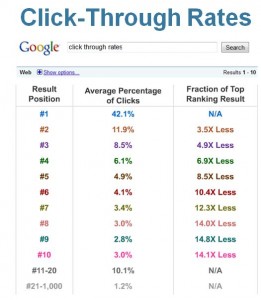
In fact, according to the latest data from SEO MOZ, it equates to just 10%, with 90% going to the organic results. In fact, they have shared their latest PowerPoint presentation on Search Engine Optimisation on their blog post A Comprehensive Intro to SEO PowerPoint Slide Deck. This a great resource for anyone wanting to understand the murky world of SEO. It’s full of great information not least how your position within the rankings will affect the number of hits you get – take a look at this:
It really does pay to keep on at your SEO to gain the highest possible position.
So basically, organic SEO really is the most effective way to market your business online.
If you are a follower of this blog, you’ll know I have been championing the art of blogging for quite some time now.
I have written numerous posts that extol the blog as a form of expression, a way of driving traffic to your websites as well hints and tips on how to blog and generate fresh ideas.
The content is obviously key to the readership you attract, but the look of your blog is also important.
Use a design that is over fussy and you’ll put people off. Loads of advertising can also be a turn off – so you have to be careful about the look you go for.
You can also use a number of plugins on your blog to make it work harder for you. This blog post from Social Media Examiner identifies 24 Impressive Blog Plugins You Should Consider. Why not take a look and see which ones you want to add to your blog. They relate to the WordPress platform and illustrate how you can customise your blog to suit your needs perfectly.
Once you’ve taken a look at that, why not have a browse through these posts to help you make the most out of your blog:
Your writing has to perform a number of functions simultaneously:
It has to attract traffic
It has to be interesting
It has to capture your readers’ attention
It has to persuade
It has to convince
It has to make your reader buy
As I said, it has to perform a number of tasks which is why you must create powerful website copy that is capable of satisfying all of these needs.
If you merely start writing about your business, awards you have won or your premises you’re not going to capture your reader.
The women’s Rugby World Cup is happening at the moment and the following video illustrates my point. We’ve all seen the All Blacks perform their menacing Haka before every game. Their gesturing, shouting, tongue sticking-out and other shenanegans would certainly make you think twice before approaching any of them.
But I recently saw the Black Fern’s version (that’s New Zealand’s female rugby team) – it’s not quite so scary:
Don’t get me wrong, I still wouldn’t like to face them on a rugby pitch. The closest I get is watching my son on a Sunday morning play for Ipswich – and that’s close enough. But to me it’s more akin to mums at a disco trying to recapture their youth by trying to remember dance steps to the hits of the 80s. Their movements seem to be too gentle to strike fear into the hearts of their opponents.
It’s the same with your web copy. You are competing with a huge number of other businesses on the web so you have got to create copy that will make you stand out from the crowd. And that means just one thing – write about your reader.
Tell them what they want to hear
As people browse websites, they are looking for one simple piece if information – what you’re going to do for them. They aren’t interesting in anything about your company. They are totally self-centred.
So make sure you tell them what they want to hear. If you do, and you address them directly and state the benefits immediately your website will stand out from the crowd.
Why?
Because I see far more sites with bad copy that revolves totally around the company than good sites that address the reader directly and show them precisely how they will benefit.
The easy way to good copy is to find yourself a good freelance copywriter. As they are not directly involved with your company they will be able to look at your products and services from a customer’s point of view. Even if you are the best writer in the world, if you try to write your own copy you will find it very difficult to distance yourself from your company and be completely objective.
Why do you need to know this?
Quite simply because you want your website to:
a) Attract visitors
b) Get people to buy
And the only way you are going to do that is by creating copy that is focused on the reader, tells them what your product or service will do for them (the benefits), and then tells them what to do through a strong call to action.
We all make promises. But how many of those promises do you keep?
Take my teenager for example (please take him). When I ask him to do something the usual response is: “Yeah, I’ll do it in a minute.” An hour later, when the task still hasn’t been done and I start to get annoyed with him I get the rolling eyes followed by “I was just about to…”
How many times has you made a complaint only to be assured by the staff member that “I’ll pass your comments on to my manager”. Do they really do as they promise? Very unlikely.
You’re probably wandering what this has to with website copy. Well, within your copy you’ll make various promises to your reader. In fact the benefits of your business are promises. So they are things like:
Being available 24/7
Smart and polite staff
Getting things right first time
We can’t be beaten
But when putting together your website copywriting, if you merrily add in loads of benefits like this without thinking too hard about them, you could be doing yourself a lot of harm.
When a promise becomes a problem
It’s the small things in life that matter.
You may offer a great guarantee, free postage etc., which you can easily fulfil. But if you can’t get the simple things right, are your customers going to believe your bigger claims and promises?
If you say your service is available 24/7 and when a customer phones they get placed in a queue constantly being told by a disembodied voice “your call is important to us” even though it doesn’t get picked up for 15 minutes, you could lose customers.
I tried to get in touch with a well known UK business recently. I didn’t want to send an email because I needed a quick answer so I decided to call them. Oh boy, what a palaver. The phone rang and immediately found myself in an automated system. After about 5 minutes going through umpteen menus, I finally got to speak to a real person. In all fairness they dealt with my query promptly, but it took some perseverance on my part. The thing that really annoyed me was they gave the impression that they didn’t want to speak to me because the first thing I heard as I entered the automated system was:
“You can find answers to your questions on our website…”
If I could find the answer to my question on the website I wouldn’t need to ring!
This was supposed to be a company that welcomed queries and were ready to help in any way they could – as it turned out, that relied on the customer’s ability to navigate their way through a (seemingly) never ending list of menus in order to speak with a real person.
Customer service is for life not just for Christmas
People are always talking about how good service is a thing of the past.
These days when you’re in a shop, the staff are more interested in discussing what happened to Tracey and Dave the night before than serving customers. And, worse than ignoring you, they serve you while still discussing the latest gossip breaking off momentarily to take your money.
Customer service is vital which is why you must be able to carry out all the promises you make on your website.
Many companies still fail to see their website as being their business. It isn’t a separate entity, and it’s quite often the first impression customers will gain of your business. If you say you answer all calls within 5 rings, do it. If you say you reply to emails within 2 hours, make sure you do – it sounds so simple but you’d be amazed at how many companies get it spectacularly wrong.
Promises like this are made just to look good. But if you can’t fulfil simple pledges like those, how are you going to convince customers you can fulfil your bigger promises?
So when you are writing content for your website think very carefully about what you promise. Ask yourself if you can really live up to what you’re claiming. You have to be able to fulfil every claim – if you can’t you’re leaving yourself open to a barrage of complaints.
Image is everything. Make sure yours is a good one.
 I’m sure you’ve noticed by now that Google has been making a few changes to its search facility.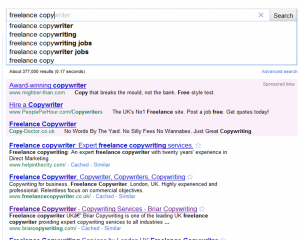
 Are you one of the many businesses out there with your head firmly lodged in the sand?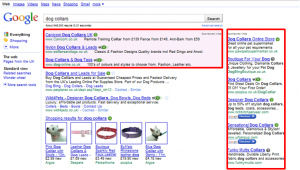
 If you are a follower of this blog, you’ll know I have been championing the art of blogging for quite some time now.