Entries Tagged 'Press releases' ↓
January 14th, 2015 — Building a business, copywriter, copywriting, marketing, Press releases

It’s the age of the entrepreneur. Businesses are springing up everywhere, so how do you get yours noticed?
As a start-up you have no track record, no testimonials, no social proof. That might sound like a brick wall, but if you can prove to the media that you can change the world you will get your story heard.
Your pitch: I can change the world
The usual course of action for a new business trying to get noticed is to write umpteen press releases, but journalists are inundated with them so how about trying a different approach?
Writing a pitch, tailored to the journalist you’re targeting, will help you stand out, but only if you write it from a benefits point of view rather than as a sales document. Give them everything they need, from your logo and contact details to ideas for your story. Remember though, as I said earlier, this isn’t a sales document. You must prove you can change the world.
What do I mean by that?
Your business, whatever it does, will solve a problem, create wealth, make someone smile or take their pain away.
Why?
Because if it doesn’t have a tangible benefit it’s not a business.
Your job is to understand that and show the reader (in this case the journalist you’re pitching to) how you change people’s lives. The “people” are their readers, so if they can smell a great story you’ll have their attention.
Who do you contact?
It’s all well and good creating a great pitch, but who do you send it to?
Every newspaper, magazine, TV and radio channel has it’s own audience. Your job is to do your research to find the journalists who write about the problems your company solves.
Why?
Because their audience will be the people who will buy your product or service.
If you want to maximise your coverage you have to match the journalist with your message.
Once you have your list, don’t just send cold pitches because they are likely to be ignored.
It’s all about who you know. Look at your contacts, is there anyone who can help you? Perhaps there is someone who can make an introduction for you?
Get in touch with journalists and build a relationship with them. See if you can help them out before pitching to them. Try to meet them in person. The stronger the relationships you forge, the more likely they are to run with your ideas.
Did they say yes?
If they say yes and run with your story, fantastic, well done. Keep in touch with them and let them know your areas of expertise and that you’re interested in being interviewed or happy to contribute to future stories.
If your idea doesn’t get picked up don’t hound them. Chase after about a week, sending your story again just in case they didn’t receive the first one. If they’re still not interested, don’t just give up. Try sending it to a different contact, even one within the same outlet – just because one person wasn’t interested doesn’t mean no one will be.
If you want people to talk about your business you have to show how you can change people’s lives.
There are too many press releases out there that try to sell. The trick to getting noticed is to show yourself as a company that puts its customers first by highlighting the benefits they receive.
Author – Sally Ormond, Briar Copywriting Ltd
October 29th, 2014 — Press releases
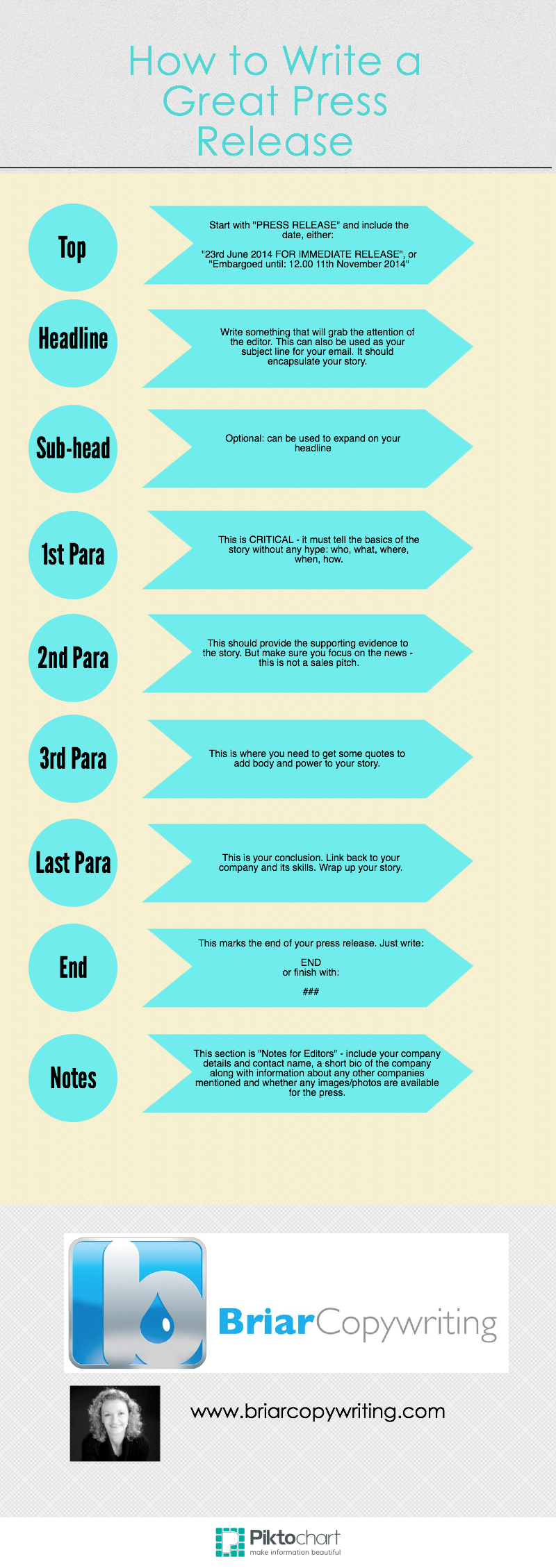
Press releases are the staple of your marketing strategy, but they are often done badly. This infographic outlines how to write the perfect press release that will get you noticed.
October 17th, 2012 — PR, Press releases
The following guest post was written by Vicky Fraser. The author’s views are entirely her own and may not reflect the views of FreelanceCopywritersBlog.com. If you are interested in producing a Guest Post for this blog, please get in touch with your ideas.
Thousands of press releases land in the inboxes of journalists every day. Why on Earth should they bother properly reading, let alone publishing, yours?
The hard truth is that nobody is as interested in your business as you. If you want people to read about it, you need to give them something fascinating to read. But first, you need to generate press interest and spark a story idea for the journalists to whom you’re sending the release.
Obstacles
Not only do publications receive thousands of press releases, many of them are badly written, overlong and full of spelling and grammatical mistakes.
Others are stuffed full of meaningless marketing waffle and jargon, while others are just a thinly (or not so thinly) veiled advertorial. Still more are irrelevant to either the industry area covered by the publication, or the geographical area, or both.
Once your press release lands on the desk of a journalist or news editor, its fate is in their hands. However, there are a few things you can do to improve its chances of publication.
1. Keep it clear, short and simple
If a press release is longer than one page of A4, it will often get put straight in the bin. Make sure the headline grabs people’s attention but is descriptive of the content, and ensure the first paragraph summarises the press release succinctly and engagingly.
Don’t use marketing waffle, jargon or the hard sell. The purpose of a press release is to impart news, not sell a product. Tell a story and raise your business’s profile: that’s what it’s all about.
2. Think of your press release as a tool for the journalist
Remember two things about journalists: firstly, they are people too, and if your press release doesn’t interest them, they won’t publish it. Secondly, they are very busy. Budgets have been cut, staffing levels are lower than they’ve ever been, and they (local papers, certainly) genuinely find it difficult to source and write great stories.
With this in mind, be helpful! Make it as easy as possible for the journalist to publish your press release. The less they have to do to knock the release into shape, the more likely it is to get published.
If you don’t have much experience writing press releases, do a little research. Take a look at articles in newspapers and magazines, and try to emulate them. Include quotes from relevant people – journalists love this, because it saves them having to contact you themselves.
3. Send your press release to the right places
It may seem obvious, but it’s worth mentioning anyway. If your business is a technology firm and you’re talking about an award you won (for example), don’t send your press release to Horse and Hound or Ideal Home magazine.
Similarly, if your story is a local interest one, don’t send the press release to publications outside your geographical area. They won’t use it.
4. Send it to the right people
A little research goes a long way. When you’re building your distribution list, spend some time finding out which journalists to target. Many smaller publications will simply have a “news desk” email address, but others will have health reporters, technology reporters, political reporters, etc.
If your press release goes to the right person first time, it shows you’ve done your research as well as reducing the chances that it will get lost.
5. Check, check, and check again
As a sad indictment of today’s education standards, more and more press releases arrive full of spelling and grammar mistakes, and typos. They are very unlikely to be used and the business’s card is usually marked by the journalists receiving such releases.
The value of proofreading cannot be understated: get your press release checked before you send it anywhere. Check for spelling, grammar and general sense and interest.
Putting out great press releases will create goodwill with the journalists you’re targeting. If you get a reputation as a good PR, you will find that journalists start to come to you. A solid relationship with a reporter is like gold dust: difficult to stumble upon, but extremely valuable.
Don’t forget, too, that there is a multitude of online press release portals that you can use for distribution. There’s a lot of mileage in a good press release: it can be reused on blogs and website news sections, shared via social media, and linked to by customers and partners. So make it SEO-friendly too and let it work harder for you, your customers and the publication to which you’re submitting it.
Vicky Fraser is a freelance copywriter and marketeer based in Warwickshire. Being a science nerd undertaking a physics degree, she specialises in simplifying and clarifying scientific and technical copy but writes about all manner of things for a wide variety of clients. She blogs about science, freelancing and writing – amongst other things.
September 19th, 2011 — news, Press releases, seo
 Writing a press release is one thing, making sure it gets read is entirely different.
In the good old days (really, were they good?), you would create your press release and then send it to a few editors of local newspapers and magazines.
The fate of your press release was in their hands – if they liked it, they printed it. If they didn’t, it was consigned to the bin, never to be seen again.
Today, things are a bit different. Now you can distribute your press release to various online services, re-post it on news websites, include it in your own blog and email marketing. Not only that, if people like what they read, they can share it with others.
Before you start jumping round the room with glee, even if you publish it online, your press release will only be seen if it shows up in the search engine results. If you don’t pay close attention to the rules of SEO, you might as well take your chances and send out your press release the old fashioned way.
6 ways to make your press release visible
As a writer, it is up to you to give your press release as much chance as possible to be seen. The following 6 tips will help you achieve this:
1. Keywords
In the online world, there’s no getting away from keyword research. Think about the words and phrases people are most likely to use to search for you.
For example, if you’re a coffee shop in Ipswich, using ‘coffee shop’ is a bit too generic (and you’ll have hot competition to rank well). Choose 2 or 3 keyword phrases that are highly specific to your business. For example, ‘Barney’s coffee shop Ipswich’ includes the company name, what it is and its location.
2. Headline
The headline you choose will also act as your title tag or page title. Therefore, it is vital your primary keyword phrase and company name appear in it (with your keyword phrase at the beginning).
In the world of SEO, it is your title tag that Google reads first because it tells it what your content is about.
3. Short and powerful
Staying with your headline for the moment, Google only displays 65 characters in the title tag (including spaces) so your headline should be no longer than this. Of course, that is easier said than done. Normal practice suggests that a headline between 60 – 80 characters is acceptable, but your keyword phrase must be at the beginning.
4. First paragraph
As you already know, the first paragraph of your press release is vitally important. It should contain the most important and relevant information. Therefore, your primary keyword phrase must appear in the first paragraph.
5. Hyperlinks
The beauty of online press releases is that you can include hyperlinks. By linking your keyword phrase back to your website, you are telling Google that it is a website that contains highly relevant copy. And Google loves that.
6. Newsworthy
This one doesn’t have anything to do with SEO, but it is still very relevant.
Your press release has to be newsworthy. Unlike the old fashioned printed press release, when yours appears online, it’s there forever.
So, if you put something out there that is a thinly veiled advert, you could be seriously damaging your company’s reputation.
One thing you have to remember is that no matter how well you SEO your press release, results won’t happen overnight. Have patience and eventually you will see your press release being picked up in the search results.
Being online, it will remain visible forever, providing you with a potential source of traffic for a long time to come.
August 12th, 2011 — marketing, networking, PR, Press releases, social media
 What do you think of when you think PR?
- Air kissing
- Extremely expensive magazine/newspaper columns
- Glossy magazine adverts…
Believe it or not, PR doesn’t have to break the bank. In fact sometimes it won’t even touch it.
Being in the know
A lot of your PR can cost you virtually nothing. All you need it a bit of time to get to know people and build a few relationships.
Let’s look at press first. There’s bound to be an industry magazine you can contact or perhaps your networking group has a magazine or e-newsletter. Either way they are a great source of free PR.
Get in touch with the editor and find out what they’re looking for. If you have a great story (and we all love real life stories), pick up the phone and have a chat with them – tell them what you have to say. If they like it, write it down and send it in. But make sure it’s ready to go (without any typos etc) because if they can just cut, paste and print they are more likely to use it.
Being seen
Getting in front of people is another great way to boost your exposure.
Whether it’s having a stand at an exhibition (yes that will have a cost attached to it), giving a talk at an event (that won’t), chairing a committee or attending events, you will gain great exposure and meet interesting and potentially useful people.
In other words, get out there and network.
Being bold online
You don’t have to be seen in the flesh to gain great PR.
Social networking is everywhere – Twitter, Facebook, Google+, not to mention all the online forums.
Get out there, start interacting and offering advice.
Of course you can also blog. Having a blog that concentrates on your expertise (I’m a copywriter and marketer so that’s what this blog is all about) enables you to write posts that help people and that will position yourself as an expert in your field.
Be yourself
Everything you do (within reason) can be used to further your PR.
If you do daft things for charity, publicise it.
If you’re launching a new look website, tell people
If you’ve moved premises, shout about it.
If you’re taking on new staff, tell the world.
Basically anything you do that is newsworthy can be turned into a press release.
So you see, PR doesn’t have to cost the earth. Virtually everything you do has an element of PR in it, you just have to learn how to leverage it.
What do you do to help your PR? Leave a comment below and share your best piece of free PR or any other PR tips you find that work for you.