Entries Tagged 'copywriter' ↓
April 11th, 2011 — copywriter, copywriting tips, search engine optimisation, seo, social media, social media marketing, twitter
 Can Twitter really help with your SEO?
That’s the question answered by Wasim Ismail on searchenginejournal.com.
The web is becoming more and more social. Social media is becoming a major part of business marketing strategies and is not just the latest ‘thing’ for teenagers. The search engines recognise their importance and are constantly finding ways to integrate social and search results.
Why?
Because social media is the voice of internet users and can no longer be ignored.
Of all the social media platforms out there, Twitter is probably the most popular micro blogging platform (that is until the next big thing comes along).
Due to its vast size, Twitter really does have the potential to help your SEO activities as your tweets can help build your online brand and reputation.
In his post, 10 Tips to Improve Your SEO Using Twitter, Wasim shows how you can utilise your Twitter account and tweets to enhance your SEO activities on line. This is a must for any Twitters out there looking to make the most of their social media activities.
So grab a coffee and have a read – it could be the most productive 10 minutes of your day.
April 6th, 2011 — briefing a copywriter, copywriter, copywriting tips, Copywriting tone, freelance copywriter
 Something strange happens to people when they try to communicate through writing. Their normal chatty engaging style goes out the window for something more akin to a literary novel.
Why?
You’re still talking to the same people (your customers), it’s just through the written word rather than voice.
Getting the tone and voice of your copy right can make a huge difference to customer engagement and your conversion rates. Your copywriter will be able to adapt their writing style to any ‘voice’ you want, but you might have to give them a few clues.
What do you really want?
Your copywriter is an expert at what they do, however that doesn’t make them a mind reader.
When you brief them make sure you give them a real taste of what you’re after with regards to the voice and tone you want the copy to convey.
Saying something like – “I want quirky”, or “I want something fresh” doesn’t really help. Granted they realise the type of approach you’re after but quirky and fresh could cover numerous styles.
It is very likely you’ve done your research and come across another website or brochure etc., that uses the style you’re after. If so, cite them as examples to your copywriter so they can read the material and get a real feel for what you are trying to achieve.
The copywriting process is a very collaborative one. You can’t just hand over a brief and expect copy that is spot on first time (OK, that’s not strictly true, that does happen sometimes – and it’s great when it does – but frequently it’s not until you actually see the copy that you begin to work out what it is you really want).
The first draft is the copywriter’s visualisation of what the brief you provided asked them for. Once you see the copy it is then shaped into exactly what you want.
By giving a visual example of the tone/voice you want will help the creation process enormously so please make sure you provide examples wherever possible.
April 1st, 2011 — copywriter, social media, social networking, twitter
 We don’t talk any more.
That’s what people are saying.
Today we communicate through email, text, Facebook, Twitter etc. The art of conversation is dying.
Is it really that bad?
Have advances in technology, and in particular social media, begun to change the way society interacts?
For some social media is killing conversation and personal interaction; for others social media is opening up new channels of communication and giving opportunities never before offered.
Which camp are you in?
It’s advances in things such as Wi-Fi that have really revolutionised our work and social lives. Now you can tweet, Facebook and blog practically anywhere which is changing the way we work.
I came across this entertaining and thought provoking post by David Murton on Convince and Convert – Is Wi-Fi Making You Anti Social? It’s well worth a read and addresses the way in which greater connectivity has made social media on the move easier and takes a look at how it could change society.
What are your thoughts?
Sally Ormond – Copywriter, blogger and social media addict
March 30th, 2011 — copywriter, copywriting tips, email copywriting, email marketing, UK copywriter
 If your business is new to email marketing working out how to get people to open your emails can be a real headache.
Mind you, you don’t even have to be a newcomer to email marketing to feel the frustration.
The problem is the success of your email all comes down to the recipient, the type of day they are having and the amount of time they have.
Little wonder then why it can seem an up hill struggle to get your emails opened and read.
Improve your email open rates
This is a short list of 5 very simple things you can do to give your email open rate a boost. Some of them may seem obvious but I think it helps every now and then to restate what many people over look.
1. When?
The day on which you send your mail will have a big effect on whether it’s opened or not.
Generally speaking Mondays and Fridays are not good days. On a Monday most people are wading through emails that weren’t cleared the week before, came in over the weekend or they just haven’t gotten into gear yet.
Fridays are bad because people are winding down for the weekend and they don’t have time to read your email.
So, in general, the best days to send are Tuesday, Wednesday or Thursday.
2. Subject line
Subject lines are difficult to write. Not only do they have to grab attention and make the recipient want to open your email, they also have to avoid spam filters.
Including things like ‘discounted offer’ or ‘free product’ or ‘free trial’ will get attention but you must test them to make sure they don’t trip any spam filters.
Another good way of drawing attention to your email is by using your brand name – especially if it’s one the recipient will instantly recognise.
3. How often?
When’s too much or too little?
Getting the frequency right is vital. As a general rule, once a month is ideal. If you bombard your readers with several emails a week they’ll soon get fed up and unsubscribe.
Equally if you send them only once every 6 months or so (or at random intervals) they may forget they’d subscribed in the first place and delete it.
4. List
Your list – who you email to – is vital which is why it’s always best to build your own rather than buy one in.
If someone has signed up for your emails there’s a pretty good chance they want to hear from you. if you buy in a list you are ‘cold emailing’ and they’ll probably end up being deleted.
5. Ask
Sending out emails willy-nilly is fine if you just want to fill them with stuff you want to say. But what about what your reader what’s to hear?
Every so often its good practice to ask them what they want to see so you can be sure the information you are passing to them is what they want to read.
Email marketing is great if you get it right but it takes time to perfect.
Sally Ormond – freelance copywriter
March 28th, 2011 — copywriter, copywriting, copywriting tips, marketing, sales writing, UK copywriter
Can you really tell whether copy is good or bad just by looking at it?
The answer is yes and no.
It rather depends on what the copy is, what it’s meant to do and what form it takes.
For example if it’s SEO copywriting and it’s very obvious what the targeted keyword is, like in the example below…
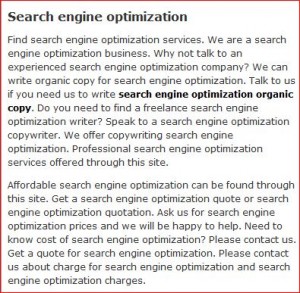
…then it’s pretty safe to say it’s bad copy.
The problem is a section of text can be very well written (grammatically correct and no spelling errors) and yet, from a sales perspective, it’s about as useful as a chocolate teapot.
That’s why it’s not always easy to spot bad copy.
It’s probably easier to look at this from a different angle and think about what makes good copy.
The traits of good copy
Luckily there are 5 characteristics that good copy has. No matter which format it’s written for or what it’s trying to sell, good copy will always:
- Grab the readers’ attention immediately
- Be clear and unambiguous
- Answer all the readers’ questions and so counter any buying objections they may have
- Build trust and rapport with the reader
- Motivate the reader into taking a specific action through a strong call to action
What it comes down to is this – copy is written for a purpose (generally to sell something) but if it doesn’t fulfil that purpose it’s not doing its job.
Selling through text alone is difficult. You don’t have the personal contact with the customer; you can’t think on your feet to counter their buying objections and you can’t shake their hands.
Your copywriting has to do every thing:
- Inform
- Build trust
- Convince
- Convert into a sale
That’s not an easy thing to achieve.
What are your thoughts? Can you think of any more traits you find in good copy? Why not share them here along with any shocking examples of copy you’ve come across.