Entries Tagged 'marketing' ↓
September 27th, 2010 — case studies, copywriter, freelance copywriter, marketing
 In any sales relationship, trust is probably the most important factor. Without trust, you are unlikely to make a sale.
Therefore when producing copywriting for any marketing collateral you have to be able to convey trust.
If you blog, you’re laying your soul bare for all to read. Your posts are very personal so your reader feels as though they know you through your words. And it is that connection you have to try to replicate in your sales writing.
Too often you see dire sales letters – they’re full of hype and practically shout at the reader BUY MY PRODUCT NOW!
So it’s not surprising when they don’t yield great results.
People have a natural resistance to buying. You are asking them to part with their money so you have to show them you’re not a charlatan and you’re not going to rip them off. You have to convince them to trust you – not something that’s easy to do through text.
To help you get your sales message across in a non-shouty and threatening way, why not try one of these three techniques?
Tell them a story
If you want to tell someone about a product you are selling, don’t rely on bold or colourful lettering, just tell them about it.
Using the tried and tested story telling style will help you build credibility in the eyes of your reader. Tell them why you created the product weaving in your credentials (number of years experience, clients you’ve helped etc.) to your benefits driven copy.
This approach will help you get your benefits in first to instantly start to break down their buying resistance. Plus, mention of your experience, clients and motivations will help convince them you’re genuine.
It was all a mistake
If you happened upon the idea for your product or you were involved in doing something that others wanted to be part of, telling your reader that your service/product evolved by chance will show them the thought process behind your product, how it has helped others and – well, if they thought it was great, it must be.
Of course your story has to be true and credible if it’s going to work. This approach is an excellent way to make a human connection with your reader.
This is one of the most powerful sales tools there is. Writing about a client’s experience of your product/service will show the reader exactly what can be achieved. As with the other techniques this has to be based on fact and written with your client’s permission.
Name names, show quantifiable results and use direct quotes from your customer to add weight to it.
This type of real life illustration will really resonate with your reader.
As you can see, selling is about showing the benefits, breaking down resistance and convincing them to buy.
Once you’ve put your ‘sales pitch’ across don’t forget to add in your call to action.
Sally Ormond – freelance copywriter
September 24th, 2010 — copywriter, freelance copywriter, marketing, online marketing
Wouldn’t it be cool if you could produce a piece of marketing collateral that will promote your business forever?
Do you think that’s impossible?
Think again, not only is it possible, it’s something that many people are already doing. They just don’t realise it.
The legacy of online marketing
In the past, most of your marketing materials would have been off line – things like brochures, leaflets, magazine adverts and direct sales letters. The main problems with these are:
- They only reach a limited audience
As soon as your brochure is binned, the magazine has been read or your sales letter shredded, their contents are lost forever.
But if you market online, the beauty of the internet means your collateral is there forever. If you create it so it’s SEO friendly, it will continue to attract an audience for eternity – or at least for as long as it remains on the internet.
Imagine the power of that.
Using SEO techniques your blog posts, articles and web pages will draw new readers like a magnet. So are you making the most of it?
Boost your online presence
Take a look through your computer files. What information do you have that you’d forgotten about? I’m willing to bet you’ve an untapped gold mine of suitable marketing material just waiting to be uploaded onto the web.
It could be turned into articles, blog posts and even web pages. You’re bound to be harbouring a small flotilla of PDF files that could be utilised. But rather than simply adding them in their present form to your website, restructure the information into HTML web pages. The reason for this is a PDF has limited SEO abilities whereas changing into an HTML format will give you countless more opportunities to exploit SEO.
Why you need to know this
Online marketing is all about owning as much of the web as possible. Writing articles and blog posts not only provide you with valuable back links it also exposes your company to a vast, eternal audience.
Sally Ormond – freelance copywriter
September 6th, 2010 — Business card design, copywriter, freelance copywriter, marketing
Business cards may seem a strange subject to be talking about on a copywriting and marketing blog. After all, can a copywriter help with the creation of business cards?
Well the answer is yes – in a way they can.
It is not very often that the humble business card gets to fulfil its potential. Seen by many as a simple means of leaving their contact details with someone, the business card is in fact a mini marketing tool. A fact that is usually overlooked.
Its layout, contents, strapline and use of space is very important in creating something that is eye-catching and memorable. After all, how many times have you been to a networking event only to return home with a fist full of cards that all look the same? Usually they are plain white with a bit of text on showing a name and contact details. They are instantly forgettable and, sadly, so are the people who they belonged to.
If you want to be remembered, make a mark with your business card.
There are two sides to every story
There are also two sides to every business card. So why do so many people forget to use the space on the back of their cards?
Use it to show the services you offer, your USP, even images of your product.
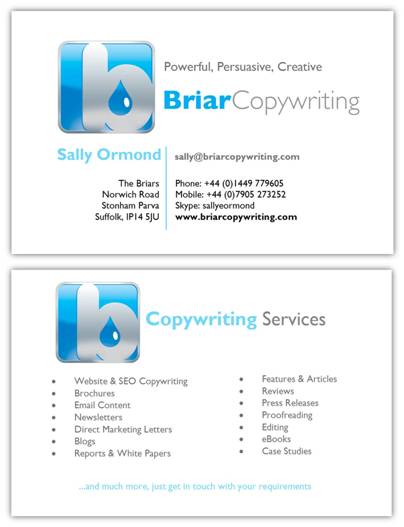
Above is my business card. As you can see I have used both sides of the card to show not only my contact details but also the services I offer to my clients. That way I avoid the conversation that goes…
“Oh, I didn’t realise you did that as well. If I’d known I would have called you.”
The reverse side of your card can be used for many purposes:
- List of services (as above)
- Images of your products
- Your USP
- An offer
- Your picture
- Testimonials
I’m sure you can probably think of a few more.
Make an impact
As you can see from the above, my business card is fairly plain. But its white background sets off my blue logo and works well.
But business cards don’t have to be white. Utilising colour is another way of generating interest and getting your card (and you) remembered. Whether you go for something soothing and pastle or bold and vibrant, the colours you use can say a lot about your business.
For example, if you are a young and funky design agency, your business card will need to reflect that with bold colours and vivid text or graphics.
The market you are aiming for will be reflected in your colour pallett – heritage colours (burgandy, dark green etc.) for the more serious professions (e.g. Solicitors, Accountants etc.), bright and vibrant colours for ‘cool’ businesses (e.g. Design agencies, IT etc.). Of course that’s not set in stone, I’m sure there are many trendy accountants out there who would benefit from a bright, eye-catching business card design too.
Don’t be square
People often seem to believe that business cards have to be rectangular. That’s not so.
Just because most cards are that shape (yes, including mine), doesn’t mean that’s the way they have to be. Stand out from the crowd by using different dimensions or shapes:
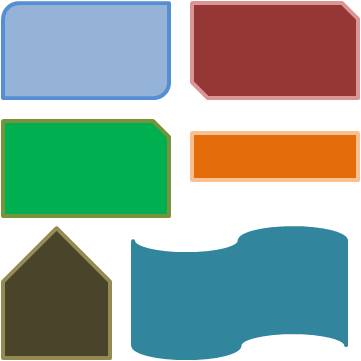
Using a shape that is slightly out of the ordinary is a great way to draw attention to yourself. And, when an unusual shape is coupled with a strong colour, the impact is increased.
Interactive cards
What do I mean by interactive? Well, your business card could fold into an card that stands up. Perhaps it can be folded into a box shape. Maybe it has a slit in it to hold something – the pizza restaurant Zizzi is very good at that. Your bill arrives slotted into a business card.
This makes your card stand out from the crowd and gets you noticed.
So you can see there are lots of ways you can use colour, shape and clever functions to get your card and you noticed.
Where does the freelance copywriter come into all of this?
Well, we may not be designers, but we are very good at coming up with straplines and succinct ways of putting your marketing message across.
This post was inspired by an entry I found on dailyblogggr.com. Here are the 36 brilliant examples of business card designs they identfied. It’s amazing the impact such a small piece of card can have – they really can be a very powerful tool in your marketing armoury.
August 30th, 2010 — copywriter, email copywriting, email marketing, freelance copywriter, marketing
 Email marketing is possibly the most important and effective marketing tool available to businesses today. It offers a way of regularly communicating with your customers to give them up to date information, telling them about new products and offers. Within seconds you can communicate with thousands of customers simultaneously – and that’s very powerful.
I have written numerous posts about email marketing in the past, such as:
How to build your email marketing list
Email marketing – Welcome
How to be an email spammer
How to become the King or Queen of email marketing
Consistent email marketing
10 words that will make people open your email
Email marketing – When’s the best time to send?
Boost your email open rate
So this time I want to address a question I am frequently asked by clients…
How often should I email my customers?
As we all know life is rarely simple, so you can probably guess what my answer is going to be….it depends.
Not very helpful I know, but it really does depend on your business type. What’s right for one person isn’t necessarily going to be right for the next. You have to find the right balance for you. Take a good look at your business and the products or services you offer – the frequency of your emails will dependly largely on:
- What you are offering your customers
- Who your customers are
- What you have to say
Common frequencies are quarterly, monthly, bi-monthly (i.e. once every two months), twice monthly, weekly and sometimes daily (or multiple times per day).
To help you out, here is a short guide to email frequency:
Quarterly
The businesses that opt for a quarterly mailing usually don’t have a vast amount to say. Perhaps their products or services don’t change regularly and they don’t have offers to make. Although some would argue some contact is better than none, I struggle to see the point of only making contact once a quarter. By leaving so much time between communications you run the risk the recipient forgetting who you are.
To be quite honest, if you are considering quarterly mailings I would think very hard about it. There’s almost no point in bothering.
Monthly
Many companies go for the monthly option because it is regular without seeming intrusive. Often the businesses who opt for this frequency don’t use their newsletter/email to sell things. Normally they are more concerned with imparting valuable knowledge on the recipient. Giving away great information regularly is an excellent way to build and strengthen relationships with your customers.
As a copywriter I send out a monthly newsletter which offers my readers hints and tips on copywriting, marketing and social media. It is free information that I am giving away and I never sell through it. By the way, if you want to get on the mailing list visit my website and sign up.
Twice a month
This is a compromise for those companies that want to make contact more than monthly but don’t have enough to say to make weekly contact. One of the benefits of this frequency is you can alternate the type of content you email. One could be giving away information whilst the next could be an offer on one of your products. That way your reader won’t feel as though they are constantly being sold to.
Weekly
Weekly emails are often sent by stores looking to sell. Whether they are High Street chains or independent shops, weekly emails enable them to communicate offers and new lines quickly and easily to their customers. Plus being retail outlets it won’t come as a surprise to the recipient that they are being sold something.
So these are the most common frequencies used. There are companies that email daily or even multiple times per day but you’d have to have a lot to say to be able to keep that up.
Keeping up with your chosen frequency is important. Your customers will grow to expect their next newsletter/email so if you have to miss one for any reason (e.g. holiday etc.) make sure you let them know. Just a simple one liner to say there’ll be no newsletter this month but service will resume as usual next month will keep them informed.
If you are not already doing it, give email marketing a try. Coming up with a constant stream of ideas and content can be a challenge, but the results make it worth while.
Sally Ormond – freelance copywriter
August 27th, 2010 — copywriter, freelance copywriter, marketing, online marketing
 If you own a business, you can’t help but have noticed that online is the place to be these days.
The vast majority of the population is searching the internet for the goods and services they want, so if you want be part of the action you have to have an online presence.
But lobbing a website into cyber space isn’t as easy as it sounds.
There are a number of online marketing pitfalls just waiting for the unsuspecting business owner who perhaps isn’t quite as web savvy as they think. That’s not meant to be criticism of all business owners – it’s just that the web changes at an alarming rate so it is vital you understand it and keep up with the latest techniques, taboos and pitfalls that await you.
Having a successful web presence takes time and money. Throwing any old thing together will kill your business quicker than anything. After all if you had a High Street store you would make sure the window display was inviting to passers by. Your website is your online shop window so treat it as that. It should be professional, appealing and tailored to your business needs.
This superb post on Copyblogger will help you navigate the mine field that is online marketing. Mel Brennan’s post 6 Online Marketing Mistakes that Will Kill Your Business takes you by the hand and walks you through the 6 no-nos of internet marketing.
It’s really worth taking a few minutes of your day to read through it and make sure you’re not committing any cardinal sins.
Sally Ormond – freelance copywriter