Entries Tagged 'marketing' ↓
February 7th, 2011 — b2b copywriter, copywriter, copywriting tips, freelance copywriter, internet marketing, marketing, seo website copywriter, website copywriter, website copywriting
 Whether you’re starting out and setting up an online presence or looking to create some new marketing materials, your success will be determined by their content.
Is your message engaging? Does it really give the reader what they want? Does is make them say “Wow, I really need that. How do I buy?”
Because that’s what it comes down to – the words you use have to attract, convince and convert.
I can do that…can’t I?
As well as working with individuals and companies directly, I also work with a number of graphic and web designers. When talking to them we always end up having the same conversation—they often find it hard trying to convince clients of the need for professional copywriting.
Why?
Well their thought process follows this pattern:
I have a limited budget…
I don’t know who to do HTML so I need a web designer…
Design is not in my skill set so I need a graphic designer…
I have no idea where to source great images from so I’ll pay someone else to do that…
Writing? Hey I can write I’ll do that myself.
Big mistake
So what happens next?
Someone in your company gets lumbered with the task of writing your sales copy. Here’s the problem:
- It is unlikely they have experience in writing sales copy
- They take ages to write it because they don’t have the time which holds up the whole project
- The finished copy tends to fall into the category of ‘it’ll do copy’
It is very difficult to write about your own company because you’re too close to it. To write effectively you have to distance yourself from your business and write it from your customers’ point of view. Your readers want to know how your product or service is going to benefit them. So your copy must be written for your customer.
What a copywriter will do for you
When you hire a professional copywriter they will get to know you, your business and your product/service.
They’ll put themselves in your customers’ shoes and create structured copy that addresses their needs, sells the benefits and talks to them directly.
Your website copy will be optimised for the search engines so it will attract targeted traffic. The content will convert those visitors into buying customers. And the copy will tell them what action they need to take to buy your product.
Your brochures will sell not just inform. They will convince the reader your company is the one they should deal with. No longer will they be used as a mat for their coffee cup.
Your case studies will entertain, inform and sell. Your press releases will engage and attract new business. Your email marketing will be opened, read and acted upon.
Does that really sound like a waste of money to you?
Yes we can all write, but creating eye-catching, compelling and powerful sales copy is a difficult skill to master.
So next time you are looking to create a new website or piece of sales copy, don’t try and go it alone. That piece of writing, whatever form it may take, will be the first impression the reader gets of your company – hire a professional and make sure it’s the right impression.
Don’t gamble with your company’s image.
January 28th, 2011 — copywriter, copywriting tips, marketing, social media

In a recent post, How Do Your Work Out Your Customers’ Needs? I looked at why you shouldn’t assume your customers think the same way you do.
The post generated several tweets asking for tips on how to discover what your customer wants.
The simple answer is ask them.
They are your bread and butter and are better placed than anyone to tell you what they need from you or why they don’t feel you’re the right supplier for them. They are also best placed to tell you how they use social media.
So what’s the most effective way of communicating with them?
1. Ask them
Many believe conversation is a dying art so why not resurrect it by speaking to your customers?
Scary thought isn’t it?
Chatting to them will help you discover why they bought from you or why they decided not to. How they found you, what social media channels they use etc.
Whether you come into physical contact with your customers or not, it’s simple to strike up a conversation. Pick up the phone and make a courtesy call to make sure they were happy with your service. While you’re chatting ask them what they liked best about your product/service, what they liked the least, what could be improved, how they first heard about you, do they think using social media would strengthen their standing with customers. In fact ask them if they realised you were on Facebook/Twitter—would they use those channels to communicate with you etc.
2. Newsletter
If you want to conduct a spot of market research and already send out a regular newsletter, add in a short survey and offer a prize or discount to those who complete it to encourage them to help you out.
The questions can be tailored to discover whatever you need to know about your service, products, website, staff etc.
You could also ask them about their social media habits to find out where they ‘hang out’ to make sure you as a company are utilising the right channels for your marketing and monitoring. And of course always include your links to your Facebook or Twitter accounts so they can interact with you.
3. Case studies
We all love a good real life story and that’s where the mighty case study comes in to its own.
Ask one of your recent customers if they would be willing to be the subject of a case study – they’ll be flattered you asked them and you’ll get great publicity from it.
Through the case study you’ll discover what their problem was, their motivation behind approaching you for the solution, how they perceived your service and their feedback on the whole process. Plus you can discover how they first came across you.
Whether you write it yourself of get a professional copywriter to do it for you, the humble case study is a great promotional and research tool.
4. Feedback
So simple and yet often forgotten.
Once you’ve sold to someone or missed a sale, ask for their feedback. Ask them why they bought from you, or why they decided to go elsewhere.
Ask them where they first heard about your company (if you sell online you could always add this question into your order form to help you discover the most effective advertising channels—whether that’s through Google search, Facebook, Twitter, advertisement etc.)
Taking the time to ask your customers for their feedback also shows you as a company that cares. Yes, it helps you in the long run to improve service, your products and to discover where your customers are hanging out but it also shows that you listen.
5. Test the water
When using applications like Twitter and Facebook try running competitions to see what reaction you get.
Interaction through social media will highlight how your customers are using it. Plus competitions will boost your profile and you can monitor how successful each channel is through the number of entries. You can also grasp an idea of the demographics of social media users by looking at the entrants/comments you receive.
So if you want to find out where your customers’ are hanging out the simple answer is to ask them.
January 28th, 2011 — copywriter, copywriting tips, email copywriting, landing pages, marketing, online copywriting, sales writing

What do I mean by calm copywriting?
Well let me first tell you about what prompted me to write this post.
I took my eldest son to the Orthodontist this morning. The Orthodontist is a lovely chap and comes from Eastern Europe…somewhere. Anyway, after making my son’s next appointment we got in my car to head back to school when I mentioned that I might get his father to take him in for the next appointment as I might not have my car that day.
My son looked at me in horror and said “no, you can’t do that. You know what dad’s like, he’ll try and talk in his European English so the Orthodontist understands. It will be soooo embarrassing!”
The ‘European English’ my son is referring to is the good old fashioned British way of communicating abroad – s-p-e-a-k-i-n-g v-e-r-y s-l-o-w-l-y a-n-d l-o-u-d-l-y to make sure our European cousins can understand us perfectly.
Admittedly it usually ends up either offending or reducing people to hysterical laughter.
So how is all this related to copywriting?
Well there’s a lot of ‘European’ copywriting about too.
We’ve all seen the landing pages which comprise of different sized fonts, bold colourful words and truly awful graphics. And this isn’t just confined to landing pages you can also come across it in emails, sales letters and websites.
Does it give the reader confidence?
No.
Does it engage, enthral and sell?
No.
Instead it annoys, switches the reader off and encourages them not to buy.
Rather than relying in brash sales techniques like these, use your words carefully and let them do the selling.
Keep your text uniform (other than your sub headings), calm and persuasive. It will have a great effect; make you appear more professional and approachable.
Remember your reader isn’t an idiot. They will see through all the frills, fonts and colours. If you want to be taken seriously, write seriously.
January 26th, 2011 — copywriting tips, email copywriting, email marketing, freelance copywriter, marketing

A new year is a time for resolutions, a lot of which probably only last a few days at most before they are broken.
But just because 2010 is over you shouldn’t just forget about it. Now is a great time to reflect on what happened last year, discover what worked for you and what didn’t. Once you have the answer to those questions you can begin to plan your email marketing strategy for 2011.
Email marketing for 2011
To help you make sure you enjoy successful email marketing campaigns this year I have listed below a few suggestions that might make all the difference.
Now’s the time to try something new to help you enhance your results from last year. So without further ado, here are my suggestions:
1. Remember mobile
One thing many companies forget is how their emails are being read.
More and more people will first become aware of your email on their mobile phone.
How do you decide whether to open and email or not? You probably look at who sent it to you first, followed by the subject line—if it looks interesting you’ll open it. If it doesn’t catch your attention it’ll probably remain unread.
Boost your email’s chances of being read by adding text above your header:
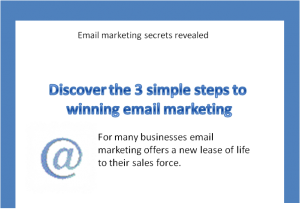
Therefore when the email appear on their phone they will see who it’s from, the subject line and the text ‘Email marketing secrets revealed’.
2. Hook line and sinker
The subject line of your email will ultimately determine whether it is opened or not.
It has to be intriguing, promise something new/important or offer them something that’s going to make their lives easier or help their business.
But once you have them hooked it is just as important to make sure the body of your email provides them with the answers.
Using a strong subject line but then talking about something different in the email will dissolve any confidence they had in you.
Make sure that what your subject line promises, your email delivers.
3. Drop off zone
How long should your email be before your reader dozes off?
An email that goes on and on and on will bore the pants of your recipients so if you have a lot of information you want to get across, add a teaser in the email and then link out to the full article so if they want to learn more, they can.
Everyone is busy and if you constantly send out mind-numbingly long emails you’re going to get a lot of unsubscribers.
4. Call to action
You call to action is vital because it asks your reader to take an action—call you, email you or buy now, book here…
Frequently they are seen as hyperlinked text inviting the reader to click it. But how about using a button instead? It stands out more and there’s something compelling about seeing a button – you just have to press it.
5. Proofread
A simple thing but something that’s not done often enough.
There’s nothing worse than sending out your email only to then discover a prominent typo.
Make sure you speak to your public and not the pubic, offer to nurture your clients but don’t neuter them.
An email full of typos will do untold damage to your reputation, so read it carefully before hitting send.
These 5 simple suggestions could help your 2011 email marketing campaign go with a bang. Try them out and see how you get on.
These tips are brought to you by Sally Ormond, freelance copywriter, blogger and social media fanatic.
January 24th, 2011 — copywriter, copywriting tips, internet marketing, marketing, online marketing

I have often written about the importance of internet marketing.
Today, if you want to find new customers, expand your business or grow your reputation, the internet is the place to be.
By utilising the power of online copywriting, blogs, article marketing and social media, you can drastically improve your company’s exposure within the marketplace.
Still not convinced?
Well the lovely people over at Pingdom have generated a list of mind-blowing internet numbers for 2010.
Below are just a few of the stats, for a more detailed analysis take a look at their site.
Email
- 107 trillion – The number of emails sent on the Internet in 2010.
- 294 billion – Average number of email messages per day.
- 1.88 billion – The number of email users worldwide.
- 480 million – New email users since the year before.
- 89.1% – The share of emails that were spam.
- 262 billion – The number of spam emails per day (assuming 89% are spam).
- 2.9 billion – The number of email accounts worldwide.
- 25% – Share of email accounts that are corporate.
Websites
- 255 million – The number of websites as of December 2010.
- 21.4 million – Added websites in 2010.
Internet users
- 1.97 billion – Internet users worldwide (June 2010).
- 14% – Increase in Internet users since the previous year.
- 825.1 million – Internet users in Asia.
- 475.1 million – Internet users in Europe.
- 266.2 million – Internet users in North America.
- 204.7 million – Internet users in Latin America / Caribbean.
- 110.9 million – Internet users in Africa.
- 63.2 million – Internet users in the Middle East.
- 21.3 million – Internet users in Oceania / Australia.
Social media
- 152 million – The number of blogs on the Internet (as tracked by BlogPulse).
- 25 billion – Number of sent tweets on Twitter in 2010
- 100 million – New accounts added on Twitter in 2010
- 175 million – People on Twitter as of September 2010
- 7.7 million – People following @ladygaga (Lady Gaga, Twitter’s most followed user).
- 600 million – People on Facebook at the end of 2010.
- 250 million – New people on Facebook in 2010.
- 30 billion – Pieces of content (links, notes, photos, etc.) shared on Facebook per month.
- 70% – Share of Facebook’s user base located outside the United States.
- 20 million – The number of Facebook apps installed each day.
Videos
- 2 billion – The number of videos watched per day on YouTube.
- 35 – Hours of video uploaded to YouTube every minute.
- 186 – The number of online videos the average Internet user watches in a month (USA).
- 84% – Share of Internet users that view videos online (USA).
- 14% – Share of Internet users that have uploaded videos online (USA).
- 2+ billion – The number of videos watched per month on Facebook.
- 20 million – Videos uploaded to Facebook per month.
Still think there’s no need to get your company online?