OK, to be honest it’s not that new but it is changing the way you do business.
Cast your mind back to the way it used to be done. Marketing your products and services involved paying vast quantities of cash for newspaper or magazine articles – one little add competing with hundreds of similar ads.
You sent cold mail shots or put inserts in your local paper…which usually ended up in the bin or used as an impromptu coaster.
Finally you unleashed your secret weapon – the cold call. Every day you would sit with your list of phone numbers crossing them off one by one as you doggedly dialled them in the hope that one day someone would say ‘yes’ rather than ‘**!~~~@@#####’.
“But it works!” I hear you cry. Does it really?
Do you love having your evening interrupted by an unsolicited call trying to sell you double glazing? Do you enjoy your working day being interrupted by a persistent stationery salesman who just won’t take no for an answer?
I didn’t think so.
And is the one sale to the person who said yes (just because you happened to phone them at the exact moment they were considering buying an entire set of Encyclopaedias)really worth hacking off the other 299 people?
Forget ROI and think ROR
Social media marketing has opened up a wealth of new opportunities for businesses.
Now you have the opportunity to listen, engage and converse with a massive market place. You can tweet with people and offer advice when they are in need of your help. By helping them and giving them tips you’ll build trust which could land you some serious sales.
So what’s stopping you?
Many businesses are obsessed with ROI – and the one thing that’s very difficult to measure through social media is your ROI. But you can’t think of it that way. What’s far more important to your business is the ROR – return on relationships.
Listening and talking to people is worth its weight in gold. Giving timely advice when people need it will show your company as one that cares, that wants to help, and that’s open and approachable. In other words, your company is one that will be good to do business with.
As a freelance copywriter I use social media a lot. By listening to my followers on Twitter (and others through searches) I can step in and offer advice and guidance when they need it the most.
What have I gained from it?
New clients
Great friends
Help and advice when I’ve needed it most
More traffic to my website and blog
Service providers
A lot of fun
So what are you waiting for?
Get yourself online and join in the conversation. If you need some pointers follow me (@sallyormond) and I’ll be happy to show you the ropes.
We’ve all seen them – videos that are produced by companies to market their products that go viral. They’re viewed thousands of times by people all over the world. People talk about them and share them through social media.
So how do they do it?
Why is it their video goes global but yours remains unloved on YouTube?
Stop marketing
“Stop marketing – are you serious?”
Yes I am.
Think of marketing as a whole rather than just relating to video marketing.
Do you like getting cold calls or unsolicited mail shots?
Probably not – and if you don’t why do you think your customers do?
Here’s a news flash for you, they don’t like it. They don’t like being disturbed during the day by a company they’ve never heard of before trying to sell them something. They don’t like having their inbox cluttered with unsolicited emails and they don’t like getting piles of junk mail.
They would rather you engaged them, got to know them, help them with advice and tips. They can then get to know you, get to like you and get to trust you. That’s when they may decide to do business with you.
OK, going back to video marketing, what do you think a successful video should be like?
A) One that harps on about your company all the time
B) One that makes an emotional connection with the viewer
It’s the emotional connection that will make people want to share your video. Here are a couple of examples of companies that used their videos in precisely that way. They are not blatant adverts – they offer the viewer entertainment and a few laughs which in turn made thousands of people share them offering the companies a perpetual marketing machine.
Samsung’s video which took a novel approach to promoting its LED TVs
Bensons for Beds unique way of promoting their products
T Mobile
A whole new way of thinking
Many companies go wrong because they continue to use the old fashioned advertisement within the new social media context.
Social media is all about engagement not direct selling.
When you use video marketing, Twitter, Facebook or any other social media platform you must learn to talk to people. Success in these new marketing arenas is all about engaging them, conversing with them, and building relationships.
Your videos shouldn’t be seen as TV adverts, they have to give the viewer something.
Plus, if you want people to share your video make it easy for them. Upload it to YouTube, provide a link to share. If you don’t what was the point in creating the video?
So next time you create a corporate video, forget the direct sell and your company and think about your viewer. Give them something they can engage with, enjoy and want to share with others. That’s when you’ll benefit from viral marketing.
The internet has revolutionised the way people shop and research.
Now practically any piece of information you need is at your fingertips. A quick Google search will find you local suppliers, research material and that obscure pram you have been searching for with an iPod dock.
However, as an online business are you making the most of those leads when they come to you?
Take a moment to imagine the person who has just completed your online form sitting at their computer. They have just hit the send button. Now what are they doing?
Average email response time: 19 hours, 31 minutes
*Optimum response time should be within the first hour
Average phone response time: 36 hours, 57 minutes
*Optimum phone response time should be within the first five minutes
How many companies even responded?
*Only 47.3 percent responded via email, and just 7.5 percent responded via phone!
That doesn’t make good reading.
The internet offers almost instant search results therefore internet users expect fast reaction times from companies on the internet. Recently I sent an email enquiry to a local business – it took them 2 weeks to respond and that’s not acceptable in anyone’s book.
So how can you make sure you are making the most of the leads that come to you through your website?
Here are 5 tips you can use to make your business more effective at making the most of your web enquiries.
1. Analytics
Analytics are the closest thing you’ll get to a crystal ball. They will show you where your traffic is coming from, what keywords are providing the most leads etc. Use this data to determine which sources provide you with the highest amount of converting traffic and ensure you do everything in your power to boost that source.
2. Lead forms
If you use a web based lead generation form (i.e. a form for your customers to complete when enquiring about your services), how effective is it?
If you’re asking a large number of questions you may be diluting the effectiveness of it. After all, how many people are going to want to sit for hours completing an online form?
Make sure the questions you ask are relevant and valuable – if any aren’t, ditch them.
3. Offer
Your website is nothing without an offer. But is that offer relevant and tempting?
If you find your leads are dipping, take a look at your offer. Try something new and compare results. Only through this constant testing can you define what it is that your customers see as a valuable offer.
4. Lead distribution
The chances are that within your company different people will be dealing with different leads. So how do you facilitate that at the moment? Are they printed off when someone has time and placed on desks? Do they eventually get forwarded on via email when someone has a moment?
As I’ve already said internet users want instant results. Use a system that automatically distributes the leads to the relevant people. That way they will receive a response instantly.
5. Be faster
Although left until last, this one is the most obvious. All you have to do to make your web leads more effective is respond to them quicker.
Even if that means sending an instant holding email that tells the person you’ll be in touch within 24 hours. Of course, if you do send a message like that make sure contact is made within the specified time.
If someone out there has taken the time to find your website, read what you have to say and complete your online form the least you can do is respond to them quickly. Do that and you’ll gain a great reputation and quality leads.
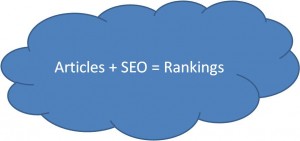
There is one formula that is ingrained in the minds of many internet marketers and internet businesses out there:
The regular addition of fresh content will undoubtedly help your search engine optimisation strategy, generate more traffic and therefore potential business.
But just adding content for the sake of it could do more harm than good.
If you write or commission a copywriter to create a vast number of SEO rich articles for your website are you really adding value?
“But I’m driving traffic!” I hear you cry.
You many well be but what’s in it for those people when they find your article?
What value will it add?
What’s your call to action?
Is it really all that relevant?
If your content doesn’t offer the reader anything or ask anything of them, what’s the point?
Adding fresh content to your website is a good thing.
Making sure it’s search engine optimised is great.
But you also have to ensure it’s relevant, adds value and asks something of your reader. If you don’t they’ll skim read and head off to another website because you haven’t used that content to draw them into your website, get interested about your product or buy.
So the moral of this post is – add content, make it relevant and make sure there’s a call to action/lead into your main website.
Can you really tell whether copy is good or bad just by looking at it?
The answer is yes and no.
It rather depends on what the copy is, what it’s meant to do and what form it takes.
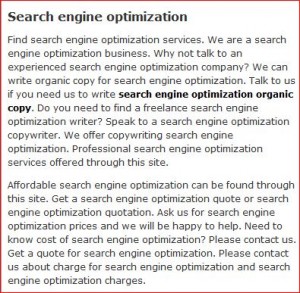
For example if it’s SEO copywriting and it’s very obvious what the targeted keyword is, like in the example below…
…then it’s pretty safe to say it’s bad copy.
The problem is a section of text can be very well written (grammatically correct and no spelling errors) and yet, from a sales perspective, it’s about as useful as a chocolate teapot.
That’s why it’s not always easy to spot bad copy.
It’s probably easier to look at this from a different angle and think about what makes good copy.
The traits of good copy
Luckily there are 5 characteristics that good copy has. No matter which format it’s written for or what it’s trying to sell, good copy will always:
What it comes down to is this – copy is written for a purpose (generally to sell something) but if it doesn’t fulfil that purpose it’s not doing its job.
Selling through text alone is difficult. You don’t have the personal contact with the customer; you can’t think on your feet to counter their buying objections and you can’t shake their hands.
What are your thoughts? Can you think of any more traits you find in good copy? Why not share them here along with any shocking examples of copy you’ve come across.
 A new wave of marketing is taking over.
 The internet has revolutionised the way people shop and research.