Entries Tagged 'copywriter' ↓
December 1st, 2010 — copywriter, Kindle, marketing

Making a statement like that might seem like a strange thing for a copywriter to say but it’s true.
No matter how great the copy you write, not everyone is going to want your product or be ready to buy your product. It might simply be the case that your product isn’t the right fit for them.
So don’t be surprised when you don’t get a 100% conversion rate.
What prompted this post? Well, it was a conversation I had with some girl friends over dinner last night. Many of us around the table were avid readers so it wasn’t long before the debate about Kindle or book began.
To illustrate how a marketing campaign can fail with some people, I’ll give you my thoughts about what’s best—the Kindle or a book.
Let’s take a look at the Kindle to start with.
As a technology lover and avid reader you would expect me to be at the front of the Kindle queue. It has everything:
- E-ink screen so it can be read even in the brightest sunshine
- A compact design so it’s easy to carry around
- Instant access to more books than you can possibly read in a lifetime
- Fast downloads with inbuilt wi-fi capabilities
- Fast page turning ability for seamless reading
- Long battery life so you won’t be interrupted as you get to the good bit
It sounds absolutely fantastic. So why haven’t I rushed out and bought one yet?
For me, a book is so much more than just a way of conveying a story.
They have a lot of down sides:
- They take up a lot of suitcase space on holiday
- They get soggy when you read in the bath
- You need a lot of bookshelves to house your library
- They don’t easily fit into a small handbag
But for me there’s no substitution for the smell of a book, the feel of its pages and the sense of being privy to someone’s innermost thoughts. It is exciting to hold a book, become immersed in its words and to turn each page with trepidation never quite knowing what’s coming next.
So no matter what Amazon.com says technology will never (for me) replace a book.
Mind you I did make the transition from vinyl to CD to music downloads so here’s a challenge for Amazon.com why not send me a Kindle to try out and see if you can convert me.
November 29th, 2010 — copywriter, freelance copywriting, networking, social networking
 A short while ago Tom Albrighton wrote a blog post about networking.
His post really resonated with me as I have never been comfortable with face to face networking. To me it all seems very contrived. But before I receive an onslaught of pro-networkers having a go, let me explain.
When I first started out as a freelance copywriter about 3 years ago, I was constantly told I had to get out and meet people if I wanted to succeed. Not that I’m a stubborn old girl or anything but I completely ignored that advice, set up a website, started blogging and have never looked back. I have been fortunate enough to work with some amazing clients (who are still with me) and now enjoy getting referrals. It’s always a thrill to pick up the phone or read an email to be told that I’d been recommended to them.
Anyway enough of that—back to the networking thing.
In my early days I was seduced into attending a couple of ‘formal’ networking events by clients. You know the type of thing—a room full of strangers wearing sticky labels holding their delegate sheet in one hand and a pile of business cards or leaflets in the other. I have never felt so uncomfortable in my life.
As I was there I thought I ought to make an effort, took a deep breath and hovered on the edge of a group of people deep in conversation. Luckily for me one or two of them were reasonably friendly and did welcome me into their conversation. Not something that always happens; I’ve lost count of the number of times I’ve tried to get involved in a conversation only to be ignored—especially, I hate to say it guys, by men. I often think that to get noticed and spoken to I ought to turn up in a bikini—ugh, on second thoughts perhaps not.
Back to the event—there I was chatting with strangers when another lady came to our group with delegate list in hand. Again we stopped and welcomed her. She smiled, stared at our chests (another pet hate, why do we have to wear sticky labels? When men approach women you can see them glancing but trying not to at the same time for fear of looking pervy) checked her delegate list, realised she didn’t actually want to talk to us and walked away!
Err, hello? Just because you don’t want to do business with us doesn’t mean we are not worth talking to. We might know people who are looking for whatever you do. But you’ve blown that chance now honey—goodbye! And besides, when you do finally track down the person you were looking for who’s to say she wants to speak to you?
That experience summed up formal networking events for me. As soon as you walk into the room you’re not seen as a person, you’re seen as a potential sale. And I really hate that. And yes that is just my opinion and I’m sure many of you will disagree.
You probably think after reading this little rant that I live in a deep dark hole somewhere living the life of an eccentric writing recluse. Well you’d be wrong. I do go out and ‘network’. Admittedly a lot of it is done online through social networking, but you can’t beat a bit of face-to-face social networking too.
The other evening I made the journey to London to attend Andy Maslen’s (@andymaslen) book launch. For those of you who don’t know Andy (shame on you), he is a fellow copywriter and my copywriting hero (are you blushing yet Andy?). His book ‘Write to Sell’ was the first book on copywriting I bought and has been my bible ever since.
You can imagine therefore my shock when I received an email from said copywriting guru earlier this year asking whether he could interview me for his new book ‘Write copy, make money—How to build your own successful freelance copywriting business’.
Of course my answer was YES.
Anyway, I was looking forward to meeting Andy at the book launch but then I saw a tweet he put out inviting people to the launch to…’network’. Argh! Network? No, I was just going for a chat. So for weeks I told myself over and over, this is a gathering of friendly people, you are not networking, you are chatting.
Yes, I can already hear you arguing with me telling me that ‘chatting’ is ‘networking’ and you’re right. But to me that’s how networking should be; it should be informal without elevator pitches or Q&A sessions. They have their place if that’s what you like to do but for me, it’s more fun and rewarding meeting a bunch of people and having a chat over a glass of wine. So far that’s how I’ve met some of the most interesting people I know (and it’s also the way I’ve met most of my biggest clients). Because there is no pressure, people get to know the real me. They find out who I am and that I just happen to write for a living.
Back to the launch party.
Did I work the room? Not exactly because I still can’t do that ‘OK I’ll talk to you for 5-10 minutes before moving on to the next person’ thing. I normally find I really connect with a few people and end up chatting to them for the rest of the evening. Admittedly at the launch party that was three fellow writers – Anthony Hewson (@ahcopywriter), Sarah Turner (@TurnerInk) and Katherine Wildman (@skinnycap)- but we had a great evening chatting about our work, how we got started, our insecurities etc. – it was very therapeutic.
So basically what I’m saying is can we please put the ‘social’ back into networking?
Remember the people there are real people and not just businesses on legs. Don’t be blinkered into thinking you have to speak to everyone and hand out all your business cards. Take time to talk and connect with people—get to know who they really are and not just what they do to pay the bills.
Treat people like real people. Have a laugh and a joke with them—that will be far more memorable than a small piece of card that they’ll probably bin when they get home. You’ll never know what you might find out about them.
For those who have met me at events, tried to sell, failed and moved on, here’s a few things you would have discovered about me had you taken the time to talk to me:
- I have two fantastic sons
- I’m a volunteer wish granter with the Make A Wish Foundation
- I love going to the gym
- This year I did a 60 mile and 50 mile charity bike ride
- A couple of years ago I did the Moonwalk to raise money for Breast Cancer
- When ice skating as a child I almost crashed into the back of Christopher Dean
- I’ve done a bungee jump
- I’d love to do a wing walk
- I’ve always wanted to go to Vienna
- I complete an English BA Hons degree with the Open University in 2007 with a First
- I’ve had one children’s book published
There you go—yes, I am a freelance copywriter but guess what? I’m a real person too.
November 26th, 2010 — copywriter, copywriting, copywriting jobs, freelance copywriter

As a freelance copywriter, in my perfect world I would be able to generate an unlimited number of original ideas at the drop of a hat.
I would never be stumped by a project, and subject-matter for my blogs, articles, client web copy, emails and newsletters would flow freely without any effort on my part.
But sadly it’s not a perfect world and, yes even I suffer from writers’ block every now and then. I have been known to be sat in front of my PC waiting for inspiration to strike. Only the number of empty coffee mugs littered across my desk betrays the length of time I’ve been wracking my brain trying to come up with a winning concept.
So how can you get over a barren spell?
The simple answer is a swipe file.
As I read newspapers, magazines, mail shots, websites and emails I make a note of anything that grabbed my attention.
If a particular layout was particularly effective or an image suitably eye-catching – anything that made me stop and read, it goes in my swipe file.
One word of warning—a swipe file is not there to be directly copied or plagiarised—a swipe file is there for inspiration.
After all if a headline grabbed your attention it will probably grab others’; if an email subject line made you open it others will too; if the layout of an advert made you stop and take notice others will also stop.
Over time you will build up a reference tool of hundreds of ideas to which you can add your spin.
Let others inspire you to create copy that sells.
November 24th, 2010 — copywriter, freelance copywriter, freelance copywriting, Google Instant Preview, search engine optimisation
Things are changing in Google’s house once more.
If you are a regular user of the search engine you may have noticed its latest offering—Google Instant Preview.
As shown here, along side your search results are little magnifying glasses. By clicking on one a pop up appears showing a ‘preview’ of the website so you can check it out before clicking on the actual link for the site.
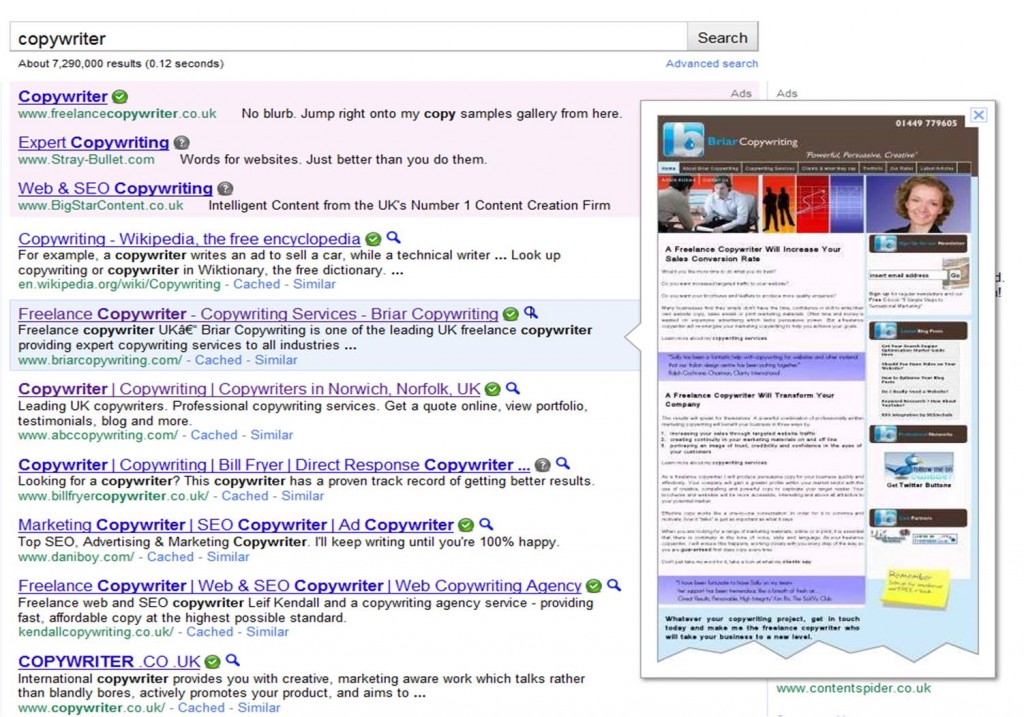
It’s designed to help the user save time by taking a peak at what the website offers before committing to that ultimate click.
But how does it affect the website owner and their search engine optimisation strategy?
The short answer is no one really knows yet—time will give us more of an insight into how it affects searching habits. But there are a few things you can do to maximise the chances of your website being chosen.
Banish flash
You already know that flash isn’t great for SEO. The search engine spiders have a tough time crawling through it and are unable to distinguish between normal text and that within header tags. But the added complication with flash is that it doesn’t do anything for your Google Instant Preview. This is because the Preview can’t render the flash element leaving your website looking distorted. So, if you want your website to look its best, you’d best ditch the flash.
META Descriptions
We all know that your META Description doesn’t have a direct effect on your SEO as far as ranking position goes, but it does as far as attracting that all important click goes.
The 150 characters within your META Description have to convince the reader your website is worth checking out. So if you want them to click your link or Preview magnifying glass, you must make every single word count.
Header tags
As you can see from the image above it’s not easy to make out the body text on the preview. But what are readable are the headings. Therefore the reader is going to base their decision on whether to click on your link or not, on the layout, headings and styling of your page—so you’d better make sure your headings are relevant and the look is just right.
Images and Alt tags
The images you use on your website are there to lure your reader so to give your SEO as much chance as possible make sure their filenames and Alt tags are descriptive, relevant and contain your keywords.
So whether you’re a copywriter, electrician, solicitor or builder these are 4 very simple techniques you can use to boost your website’s chances of receiving that coveted click.
November 22nd, 2010 — blog, copywriter, copywriting, copywriting tips, freelance copywriter
 Today’s guest post was contributed by James Adams, a writer with CartridgeSave covering the latest releases of Canon supplies.
The author’s views are entirely his own and may not reflect the views of FreelanceCopywritersBlog.com. If you are interested in producing a Guest Post for this blog, please get in touch with your ideas.
5 Tips for Writing Effective Copy for Products
If you’re running an ecommerce store, then you know that there are two main pillars to your success: get relevant traffic to your store, and then convert that traffic into sales. One of the best ways to do both is to learn how to write not just good sales copy for your products, but sales copy that compels prospects to buy. Ideally, you would like to have compelling sales copy that encourages people to buy, but which is also search engine optimized so that it sends more traffic your way. Let’s take a closer look at 5 tips for writing effective copy for products of any kind.
1. Focus on Benefits
As you browse different ecommerce sites, you will notice that some sites emphasize the benefits of the product, while other sites might merely list all of the features. In all likelihood, the site that emphasizes benefits is making more sales. People don’t purchase a product because they are impressed by the list of features: They want to know what those features will do for them. They want a product that satisfies some of their needs and wants, or they want a product that will better satisfy a frustration that they are currently experiencing. If you are selling a pair of boots, for example, you might want to let the customer know that it has double Teflon-sealed soles. However, there is a good chance that your potential customer doesn’t even know what Teflon is, so it would be much better to tell him that the double Teflon-sealed sole will keep his feet dry even if he gets caught in a rainstorm or steps into a puddle.
2. Know the Audience
When you list the benefits of a product, it is important to know who your target audience is. If you are selling a cell phone, there will be a world of difference between what a teenager and what a business man is looking for. A teenager may want to send text messages to his friends, watch YouTube videos, and play video games. A business man wants a phone that will handle multiple email accounts, allow him to take notes at meetings, and allow him to manage his stock portfolio. Even if a single phone is more than capable at handling all of these tasks, you will want to emphasize a different set of benefits depending on which demographic most often shops in your ecommerce store.
3. Describe Your Prospect Using the Product in the Future
If you can get the prospect imagining himself using the product, then you are halfway to the sale. If you think to all of your own purchases both online and offline, you will realize that you never bought a product unless you could picture yourself using it in the future. It’s an essential part of the human decision making process. You can help your potential customer get there by describing him in a scenario of your own making. If he couldn’t picture himself using the product before, he definitely can now.
4. Weave in Your Keywords
Once you’ve written your sales copy, it is time to work in some keyword phrases so that you can get some additional traffic from the major search engines like Bing, Google, and Yahoo. Excellent sales copy is important, but if no one sees it, then you aren’t going to achieve any sales. However, you should incorporate your keyword phrases in such a way that they don’t distract from your copy. If it sounds stilted, then you should take a few of the keywords out. It’s a good idea to write your copy without the keywords in mind, and then to go back and add them in later. If your sales copy is pretty long, then you can target several keywords. However, if it is only 60 or 70 words long, then you should probably just focus on one keyword phrase.
5. Always Test and Track
It’s a good idea to always have two different versions of sales copy for each product that you sell. You can use various tracking software, including free software provided by Google, to alternate between the two versions of your sales pages and to track the results. After tracking for a month, you can keep the version of copy that converts better and construct a new one to test against it. By doing this, your product conversion will continuously improve, and you will become continuously better at writing copy. You shouldn’t worry too much if you don’t get it right the first time.
Writing great sales copy can be a tough skill to learn. In fact, it is one of the most valuable skills in all of sales and marketing. If you have mastered it, then you should be able to sell nearly anything. Despite its difficulty, there are a few proven techniques that you can incorporate into your product copy.