Entries Tagged 'online marketing' ↓
December 27th, 2010 — article writing, blogging, blogging for business, Content marketing, copywriter, internet marketing, marketing, online marketing, website copywriting

As an internet marketer you are spending hour upon hour producing content to promote your business and help build links.
You have a list of topics as long as your arm and every spare minute you have is spent producing blog posts, articles and website copy.
Your dedication is admirable.
Once you’ve uploaded your fantastic value-laden information and hit publish…
…absolutely nothing happens.
No tweets (not even a re-tweet), no comments, no nothing.
Immediately you think “Argh! My writing must really suck.”
But before you enrol in a writing class, just stop and think for a moment. Your writing style is probably perfectly fine, but what about the structure?
You may look at your work and think how proud your old English Teacher would be—stop right there. That’s your problem. When writing for the web and an online audience, you can forget just about everything learnt during your school days.
You need to spend less time writing and more time thinking about how you structure your work.
Writing for an online audience
There is a peculiarity about writing for the web—most people will only scan a web page rather than read every word.
That’s because they are searching for information and if they can’t find it quickly, they’ll move on to another website.
So the trick is engaging your readers and getting them to stay with you until the bitter end.
How do you do that?
1. Snappy
Your writing should be relatively short (long enough to cover your subject). So if you’re writing about a very complex issue it may be worth breaking it down into several posts. Not only will that make it much easier for your reader to follow, it will also encourage them to return to your site for your subsequent posts.
Also when you’re writing start with your conclusion—sounds odd, but by doing that you are immediately giving your readers what they want. Once you’ve done that, follow up with supporting evidence point by point.
2. White space
Does your finished article, blog post or web copy look like a page from a novel?
If your text is in one long, or several long paragraphs it won’t look very inviting.
Lighten it by increasing the amount of white space on your page. Break it down into small paragraphs (no more than 3 or 4 sentences each).
Or go really mad and use a single sentence paragraph.
3. Sub headings
While you’re following step 2, insert some informative sub headings between your paragraphs. This will help your reader get the gist of your post while they are scanning the page.
4. Bullets
- Using bullet points creates interest
- Highlights important points
- Are instantly scan-able
- Draw the reader’s eye as they break up the rest of the text
5. Links
Don’t only use your post to generate links to your own website. If you have researched your content well you’ll probably have an external source to link to. This will show your reader that your information is well considered (and it may also generate a link from your source too).
6. Bold
Use the bold function to pick out important concepts within your post. These, coupled with the sub headings, should help your reader fully understand the topic you are covering and whether it will be of interest to them.
But don’t go mad—you don’t want to confuse your reader.
7. Numbers
Some people have said that the days of the numbered posts—such as “8 Top Tips to Improve Your Copywriting” are gone. But reader’s still love them.
They help to grab attention and, once reading, retain your reader because they’ll want to make sure they learn everything.
8. Check and check again
Before hitting the publish button, read through your work and make sure it makes sense. Do the headings and bolded words make sense and convey the overall concept of your work?
Of course this read-through should also pick up any typos and other errors.
So there you have it—writing informative posts is one thing, but if you want people to read them they must be presented in a way that:
- Gets your concept over immediately
- Looks attractive and readable
- Gets to the point
November 8th, 2010 — Content marketing, Content writer, copywriter, marketing, online marketing
 Content marketing is all about getting out there, getting found and building a reputation for expertise in your field.
But simply churning out articles and blogs isn’t good enough. You have to concentrate on generating quality content if you want your hard work to pay off.
There are three elements that go together to help you excel at content marketing:
- Create content that sells you
- Content that is optimised for the search engines to increase its longevity
- Repurpose your content and spread the word
Many people don’t get the idea of content marketing—it’s hard work—I don’t have time for it—no one reads it anyway…
Think like that and you’ll never get anywhere. But think of content marketing as a dirty great big megaphone that ensures your message reaches the parts other marketing can’t reach and you begin to understand its potential.
If your readers see your content all over the internet they will believe your company is providing great content, your giving valuable information, you are a market leader which means they’ll be more inclined to pick you over and above your competitors.
Content generation means you’ll get found
So what is content?
We are not just talking about white papers and reports, your content can be in the form of articles, blogs, videos, FAQs, audio.
Offering a variety of styles will appeal to different audiences therefore ensuring your message will be heard loud and clear. Not everyone likes to read long reports, not everyone likes to watch video, not everyone likes to listen to audio but by offering all forms of media you will provide something for everyone.
How to make your content great
1. Don’t be over promotional
The first thing to remember when creating your content is for it not to be constantly promotional. Yes you are producing content to promote your company but it can be done in subtle ways.
By giving information to help your readers, you will be showing yourself as an expert that is open and approachable. That alone will promote you without you blatantly pushing your products and services.
2. Be relevant
For your information to resonate with your reader it has to be relevant to them. You have to understand what your reader wants and generate it for them.
3. Well-written
You may not be writing a novel but your content must till be written like a best-seller. It has to be engaging, it has to be in good English, grammatically correct—you can’t afford to put out information that is sloppy and not thought through.
4. Relevant to your company
As your readership begins to grow, you must ensure you produce content that is relevant to your marketplace and your company.
If you are a copywriter and suddenly start writing about shoes (OK daft example but you get my drift), you audience is going to be left wandering what on earth’s going on. So make sure you keep on subject.
For example on this blog I talk about copywriting, social media marketing, search engine optimisation, online marketing, off line marketing—basically all aspects of sales and marketing. So as you can see it doesn’t have to narrow, you can widen your scope of encompass all elements of your chosen field.
5. Promote it
If you’re going to write it, promote it—otherwise what’s the point?
Use all the tools available to you—social media, PR, search engine optimisation—make it stand out and get it in front of your audience.
So if you want to excel at content marketing, write regularly, write well, write relevant material and promote it.
November 1st, 2010 — blog, blogging for business, copywriter, online marketing, search engine optimisation
If you follow this blog regularly you’ll know I’m a huge fan of blogging as a way of boosting your online presence. As a copywriter I’ve been using this method for several years now and it works.
Through the power of blogging you have the potential of driving a huge amount of traffic to your main sales site as part of your search engine optimisation strategy.
In an earlier post I looked at how to give your blogs eternal life, well now I want to expand on that theme by talking about how you can optimise each of your blog posts.
Below are 5 tips to help you get the most out of your blog posts through optimisation.
1. Quality content
There is no getting away from the fact that people only want to read well written, informative blog posts.
You must therefore create posts that are easy to read, interesting and informative. If there is value in your content your readers will share it with others. Not only that, it will also attract those all important back links.
2. Keywords
Because you are writing for an online audience you must take care to work out which keywords your post should be targeting. Once you’ve written your post, read it and think about what terms would your reader use to search for it. The primary keywords tend to be quite obvious, but other terms are not so clear-cut.
There are various tools you can use to identify your keywords such as Google’s keyword tool. But there are also a few other tools you can use that will help you identify terms associate with your primary keyword. One is the Google Tilde search. But there is also another more visual tool you can use.
Let me introduce you to the Google Wheel. When you’ve entered your search term into the Google search box, if you look to the left of your screen you’ll see Wonder Wheel.
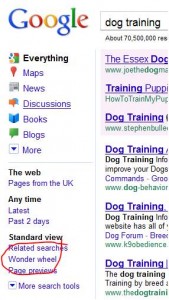
If you click on this it will produce a wheel diagram with your main search term in the centre (in this case ‘dog training’) with associated terms around it:
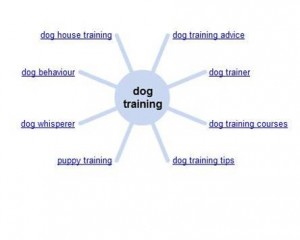
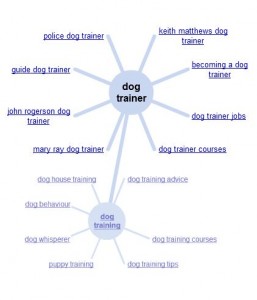
You can then click on any other outer terms to receive further results:
3. META Titles and descriptions
This is one aspect that is often forgotten. The META title and description are there to tell both the reader and search engine spiders what your posts is about. If you use the WordPress.com platform for your blog you can use the All in one SEO Pack to specify these fields.
When writing your titles and descriptions make sure your keywords are near the beginning. There is also a character limit for each (Titles – 72, Description – 165) so you’ll have to carefully plan your words.
4. Links
Both internal and external links are important when writing your posts. As you can see, I’ve used a mixture of both.
Your internal links (utilising related keywords) link out to other posts, while external links take the reader to other related websites. In both cases make sure you use keyword rich links rather than something like ‘click here’ which has no value.
Your external links can also be used to encourage inbound links from other websites as ‘trackbacks’ inform that web owner you have linked to them. Therefore they may in turn link to your posts.
5. URL
The last item on my list is your URL. This I the web address used to link to your post. Make sure you use your keywords within this as it will instantly show the relevance of your post.
Make sure it is meaningful.
By utilising each of these techniques and tools, you will produce meaningful, interesting blog posts that will be found through the search engines. Not only that, but by ensuring you create quality content you will attract links and build your reputation as an expert in your field.
Blogging is an excellent way of getting your voice heard.
October 29th, 2010 — copywriter, freelance copywriter, internet marketing, online marketing, search engine optimisation
 Having a website is the new black – everyone seems to be doing it these days. But there are still a small percentage of businesses that have resisted the urge to dip their toes into cyberspace.
Why are they resisting?
- It wouldn’t suit our customer base
- We get enough customers without having an expensive website
- I don’t understand all that computer stuff
- It’s too expensive
- I don’t want to sell online
- I don’t have time for one of those
These are just a few reasons why businesses shy away from using the power of the internet.
Well, whether you sell online or not, a website is still a very powerful tool for any business. To try to convince you it may be worth taking the plunge, here are 4 reasons why you should consider a website for your business:
1. Open all hours
The last thing you want to do, being a business owner, is to be at your customers beck and call 24 hours a day. We are all struggling to get that work/life balance right, but when you own your own company that can be difficult.
Unlike you, a website doesn’t need to eat, drink or sleep and is open for business 24/7. Your customers can browse it whenever they want to. Plus many people will research local companies on the internet before making a decision about who they’ll buy from. So if you’re not on the net, the changes are you’ll be overlooked.
2. Credibility
As mentioned in my previous point, people like to research companies online before buying.
Your website and its content is a great way to instantly build rapport and credibility with perspective customers. They can take time to read about you and what you offer. If you come across well they will be more inclined to do business with you as they will already feel as though they ‘know’ you.
If you don’t feel confident enough to create your own website copy, hire a professional copywriter to write it for you. That investment will ensure your website contains copy that is powerful, search engine friendly and will convince your customers to get in touch and buy.
3. Money
Appearing online will boost your income potential. Even if you have a physical shop, selling online will generate income for you 24/7. As in my first point, your online shop will never close. If you sell services, your potential customers can react instantly to your website and email you.
With over half of all UK consumers now regularly shopping online (Forrester UK Online Retail and Travel Forecast 2008-2014), if you don’t have a website you’ll be turning your back on a vast untapped marketplace.
4. Widen the net
Having a website will extend your reach.
Rather than relying on local customers, a website will enable to you to reach clients nationally and even internationally. You will tap into marketplaces you’d only ever dreamt of working with before. This could lead to business growth, diversification…the opportunities are endless.
If you think having a website is too expensive, there are alternative services available. I’m thinking of websites such as BT Tradespace and myProspot. Both of these offer the opportunity of utilising their powerful platforms and extensive social marketing tools to market your business.
Plus myProSpot also gives you the opportunity of having your own website, with your own URL (e.g. www.briarcopywriting.com) so it will look just like your own specially developed website but at a fraction of the cost.
So as you can see, there really are no barriers to getting a website.
October 27th, 2010 — copywriter, freelance copywriter, keywords, online marketing, search engine optimisation
Sally Ormond, freelance copywriter, comments on Kieron Hughes’ post “Using YouTube as a keyword research tool for SEO” that appeared on SEOMOZ.org
When you think about keyword research, you probably instantly think about your products, services and geographical information.
The main tool you would probably name would be the Google Adwords Keyword Tool. After all, what better authority on keyword value than Google’s own tool, right?
Well there is also another possibility; one that actually gives you data from the search engine using public – so straight from the horse’s mouth.
I came across it in a post on SEOMOZ.org by Kieron Hughes – in his post he discusses the merits of using YouTube as a keyword research tool for SEO.
As Kieron states uploading videos to YouTube is simple, anyone with a computer and internet connection can do it. But it’s not the video itself that is valuable for research purposes; it’s the descriptive content that accompanies it that is a gold mine of information.
Taking the example of speech therapy, Kieron illustrates how a search on YouTube generated associated words such as:
• Autism
• Oral motor exercise
• Chewy tube
• Down syndrome
• Oral motor therapy
• Apraxia
That would not have been generated through Google’s tool. So if you are researching a subject area for a client in which you don’t have in depth knowledge, YouTube could prove a valuable tool in your keyword research armoury.
A gold mine of information
People from all walks of life, professionalisms and personal experiences use YouTube as a platform to share their knowledge and experiences. These are normally people who use the search engines daily and so are invaluable sources of information.
So by using YouTube as a resource you could change your initial site navigation from:



To something more representative of your industry with greater SEO potential:

So next time you are doing some keyword research – either for yourself or for a client – don’t overlook the potential of YouTube.