February 10th, 2010 — copywriter, copywriting tips, freelance copywriting, SEO copywriter
Does your SEO copywriter know how to write great page titles?

SEO copywriting isn’t about keyword density. In fact if that is a phrase your copywriter refers to run away from them as fast as you can.
Today, you should concentrate on writing content that is natural, relevant and interesting. If you follow those rules, it will automatically contain a good number of keywords, naturally.
It is more important to ensure your keywords appear in your headings and page titles.
How to write great page titles
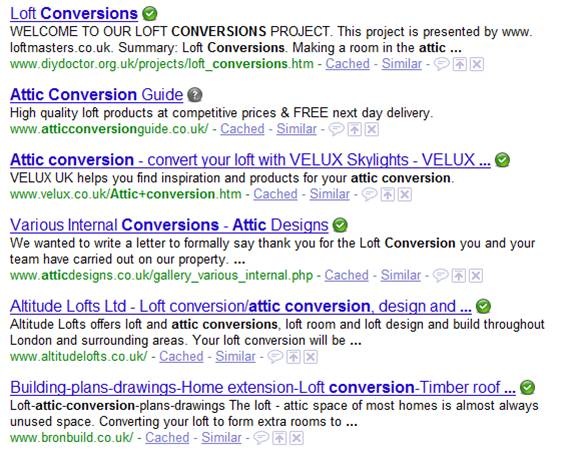
From this screen shot you can see the blue headings for each result. These are the page titles.
As you can see, what you put in your page title is going to have an effect on the positioning of your site within the search engine results.
A mistake often made with websites is that the home page’s page title is exactly that ‘Home’ – what’s the use of that? It tells Google nothing about your website and it certainly wouldn’t inspire a prospective reader to click on it to find out more.
Readers will use your page title as a reference to the relevancy of your site in relation to what they are searching for.
Here are some tips to help you get the most out of your page titles:
- Clear language – By all means use your keywords in your page title but don’t stuff it. A clear statement utilising your key words is ideal.
- Keep it short – Google only shows about 65 characters for page titles to don’t it longer than that.
- Make it relevant – rather than just listing words, make a statement, ask a question, evoke an emotional response or make a promise (just make sure you can keep it once they’ve clicked through to your site).
- Place your keywords wisely – It’s best to have your keywords at the start of your page title.
- Brand aware – If you can, it’s a good idea to get your brand name into your page title.
One last thing to remember – Google ranks pages not websites. What I mean by that is that Google lists each page of your website. Therefore you have an opportunity to rank different pages within your site for different keywords.
Bearing this in mind, make each page title different. Target different keywords on different pages to optimise your chances of being ranked well for a number of different words and phrases.
Copywriting is far more than just on page website copy. An SEO copywriter will be aware of how to write great page titles and META descriptions as well as how to write compelling and relevant copy.
February 8th, 2010 — blog, blogging, copywriter, copywriting tips, freelance copywriting

Now there’s a question for you.
Undoubtedly blogging is one of the most valuable marketing tools available to today’s online marketers.
Why?
Because it gives you a platform on which to market your products and services under the radar of your reader. What that means is that you can blog about your services without overtly trying to sell them to the reader. You can write ‘How to’ articles or give out top tips.
Basically, blogging allows you to:
- raise awareness of your product/service
- build relationships of trust with your readers
- raise your profile as an expert in your particular field
- build back links to your website
- drive targeted traffic to your website
Blogging does all that?
Of course it does. Take this blog for example. If you look back through the archives you’ll find posts covering just about every aspect of copywriting and marketing you can think of (although I bet you’ll all be rushing now to tell me that I’ve missed something out). Therefore readers of my blog know what type of information they will find.
Displaying my knowledge shows that I am an expert in my field. It shows that I know what I’m talking about so when they are looking for a freelance copywriter, they know I can do what I say I can do – get them results.
When writing my posts I use anchor text, such as copywriting services, to link back to my website building good back links that Google loves.
And because my posts are all related to copywriting, the visitors I get are looking for copywriting information which means I am generating targeted traffic.
DIY vs. out sourcing
I am often asked by small businesses whether I’ll blog for them. My answer is normally no.
OK, it looks as though I’m shooting myself in the foot with that but if you think about it for a moment you’ll see my reasoning.
As I’ve already mentioned, when you blog you are building a relationship with your readers. If you are a small business (1-5 staff) your clients will probably deal with you directly. Therefore if they read your blog posts they’ll assume it is your voice they are ‘hearing’. The more they read the more they’ll think they are building a relationship with you. So what happens when they meet you? If you don’t write your own posts it will be like meeting someone else.
Apart from the odd guest blog, I write all my own posts. I enjoy engaging with my readers and when they meet me, they know it is my expertise that I have been passing on rather than someone else’s.
But if you are a large company outsourcing could be ideal for you. In this case, there isn’t necessarily a single voice that needs to be heard. You’ll have your own brand image, tone and voice so as long as they are adhered to, outsourcing is perfectly acceptable.
Of course, you may have staff members that blog for you which is great. They are at the forefront of your business and can react quickly to customer needs. The important thing to remember is that they must comply to your company’s image.
So there you have it. Blogging is a fantastic way of raising your profile, building your reputation and driving traffic to your main ‘money’ site. What’s more, it’s a relatively cheap way of marketing.
If you aren’t already blogging give it a try – you won’t get results immediately but, but stick with it and you may be surprised at what happens.
February 5th, 2010 — copywriter, copywriting tips, email copywriting, email marketing, freelance copywriting
Email marketing is fast becoming the new black. It’s been around for a while but companies are now beginning to understand the potential it has.
In the past your mailings involved folding copious numbers of letters, sticking them in envelopes and slapping on stamps – today you simply spend a bit of time crafting your email and pressing send.
But how do you stop your email going directly into the delete file?
It’s all in the opening
The first thing your recipient will see is the sender’s name and subject line. So how do you make sure you pique his curiosity sufficiently to click on your email and open it?
Take Henry here for instance. He’s been tasked to come up with an email that will knock his customer’s socks off. 
He works for a washing power factory. His company has come up with a new detergent that will banish every stain known to man. To help him out, I have emailed him 10 little words that should him create something amazing.
———————————————–
Sender: sally@briarcopywriting.com
Subject: At last, the words you need to succeed
Hi Henry,
I thought you might find this list of words useful when putting together your sales email today. As a copywriter I find them invaluable when creating email campaigns for my clients. Try them out and see how you get on.
- Advice – this indicates you’ll be sharing something really useful “Advice for getting your whites white”
- Why – this indicates they’ll learn something new “Why stains will be a thing of the past”
- At last – this indicates that it’s finally here “At last a washing powder you can trust”
- Introducing – this gives you the opportunity to use your product name or company name “Introducing Magic White”
- How to – everyone loves to learn things “How to get whites white first time”
- How – very similar to the previous one but allows a more subtle introduction “How you can banish stains forever”
- Announcing – this can be used as an effective teaser because you don’t have to include your products name “Announcing the latest laundry technology”
- Which – this will get their interest because they’ll want to know if there is something new they need to know “Which powder banishes stains every time?”
- New – This is an old one but a good one because everyone loves something that’s new “New advanced formula that banishes stains”
- Now – this is one of the most powerful three letter words used by copywriters “Now you too can have whiter whites”
I’m sure you can come up with some better lines than the ones I’ve written above – they are just there to illustrate how the words work.
The other thing to remember is to keep your subject line to 40 characters or less so it doesn’t get truncated.
Remember Henry, the subject line is all that stands between your email and the delete file. It should be short, directed at your reader and instantly attention grabbing.
These 10 little words are tried and tested and get results again and again. Give them a go and let me know how you get on.
Warm regards,
Sally
Freelance copywriter
———————————————————-
Related posts:
Boost your email open rate
Email your way to success
Email marketing – when’s the best time to send
Work you way towards the perfect email body
Email marketing – why it doesn’t always work
Is email marketing right for you?
February 3rd, 2010 — copywriter, copywriting tips, freelance copywriting, marketing
Everyday we are bombarded by an endless stream of marketing  messages. They are on the radio, TV even our cereal boxes so it’s little wonder that more and more of us are becoming increasingly cynical about marketing.
People can spot hype a mile away and they don’t like it. If they think they’re being sold they’ll do their upmost to make sure they don’t buy.
Getting your sales message under their radar
Today, more than ever, copywriters and marketers are having to be more subtle about how they pitch to their audience.
It’s no longer the case that you can blast out an advert or sales letter and people will hand over their credit cards. Money’s tight, people are becoming more canny so you have to get clever.
6 ways you can market below radar
- Statistics – convert your marketing pitch into numbers. This will disguise it from those who think they can spot “sales speak” a mile off. Try something like “95% of dog owners reported a marked improvement in behaviour after following SITS training video”.
- Make the most of your pictures – pictures always add to your copy so make the most of them. If you add a picture you can be sure your reader will look for the caption, so make sure you give it to them. Rather than something lame like “Puddles hand cream 30ml” try something like “Puddles hand cream – used daily gives youthful, glowing skin”. Because the caption is describing the picture they assume it is the TRUTH.
- Testimonials – these work really well if they are attributed to someone your reader might have hear of. Then you get the “well if it’s good enough for them, it’s good enough for me” response.
- Case Studies – in a similar way to testimonials, case studies help add the ‘human’ sales angle. And people to love to hear real life stories.
- Frequently Asked Questions – whether you are a fan of these pages or not, they give the ideal opportunity to add more reasons why people should buy. For example if there is a question such as “What if SITS training course doesn’t work on my dog?” The answer would be “Not a problem as you are covered by our full money back guarantee.”
- Flattery will get you everywhere – cuddle up to your reader as you write to them. Make them feel special – share a secret with them – “Some people haven’t yet discovered SITS training plan. But as you and I know it’s worth the investment because a well trained dog is a happy dog.”
You product is amazing, you know that but you’ve got to get your reader to understand that too. But thanks to the many hyped up marketing messages around, your audience is growing increasingly sceptical.
By using these techniques you’ll slip under their “hype radar” so you can make your point and convince them you’re product is for them.
Sally Ormond – freelance copywriter
February 1st, 2010 — case studies, copywriter, copywriting, copywriting tips
Normally, when I talk to you about copywriting I hark on about how  important it is to write about the benefits of the product you are trying to sell.
That’s because benefits are the vital element to make your reader understand that you product is for them and so are a copywriter’s best friend.
However with the Case Study you have the prime opportunity to bring your benefits to life by dramatising them.
It’s not an easy road
Writing case studies isn’t easy, but the time and effort you spend honing them will be well worth it.
Testimonials are great, but case studies will carry more weight.
Why?
Because they are perceived as being truthful; you are telling your reader a story. Your case study will have a hero (your customer), a predicament (the problem they face), a narrative (what you did and why) and finally a happy ending.
So how can you be sure you write a compelling, interesting and relevant case study?
7 tips to creating a winning case study
Don’t make the mistake of thinking that writing a case study is simple. It isn’t. There are a lot of bad ones out there so I’ve put together a few tips for you to help you create a winner.
- Tell it from your customer’s perspective otherwise it will just come across as a piece of hype. Readers will be able to relate to your customer, after all they may well be facing the same problems. Let’s face it they probably are – if they weren’t why would they be reading your case study?
- Use real people in your photos if you can. Not everyone will be willing to do that but it adds weight to your case study if you can.
- Include as many facts and figures as you can. And give specific examples of what you did to solve their problem. Wishy-washy information will get you absolutely nowhere.
- People love pictures so use shots of your customers premises, machinery or whatever is relevant to your case study. This will add a sense of realism that you can’t achieve by using stock images.
- Let your client speak directly. Include plenty of relevant quotes and make sure you attribute them to the right person (including their full name and position). This is a great opportunity to present a new voice to your case study – try and use their language to add authenticity.
- Give it a good structure – a brief introduction to your customer, what their problem was, how you solved it, what the outcome was and future implications for them/their business.
- Make sure it is clear how they benefited from your product/service/expertise. This is crucial. If you tell your reader how your customer benefited they will associate that with how THEY will also benefit.
Now for things you don’t want in your case study
As I’ve already mentioned, your case study is your opportunity to prove to your readers that you can do something amazing.
If you want to sell something to a specific audience, you’ve got to prove to them they need it and that you’re good – very good.
Below are list of 4 elements you don’t want in your case study:
- A beginning that talks at length about your customer’s business. If you want to add information about their company, turnover or premises etc., put it in boxes at the side of your case study.
- Challenge and solution but without the results. Proof is the name of the game and without results you have proved absolutely nothing.
- No quotes. Your customer’s voice is essential. They need to speak to your reader and tell them precisely what you did for them and the results they have seen as a result.
- Dull narrative. Long words, complex sentences, excessive jargon, and an awkward flow create a boring case study. If no one wants to read it how can you prove yourself to them?
More and more people out there are taking an increasingly cynical view of “marketing speak”. Unsubstantiated claims are boring and damaging to your business.
People love to read about other people and their experiences and case studies provide the perfect vehicle for a friendly and non-salesy look at your business. Of course they are also superb vessels for a bit of stealth marketing – but hey! You’re proving what you do works, there’s no hard sell.
Sally Ormond – freelance copywriter