June 7th, 2010 — copywriter, email marketing, freelance copywriter, marketing

Everyone knows that the best way to market to your customers is by building an in-house email marketing list.
The fastest way to get your email marketing started is to use a bought-in list. But the problem with that is you are sending unsolicited emails to people who may not even be interested in what you have to say. Therefore the chances of your campaign being successful are slim.
By far the best way to market via email is to build your own list where people have opted in. That way you know that your email messages won’t be met with hostility.
That’s all well and good, but how to you build your list? What techniques can you use to get people to sign up?
Well, that’s where this little list comes into play.
12 Ways to Build Your Email List
Here are a few suggestions to get you started.
1. Trade shows and fairs
If there is a trade show, fair or exhibition you attend regularly, have a sign up list with you on your stand. Then, as you engage and interact with your customers, you can ask them to sign up so they are the first to hear about your news and offers.
2. Shop event
Whether you are a retail outlet or if you have offices, why not have an open evening. It could be to launch a new product, celebrate a business milestone or just a new season event. Again, make sure you have a list available where they can sign up for your newsletter and email offers.
3. Public speaking
It may not be your favourite activity, but we all tend to get roped into giving a talk at some point. Use this opportunity to promote your newsletter. Weave into your speech mention of your newsletter and how they can sign up to receive your latest hints, tips and offers.
4. Prize draw
No one likes to think they’re missing out on anything. Offer your newsletter subscribers a free monthly draw. If there is a chance of getting something for nothing, people will sign up.
5. Packaging
If yours is a business that ships products out to people, make sure you have something within the packaging that mentions your newsletter. Make signing up more tempting by telling them of your email only offers. If they think it is in their best interests to sign up, they will.
6. Twitter
OK, let’s just get one thing straight, Twitter is not to be used for spam. Twitter is about engaging with your followers but there is no harm in mentioning your newsletter occasionally. Just make sure you don’t over do it. Perhaps if you have an email offer coming up, you can mention that: “sign up for my newsletter and get the latest email offer”.
7. Business cards
Business cards are often under utilised. They are seen as only being useful for passing on your contact details. Use the back of your card to tell people what you can do for them and include a call to action to sign up for your newsletter.
8. Email signature
Another under utilised tool. By simply inserting a hyperlink in your signature with a CTA to sign up for your newsletter, you are increasing your list building opportunities.
9. Something for nothing
Don’t we all like that? Getting something for nothing is always a great motivator so give something away in return for their signup. It can be an eBook, white paper, industry report, even a discount off a first purchase. Whatever it is, make sure it adds value.
10. Make the most of your bounce backs
Email addresses change, and most of the time people can’t remember what newsletters they’ve sign up for. So the first you’ll know about it, is when you get your email message bounce back. But don’t just delete it from your list, send out a postcard asking for their new email address.
11. Make it easy to opt in
Don’t hide your sign up box. Make sure it stands out. And to maximise your chances, include it on every page of your website.
12. Pass it on
Your email recipients are a great marketing tool in their own right, so use them. They are bound to know someone else who would be interested in what you have to say, so make sure you include a ‘forward to a friend’ button. Also, make sure when it is forwarded there is an opt-in form included in your communication somewhere so they can sign up immediately.
There are a few suggestions to get you started. Do you use any other techniques that I’ve not touched on here? If so, why not share them with us? Email marketing is a powerful tool that all businesses should be utilising. Building your list is one of the most vital aspects and by following these simple techniques, you’ll build a quality list, fast.
Sally Ormond – freelance copywriter
June 4th, 2010 — blogging, copywriter, freelance copywriter, internet marketing

Blogging is a very powerful social media marketing tool.
It can help drive targeted traffic to your website as well as elevate you to expert status within your chosen field.
But if your blogging is to be effective, you have to keep it fresh.
The best way to achieve that, is to post regularly. In an ideal world that would mean daily posts, but for many (including me) that simply isn’t possible. But, it is vital that you decide how regularly you are going to up date and stick to it.
Your readers are creatures of habit and will get to expect the same frequency of posts from you. For example, I blog three times a week on Freelance Copywriters Blog. Therefore my regular readers know that on a Monday, Wednesday and Friday a new blog will appear. (I also blog twice a week on my main website – Briar Copywriting.)
This constant stream of fresh content is vital to:
- Keep you readers interested
- To keep the search engines interested
Keeping up momentum can be difficult – so here are 3 tips you can use to help you keep your blog fresh.
Specify a time
Once you’ve decided how often you’re going to blog, you need to make sure you set aside some time every week to ensure you produce the content.
The best way is to be very strict and allocate a couple of hours a day dedicated to research and blog writing. If daily writing isn’t possible for you, set a specific day or part of a day when you just blog. It won’t take long to get into the routine.
For me, my week days are pretty full-on keeping up with the copywriting work for my clients. Therefore I allocate a few hours on Sunday afternoon – normally when my son is at fencing club. So while he’s playing with swords (OK, foils) I’m sat in the leisure centre’s cafe with my laptop, writing.
Of course there will be times when life conspires against you and you can’t post. If this does happen it pays to get into the habit of posting up a short message telling your readership when the next post will appear. If you keep them informed, they are more likely to stay loyal.
Use publishing tools
As I mentioned above, I write my posts for the week on a Sunday. Therefore I use the publishing tools available to me on my blog to schedule my posts.
Therefore I can spend a few hours writing, upload them to my blog and set the date and time I want them published. Then I am free to crack on with my workload through the week knowing my pre-written posts will be published when I specified.
Guest bloggers
Using guest bloggers is another way to ensure regular content appears on your blog.
They can also add variety to your blog by introducing a new voice and perspective. Of course, you’ll want to ensure the subject matter is relevant to your readership.
The best way to see whether guest posts go down well with your readers is to check your analytics after each post. If it didn’t go down well, it may be best not to use that guest blogger again. After all they should enhance your blog not damage it.
Regular blogging will pay dividends, but it is hard work and time consuming. But by building your blogging time into your weekly schedule you’ll ensure fresh content is always available for your readers.
June 2nd, 2010 — blogging, copywriter, copywriting tips, internet marketing
So you’re a blogger.
You may have been blogging for a while, or you may have just started out. Whether you are blogging for business or for pleasure, maintaining your blog is essential if you are to keep and build on your number of readers.
There are three main factors that can determine the success of your blog:
- The subject of your blog
- How your blog looks (it’s aesthetic layout)
- How you promote your blog
If you write about an obscure subject, you will limit your audience. But if you are writing about specific topic – for example, I use this blog to mainly talk about copywriting – try and stick to that area. For me, I write about being a copywriter, copywriting tips, marketing suggestions, social media and search engine optimisation. Basically, all these areas interrelate and so add value to my readers (I hope).
The look of your blog is also very important. Many people like things clean and simple. Over use of adverts and flashy images can be very off putting, so give careful consideration about how you want your blog to look.
Finally, don’t make the mistake of thinking that if you post articles they will automatically get read. You have to promote your blog so people know it’s there – list it in blog directories, utilise the power of SEO, and use social media to spread the word.
How to maintain your blog
- The main key to maintaining your blog is to post regularly. As your readership grows, they will become used to you posting regularly. If they know you are going to generate regular, great content it will give them an incentive to return.
- Blogging is also about building a relationship with your readers. Over time they get to recognise your voice. When they come to your blog it will be like popping in to see an old friend. That type of bond can be very powerful and will retain readers.
- You also have to understand your audience. The best way to attract a wide readership is by concentrating on a niche. As I mentioned earlier, mine is on all things copywriting and marketing. My readers know that each post will give them some new information about this topic. By focusing on a specific area, your readers will come to see you as an authority in that field.
- Nothing ever stays the same forever, but if you want to make changes to the look and feel of your blog, make only small ones at a time. To your readers, your blog is like a comfortable pair of slippers. They know what they’ll get when they visit it. If you give it a major overhaul, it can be a shock. People don’t like change – so if you do want to revamp, just do a bit at a time and monitor each change to see what effect it has had.
Remember – post regularly, write for your audience, only make small changes at a time – follow those simple rules and you and your readers will enjoy a mutual blogging relationship for a long time to come.
May 31st, 2010 — blogging, copywriter, copywriting tips, freelance copywriter, internet marketing

Blogging is a fantastic way of generating traffic on the web.
But blogging without a plan is rather like rowing without a paddle – you’re not going anywhere.
I’m sure you have utilised the power of search engine optimisation for your main ‘sales’ website, but are you using it on your blog too?
Many bloggers overlook this vital aspect of blogging. Generating great content regularly is all well and good, but if you’re not getting it in front of the right people, why bother?
Blogging SEO
So how do you go about SEO when blogging? For your main website you have optimised copy, optimised H1 tags, optimised title tags etc. But the content on your blog will be changing continuously, so can you maintain SEO?
It basically comes down to three elements – keywords, back links and images. So let’s look at each one in turn.
Keywords
Just as you did for the web copy on your main website, you need to research your keywords when you write blog posts. If you have a subject you want to write about, take a look at one of the free tools (such as Google’s) to find the associated words that can be used within your text to enhance your SEO.
Make sure you use your main keywords within the post’s heading and sub headings. As you write your post, don’t get hung up with the number of times you use your keywords, instead write naturally. Don’t just use your main keywords over and over; add in modifiers too – e.g. rather than stiffing your copy with copywriter, intersperse it with phrases like – website copywriter, SEO copywriter, brochure copywriter, marketing copywriter etc.
Back links
Attracting back links to your blog will help your rankings. Therefore the more people you can bring to your blog through your SEO efforts the better.
Generating interesting copy that your audience wants to read will encourage others to link to you. And, the ‘better’ the site that links to you, the more authority you will be seen to have.
One way (unreciprocated) links are the best ones to have as they are seen as more valuable by the search engines than reciprocated links. These should be generated over time by offering great content. Don’t be tempted to sign up to offerings that promise thousands of links over night – your links should be quality, genuine links. And that takes time, but, in the long run, will produce great results for you.
Images
The use of images in your blog posts will attract readers. Including eye-catching, intriguing images will lure readers to you. Although the image itself won’t help your SEO, the image tag will.
This is often overlooked by people. Use your keywords in those tags but make sure they have some relevance to the picture.
Why am I telling you this?
These three simple enhancements to your blogging will help you generate more interest and a greater number of readers. Plus, when you write your blog posts, by adding hypertext keyword links back to your main site, you’ll drive more traffic to your main site. And more traffic means more sales.
Blogging is one of the most powerful social media techniques you can use in your internet marketing strategy. But you must be patient. Shed loads of targeted traffic won’t be generated over night. But if you follow these simple SEO techniques, you’ll soon begin to build a readership.
May 28th, 2010 — copywriter, freelance copywriter, Google analytics

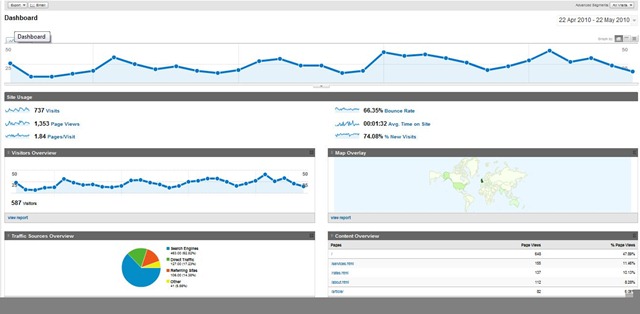
Whether you’re a copywriter, web designer, SEO guru or business owner, understanding how to use Google Analytics effectively will help you achieve more traffic and conversions.
You can keep an eye on where your traffic is coming from, which keywords are people using to find you, how long they are staying on your site, which pages get the most traffic, which referral sites bring in the most click throughs?
But, when you log in and are faced with the dashboard:
Do you really understand what it all means or how to get the best our of the data?
Probably not, which is why I was pleased to come across a recent blog post on seomoz.org
This post gives you 5 simple tips for Google Analytics that you should be using to get the most out of it. So, grab a coffee, sit back and have a read – it will change the way you use Google Analytics forever.