June 4th, 2012 — internet marketing, social media, social media marketing
Social media is gradually taking over our lives – at least that’s how it feels.
With over a quarter of all adults and nearly half of all teens now owning a smart phone (Ofcom, 2011) connecting to the internet on the move has never been so easy. In fact, it is now so easy it is beginning to affect the way we shop.
Social media has opened up access to retailers like nothing else before it. Now, it’s easy to send a tweet or comment on a Facebook page. Our complaints, compliments and questions can be fired at them with ease.
So how is that affecting our shopping habits?
Well, according to recent research by Reevoo, consumers said that social content is now beginning to shape their online shopping behaviour. Over half of all consumers found social media comments helpful when shopping online, with user reviews (48%) and friend recommendations (52%) being the biggest influencers.
The vast majority (88%) said they always consulted reviews before proceeding to the checkout, with 60% adding they were more likely to purchase from a site that carried such reviews.
Ignore social media at your peril
With online social interaction carrying that much clout, it’s imperative that businesses today engage in social media.
And that really does mean ‘engage’.
Merely having the accounts is not enough. You must also monitor them, respond to comments and questions, and be proactive by offering advice. And that means having a strategy.
More often than not, your customers’ first point of interaction with you will be through a social media channel. That means you must be alert to their tweets and Facebook comments and ensure your staff have a firm understand of what your policy is regarding complaints and compliments.
Taking in the bigger picture
You may think that your social media interaction with customers and their product reviews are separate entities.
To a certain extent they are, but your interaction as a company with your customers is bound to have an effect on the review they leave for others. Frequently, you see such comments not only talking about the qualities of the product in question, but also about the service levels received from your company.
Reviews are therefore seen as an endorsement (or not) of your company as a whole.
Therefore it is essential that you have a social media strategy in place, provide the best possible service at all times and respond to your comments in a timely manner.
June 1st, 2012 — copywriting tips, email marketing, Essential tools for small businesses, marketing, newsletter
Email marketing and newsletter marketing are great.
They allow you to quickly contact thousands of customers in one go.
But the speed can sometimes be the downfall of many marketers, because once they’ve hit send, their message is out there – mistakes and all.
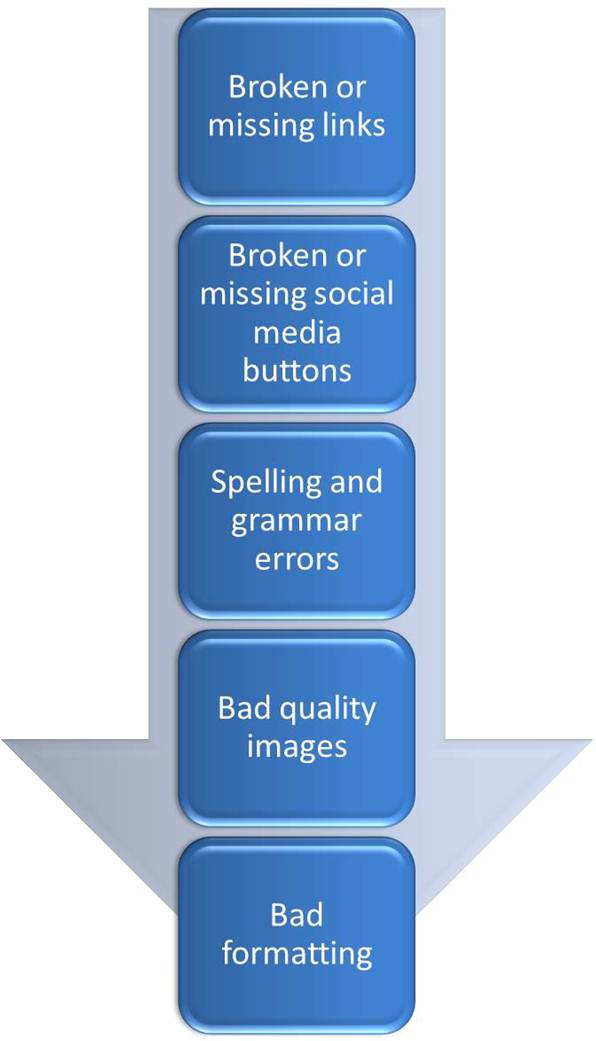
But that’s just the tip of the ice berg.
More seriously, they could easily fall foul of the CAN-SPAM Act, which provides the rules and regulations that have to be abided by for those undertaking commercial emailing and provides recipients of emails the right to make you stop sending them.
When undertaking email marketing, all your messages have to comply with the Act:
- You must not use misleading, deceptive or false information in your “To”, “From”, “Reply to”, subject line etc. You must specify whether the email is from a company or individual and the subject line must reflect the content of the email.
- Your physical postal address must be supplied on all emails.
- You must include an opt-out link and deal with every request promptly.
- Use a legitimate email service provider.
Always check before hitting send
We are all human so, occasionally, things go wrong.
But continuously sending out emails and newsletters that contain numerous errors is just sloppy.
Don’t forget that your company’s reputation is built on your correspondence with your customers, whether through emails, newsletters, web content, brochures etc. Therefore, it is essential you make sure you have thorough checking procedures in place.
Should the worse happen and something slips through the net, apologise and make it up to your customers. Never act in haste, because that could compound the problem.
Email marketing is a highly valuable tool for any business. But it’s essential it’s done well. Make sure your emails comply with the regulations set out in the CAN-SPAM Act and their content is thoroughly checked before hitting send.
May 30th, 2012 — copywriting tips, website copywriter, website copywriting
Normally, I write about how to create a strong website, but for the purposes of this post I want to concentrate on the 6 elements that signify your website isn’t working for you.
For many people, internet marketing means having a website and that’s it.
But just because you have a website doesn’t mean you’ve got it made.
Even though it’s often a long and tortuous route to getting your website published, once it’s pushed live that’s when the hard work really starts.
So how can you tell if your website is useless?
6 characteristics of a duff website
1. Where’s the traffic?
If you’ve just launched your website and wondering where your traffic is, I have some bad news for you. Just because you publish a website doesn’t mean people will come flocking to your door. You actually have to do some work to help them find you.
Blogging, article marketing and social media will all help get your name out there and your website found. As will number 2…
2. Search Engine Optimisation
If your website and its content aren’t optimised, you won’t get found.
Make sure your web designer fully understands SEO and then start reading about it yourself. If you don’t have time to constantly monitor and tweak your website’s performance, invest in someone who can.
Being found in the organic search results is important.
3. Call to action
A website without any calls to action is like a sieve without holes.
If you want your readers to call you, email you or complete an enquiry form, tell them.
You might think they are intelligent enough to work out what you want them to do, but I can assure you, if you don’t spell it out to them they’ll merely wander off to another website.
4. You, you, you
Is your website content all about you?
Is it full of ‘we’, telling your reader all about your company, its achievements and staff etc.?
Well, guess what? They don’t care about you; all they care about is what you’re going to do for them. So make sure your content is written in the second person, concentrates on the benefits they will get and is totally focused on them.
5. Analytics
The last thing on my list is analytics.
Without those, you have no idea how your website is performing or where your traffic is coming from.
But, one word of warning, the new EU Cookie Regulations come in to force later this month (May 2012), so you must ensure your website complies by asking users for their consent to use cookies.
6. Being social
Love it or hate it, social media is here to stay.
Make your website social by adding links to your Twitter and Facebook accounts (you do have those, don’t you?).
Engage with your followers, chat with them and offer advice to help make a name for yourself as an expert in your field.
Over to you
Do any of those apply to you?
If so, your website may not be performing as well as it should.
May 28th, 2012 — copywriting tips, email copywriting, email marketing, Essential tools for small businesses, marketing, newsletter
Email marketing and newsletters are the most cost effective methods to reach thousands of people quickly.
Using your own home grown marketing list, it enables you to get great information and offers out to your targeted market.
But how can you be sure you’re making the most of this marketing opportunity?
Well, as you would expect, the content of your emails is crucial to your strategies success.
Here are 5 tips to make sure you get the most from each of your emails.
1. Length
No one wants War and Peace landing in their inbox.
Everyone is time-limited these days, so you must ensure that what you send is short, concise and to the point.
On average, about 400 – 600 words is plenty, any more than that and people will start to switch off.
2. Relevant
It’s important to tie the content in with what’s happening at the current time. Make sure you give spring offers in the spring etc. With the Jubilee on its way, create a newsletter around that. If you have a local event happening, try to incorporate that to boost resonance with your readers.
3. Get to the point
No one wants to read paragraph upon paragraph of waffle.
Make your point in the first paragraph so your reader knows the aim if of your newsletter. Also, make sure you include other sub headings so people can see at a glance what your newsletter covers. That way they can pick out the information they need without having to wade through everything.
4. Links
Introducing links to your text is a great way to a) shorten your emails/newsletters and b) drive more traffic to your website.
These are especially useful if you want to add a lengthy article to your newsletter. You can add an intriguing snippet and then link out to the rest of the article so the reader can click through to it at their convenience.
5. Be human
There’s nothing worse than receiving a boring, corporate newsletter. If you send out something like that, you’ll bore your readers rigid.
Inject some personality and be human. Write it in the second person and be chatty. You’ll find people are more likely to read something that’s friendly that something overly corporate.
If you’re still uncertain about how to structure your emails and what content to add, take a look at the emails you subscribe to and that you read.
What makes them stand out?
Why do you read them?
If you can capture the essence of those that make you stop and read them you’re half way there.
May 25th, 2012 — briefing a copywriter, copywriter, Copywriting briefs, copywriting tips
Any parent will know how annoying the word ‘why’ can be.
But, for a copywriter, it is one of the most valuable words in the English language.
Why?
As a copywriter, you are:
- A master sales person
- A wordsmith
- A persuasive orator
- A great writer
However, you are not an expert in every industry sector in the known universe.
It is important that is made clear to your clients from the outset.
I often hear people ask why they need a copywriter when they don’t know anything about their business. Well, that’s exactly the reason why they do need a copywriter.
Let me explain.
In the client/copywriter relationship, the client is the expert in their industry, but the copywriter is the expert in selling their clients products and services to their marketplace.
So long as neither party crosses those lines, the relationship will be harmonious.
Why?
When taking a brief from a client, the one word that should constantly be used is ‘why’.
Don’t be afraid to keep asking, especially if you’re dealing with a complex product or service.
The client will know their business like the back of their hand and therefore will have the tendency to talk in jargon only understood by their colleagues.
Your job as a copywriter is to break through that jargon to understand the product or service in layman’s terms. After all, if you don’t fully understand it, how are you going to be able to write about it and make your readers understand?
So keep asking:
- Why?
- What does that mean?
- How does that work?
- Why is that of benefit?…
Far from annoying your client, it will demonstrate your interest in their business and your determination to produce powerful and persuasive copy that will grab the attention of potential new customers.
At the end of the day, you can’t write about something you don’t fully understand, so keep asking ‘why’ until you get to the real nitty-gritty.