January 26th, 2011 — copywriting tips, email copywriting, email marketing, freelance copywriter, marketing

A new year is a time for resolutions, a lot of which probably only last a few days at most before they are broken.
But just because 2010 is over you shouldn’t just forget about it. Now is a great time to reflect on what happened last year, discover what worked for you and what didn’t. Once you have the answer to those questions you can begin to plan your email marketing strategy for 2011.
Email marketing for 2011
To help you make sure you enjoy successful email marketing campaigns this year I have listed below a few suggestions that might make all the difference.
Now’s the time to try something new to help you enhance your results from last year. So without further ado, here are my suggestions:
1. Remember mobile
One thing many companies forget is how their emails are being read.
More and more people will first become aware of your email on their mobile phone.
How do you decide whether to open and email or not? You probably look at who sent it to you first, followed by the subject line—if it looks interesting you’ll open it. If it doesn’t catch your attention it’ll probably remain unread.
Boost your email’s chances of being read by adding text above your header:
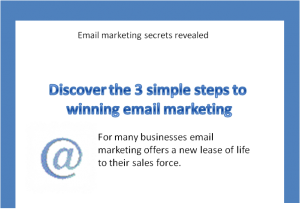
Therefore when the email appear on their phone they will see who it’s from, the subject line and the text ‘Email marketing secrets revealed’.
2. Hook line and sinker
The subject line of your email will ultimately determine whether it is opened or not.
It has to be intriguing, promise something new/important or offer them something that’s going to make their lives easier or help their business.
But once you have them hooked it is just as important to make sure the body of your email provides them with the answers.
Using a strong subject line but then talking about something different in the email will dissolve any confidence they had in you.
Make sure that what your subject line promises, your email delivers.
3. Drop off zone
How long should your email be before your reader dozes off?
An email that goes on and on and on will bore the pants of your recipients so if you have a lot of information you want to get across, add a teaser in the email and then link out to the full article so if they want to learn more, they can.
Everyone is busy and if you constantly send out mind-numbingly long emails you’re going to get a lot of unsubscribers.
4. Call to action
You call to action is vital because it asks your reader to take an action—call you, email you or buy now, book here…
Frequently they are seen as hyperlinked text inviting the reader to click it. But how about using a button instead? It stands out more and there’s something compelling about seeing a button – you just have to press it.
5. Proofread
A simple thing but something that’s not done often enough.
There’s nothing worse than sending out your email only to then discover a prominent typo.
Make sure you speak to your public and not the pubic, offer to nurture your clients but don’t neuter them.
An email full of typos will do untold damage to your reputation, so read it carefully before hitting send.
These 5 simple suggestions could help your 2011 email marketing campaign go with a bang. Try them out and see how you get on.
These tips are brought to you by Sally Ormond, freelance copywriter, blogger and social media fanatic.
January 24th, 2011 — copywriter, copywriting tips, internet marketing, marketing, online marketing

I have often written about the importance of internet marketing.
Today, if you want to find new customers, expand your business or grow your reputation, the internet is the place to be.
By utilising the power of online copywriting, blogs, article marketing and social media, you can drastically improve your company’s exposure within the marketplace.
Still not convinced?
Well the lovely people over at Pingdom have generated a list of mind-blowing internet numbers for 2010.
Below are just a few of the stats, for a more detailed analysis take a look at their site.
Email
- 107 trillion – The number of emails sent on the Internet in 2010.
- 294 billion – Average number of email messages per day.
- 1.88 billion – The number of email users worldwide.
- 480 million – New email users since the year before.
- 89.1% – The share of emails that were spam.
- 262 billion – The number of spam emails per day (assuming 89% are spam).
- 2.9 billion – The number of email accounts worldwide.
- 25% – Share of email accounts that are corporate.
Websites
- 255 million – The number of websites as of December 2010.
- 21.4 million – Added websites in 2010.
Internet users
- 1.97 billion – Internet users worldwide (June 2010).
- 14% – Increase in Internet users since the previous year.
- 825.1 million – Internet users in Asia.
- 475.1 million – Internet users in Europe.
- 266.2 million – Internet users in North America.
- 204.7 million – Internet users in Latin America / Caribbean.
- 110.9 million – Internet users in Africa.
- 63.2 million – Internet users in the Middle East.
- 21.3 million – Internet users in Oceania / Australia.
Social media
- 152 million – The number of blogs on the Internet (as tracked by BlogPulse).
- 25 billion – Number of sent tweets on Twitter in 2010
- 100 million – New accounts added on Twitter in 2010
- 175 million – People on Twitter as of September 2010
- 7.7 million – People following @ladygaga (Lady Gaga, Twitter’s most followed user).
- 600 million – People on Facebook at the end of 2010.
- 250 million – New people on Facebook in 2010.
- 30 billion – Pieces of content (links, notes, photos, etc.) shared on Facebook per month.
- 70% – Share of Facebook’s user base located outside the United States.
- 20 million – The number of Facebook apps installed each day.
Videos
- 2 billion – The number of videos watched per day on YouTube.
- 35 – Hours of video uploaded to YouTube every minute.
- 186 – The number of online videos the average Internet user watches in a month (USA).
- 84% – Share of Internet users that view videos online (USA).
- 14% – Share of Internet users that have uploaded videos online (USA).
- 2+ billion – The number of videos watched per month on Facebook.
- 20 million – Videos uploaded to Facebook per month.
Still think there’s no need to get your company online?
January 21st, 2011 — conversion, copywriter, internet marketing, marketing

You are taking your online marketing seriously.
You’ve invested in a great website, you’ve hired a professional copywriter to create some fabulous copy and your search engine optimisation strategy is ensuring you have a steady stream of traffic to your site.
Once people have landed on your website, they love what you have to say and click to your contact page to get in touch.
Then what happens?
If you’ve managed to achieve a website that delivers customers to you, you must ensure your customer service doesn’t let you down.
1. Email
As a customer there is nothing more frustrating than someone not responding to your emails.
If you receive an email from a potential client but can’t answer their question immediately, send a holding email to acknowledge their enquiry and tell them when you’ll have an answer for them—and make sure you fulfil that promise.
Try to reply within 24 hours or sooner if possible. Remember this is probably the first interaction they’ll have with you so it’s vital you make a good impression.
2. Ring ring
Answer your telephone!
When a potential client phones, if you don’t answer they’ll hang up and phone someone else.
If you have an automated system try and make sure they reach a real person quickly. There is nothing more maddening that having to go through umpteen menus before you get to speak to a human.
3. Live chat
The option of live chat on your website is a great idea. It gives someone the ability to immediately speak with you while they are on your website. There’s no need to hunt around for a telephone number or email address—with just one click they can contact you and ask their question.
This transparency and ease of contact will show you as a company that puts their customers first.
4. Knowledge is key
When your prospective customer makes contact (either via live chat, phone or email), make sure the staff that deal with their enquiry are knowledgeable.
If their enquiry is dealt with quickly and efficiently you are going to impress. But if your staff member is uncertain about your products/services or inefficient it won’t put your company in a very good light.
5. When things go wrong
If one thing in life is certain it’s that things will go pear-shaped from time to time.
Despite your best efforts something is going to go wrong, but it’s how you deal with that that matters.
Be grown up about it – apologise, put it right and follow up to make sure the customer is happy with the outcome.
A mistake won’t lose you a customer, how you deal with that mistake could.
Whatever business you are in, customer service is vital. It doesn’t matter how cheap or how wonderful your product is, if the service is bad people will walk away.
January 19th, 2011 — freelance copywriter, marketing, social media, social media marketing, social networking, twitter

Once you get to grips with Twitter, it seems to be the easiest thing in the world to use.
All you have to do is squeeze your message into 140 characters and away you go.
You can tweet to thousands of people instantly which is why you need to make sure you are not making the 5 classic Twitter bloopers.
Social media has transformed the art of communication. Now customers have a very loud voice so you must make sure you convey yourself with dignity at all times—because if you don’t, that’s when you can get into trouble.
5 Classic Twitter Bloopers
1. You talking to me?
There is one thing you must accept—not everyone is going to like your company.
Twitter is a powerful outlet through which dissatisfied customers can rant. But don’t get drawn into an online slanging-match.
Arguing the toss through Twitter may be entertaining to some, but it will do untold damage to your reputation.
Your other followers will watch to see how you deal with the situation (and that will tell them a lot about the type of company you are).
Diffuse the situation quickly, resolve their issue and apologise.
2. Autofollow
Some people on Twitter are obsessed about amassing huge numbers of followers.
Why?
For example if you 40,000 followers and yet only follow 600 people, unless you are a huge brand name or a celebrity, you’re going to look like a spammer.
My advice is to follow only those people you want to follow. Don’t use the autofollow feature. By all means when you get an email telling you someone new is following you take a look at their profile. If they look interesting and tweet great stuff, follow them. But if they don’t, don’t follow—it’s as simple as that.
Also the more people you follow the harder it gets to keep up with what’s happening. That’s when it’s a good idea to create Twitter lists – you can set one up for best friends, business contacts, celebrities etc., to help you keep track of what’s going on.
3. Tweet carefully
There are plenty of users out there who only tweet about their business, constantly linking back to their website.
If you just do that, you’ll be viewed as a spammer.
Twitter is all about conversations and sharing. If you read a great article, see a funny video or hear something in the news that’s interesting, share it with your followers. Be seen as someone who adds value to the Twitterverse.
4. Have a personality
Many corporate tweeters make this particular blooper.
If your tweets are boring, mundane and lifeless, people aren’t going to follow you.
Twitter is something you can have fun with—use it to show your company has personality. When engaging with other tweeters it’s important to make sure you show your human side. It will make you appear more approachable, a company that cares and that is prepared to listen.
5. Listen
Using Twitter isn’t all about what you can cram into 140 characters. You also have to listen to what people are saying.
Monitor it and track any mentions of your company. If someone has experienced a problem engage with them, find out what went wrong, apologise and sort it out.
If you’re on Twitter and you don’t do this, people will see you as a company that doesn’t care—and news like that will spread fast.
Twitter is a great tool for your business. It will help you engage with your customers, attract new ones and solve problems should they arise.
Just make sure you use it wisely.
This post is brought to you by Sally Ormond, freelance copywriter and social media queen.
January 17th, 2011 — blogging for business, copywriter, copywriting tips, facebook, internet marketing, Internet marketing services, marketing, online marketing, social media marketing

The one great thing about internet marketing is that it offers numerous channels through which you can interact with customers and prospective customers.
Never before have you, your brand and your company been so exposed which is why how you present yourself online is so important.
The advent of social media means there are more ways to communicate than ever before. Once upon a time if someone wanted to speak to you, they had to pick up the phone. But now they can send a tweet, post on Facebook, comment on your blog or use one of the many internet forums.
There are many ways you can enhance your online reputation, but here are three simple steps you can take to make sure your company is always seen in a good light.
1. Thank you
‘Thank you’ simple but powerful. When someone retweets you, comments on your blog or sends a new referral your way, make sure you thank them. It doesn’t take a lot of effort and will show you as someone genuine; someone they’d want to do business with.
It also pays to keep an eye on the web in general to see what people are saying about you. I use socialmention.com to keep track of what people are saying about me or my business. The alerts are simple to set up and can offer a great insight into how you are perceived as a brand online.
Again, should you receive any positive feedback or mentions, remember to make contact and say thank you.
2. Blog
Running a blog is a great way to add value to your business relationships. Through your posts you can provide information and tips to make your customers’ lives easier.
But however well written your blogs are if they are not covering topics people want to read about they will be ignored. For example if you are a holiday company don’t write about your special offers, instead write about the countries you go to, their cultures, their sights, their people – something that will inspire your reader to take a trip there to experience it for themselves.
As a freelance copywriter I use this blog to talk not only about copywriting but also about general marketing issues, social media, email marketing etc.; all topics that business owners find useful.
3. Benefits
Whenever writing about your products you must write about their benefits to your customers, but never lose sight of the fact that most people will buy from you because of who you are.
From my own experience, I will only buy from someone if I like them as a person. Why should I give someone my hard earned cash if they come across as arrogant or disinterested?
People will always buy from people so make sure you use your online marketing to connect with them. If your message resonates with them they are more likely to trust you; and with trust comes cash.
When wrapped up in marketing your business it can be easy to lose sight of what really matters – your customers. You’re so busy trying to come up with new blog ideas you forget that your customers still want that personal touch. Just because they can’t see you or shake your hand doesn’t mean they want to deal with a faceless company.
Go that step further and show your human side online.