July 1st, 2011 — briefing a copywriter, brochure copy, brochure copywriting
 Doesn’t it look great?
It took months to put it together but there it is in all its glory. Your new, shiny, gorgeous corporate brochure is ready to be distributed.
Are you pleased with it?
Hmm…if you’re that pleased there may be a problem – let me tell you why.
Giving in to temptation
Everyone does it now and then but temptation has its place and there is no room for it in your brochure.
Often, when you start to think about the content for your corporate brochure you:
- Talk about you
- You give your opinions on you
- You talk about what you want to achieve
Boring.
Don’t get me wrong. What you do is incredibly valuable but people (i.e. Joe Public) aren’t interested in what you think about your self, they are interested in themselves.
Doing it right
With the economy being what it is at the moment, the fact that you’re investing in a glossy, expensive corporate brochure tells the market (and all your competitors) that you’re doing well; you have a motivated and engaged team who are working their butts off to make you look great.
Fantastic – by why do all of this?
Well, a good brochure will help you:
- Gain investor confidence
- Attract new clients
- Show existing clients what you can do for them
- Impress the great and the good
But the problem is that there aren’t that many companies out there who do it right.
There’s no escaping the fact that you need a large team to pull off a cracking end result – designers, photographers, a great brochure copywriter. These guys are all experienced in what they do and can easily collaborate to achieve the ultimate end result.
However the main problem lies within your company. Although one person is assigned the headache of pulling the expert team together, the review stage is usually done by many people (CEOs, Directors etc.) which means there are too many opinions flying around the room.
Your brochure should not contain any corporate speak – in fact your expert copywriter would have gone to great pains to ensure the language is simple, accessible to all, clear and powerful which is not an easy thing to pull off. And yet by the time the copy has gone round everyone it’s mutated into an overly intellectual hotchpotch of meaningless drivel.
The design has been mauled mutating the understated, tasteful design into something way too ostentatious. And the wonderful photography of your staff and company has been replaced by dodgy stock images.
Why?
If you call in a group of experts to create your corporate brochure let them get on with it – they know what they are doing.
The perfect formula
Your corporate brochure has to be something people will want to pick up and read. If they don’t it becomes an extremely expensive coaster.
Use it wisely and make sure yours includes:
- A personal letter written by your Chairman or CEO
- Photos of your staff (be proud of them and show them off)
- Testimonials from customers
- Engaging case studies to show how you have helped clients overcome typical challenges
- A profile of your organisation
- Benefits driven copy to show how you can help your customers
- High level product descriptions and images
- Full and correct contact details
To make sure yours is done right make sure you start the process of with a plan. Decide amongst yourselves what you want to achieve, how you want it to look and how you want it to sound.
Then provide your expert team with a detailed brief for each element – design, photography and copywriting.
After that, sit back and let them get on with it.
Setting out your vision at the outset will ensure your get the result you were looking for.
Time to have your say
I’ve spouted on long enough, now I want to hear from you.
What, in your opinion, makes a good brochure?
June 29th, 2011 — copywriting tips, email copywriting, email marketing
 If your marketing strategy involves email marketing, you would most certainly have experienced some degree of churn.
In a nut shell, churn relates to the number of subscribers lost over a period of time. These would be people who have unsubscribed from your list, emails that have bounced back or spam complaints.
It’s a fact of life and every business will have a churn rate, so you’re not alone.
Although you are unlikely to be able to prevent churn completely, there are steps you can take to reduce it.
1. Honesty is the best policy
Email marketing is all about building relationships. And the strongest relationships are built out of honesty and trust.
So, when you encourage someone to sign up make sure you tell them precisely what they’ll get (nature and frequency of the emails) and stick to it.
If your business offers more than one type of email (especially if you provide products/services to multiple market sectors) a great idea is to set up a preference centre so your subscribers can specify what information they want to receive from you.
Oh, and make sure you tell them about your privacy policy and how you will never pass on their email address to a third party.
2. Easy
Make the whole process easy for them. A simple opt-in and opt-out process is ideal. Although you don’t want to lose them from your list, it’s better to make it easy for them and retain them as a potential future customer than make them jump through hoops and annoy them.
3. Learn
You must remember that you and your employees are only human therefore mistakes will happen. When something goes wrong, or a subscriber simply gets bored of your communications send out a polite, brief email asking them for their opinion on your email marketing. If they respond it could shed some light on why they decided to unsubscribe (e.g. too many, too few, no longer relevant etc.) from your list.
4. Re-engage
This one is for all those inactive subscribers. They are the ones who perhaps immediately delete your email when it arrives or never click on any of the links etc.
Try to temp them back by creating a superb, not to be missed offer.
As you can see, if you engage in email marketing you will experience churn but there are a number of ways you can reduce its effect on your list.
What have your experiences been?
Do you have a high churn rate?
How do you re-engage people?
Please share your experiences by leaving a comment below.
June 27th, 2011 — copywriting tips, marketing, social media, social media marketing, social media training, social networking, twitter
Gemma Thompson is a communicator and endlessly curious. Use of Facebook & Twitter led to excellent brand awareness for her start-up business a few years ago. In less than a year she had a substantial ROI – £4,083 of business for £950 hours spend, and was being asked to teach others how she was doing it! She is now a full time social media consultant.
The author’s views are entirely her own and may not reflect the views of FreelanceCopywritersBlog.com. If you are interested in producing a Guest Post for this blog, please get in touch with your ideas.
 I hear so often that people are too busy to add social media into their business lives, and in fact I’ve felt the same way sometimes!
But social media is so much more than the sum of it’s parts, sure it’s great as a resource and fantastic as part of your marketing mix, but where social media really comes into it’s own is when it is recognised as being a channel for communication and used as such.
Danger Ahead!
The danger of being ‘too busy to tweet’ is that what that really means is that you are too busy to talk (and listen!) to your customers!
The times are not changing, they have changed. So many people use social media to interact with the business’s they buy from and they want to know that you value their custom. The easiest way to do this is to talk to them, listen to them, value their conversation and even enjoy it! Scandalous I know but then in my view business really should be fun!
But I do understand the demands on time, particularly if you are a small business or sole trader, of course you can’t put off doing the work your customers are paying you to do!
Phew – A Safe Passage!
However once your selected social media channels are set up and you know what your strategy is, social media doesn’t have to steal away every minute of your day. In fact I regularly recommend to my clients that they check in just three times a day, first thing in the morning, just before or after lunch and just before the end of the day. This pattern was strongly recommended to me when email became something that threatened to overwhelm the world and I find it holds true for social media too.
There are also many tools on the Market now that can help you fit it into your day efficiently, spending time with a social media strategist can help you define which of these will be right for you.
If you really can’t squeeze 30 minutes a day of social media use into your day then I’m afraid it is time to ask yourself what you are doing that could be changed, is it time to take on an accountant instead of slogging through your receipts yourself? Maybe hiring a virtual assistant to help with your filing or outsourcing your copywriting will help? It may be that you need to employ an additional staff member.
Whatever you need to do, do it. It’s vital you take the time to talk with your customers through social media, and it is most time efficient and effective when it is you that does it. Yes I offer social media management as part of my services, but it’s not what I recommend in the majority of cases. Nobody knows your business like you do, and nobody can change things as quickly as you when your customer base is telling you they need something else. So make that time, 30 minutes a day to communicate with your customers, because they’re worth it!
June 24th, 2011 — facebook, marketing, social media, social media marketing
 More and more businesses are arriving on Facebook everyday.
They set up their page and sit back and wait for hoards of people to drop by and ‘Like’ them. As they watch their numbers increase (hopefully) they start to feel pretty pleased with themselves.
But there’s a problem. All the ‘Likes’ are from employees, friends and family. What happens when those sources run dry? Where do you get your new ‘Likers’ from?
Facebook marketing – ‘Likes’ aren’t enough
Although the ‘Like’ button is there for people to show they use/enjoy your brand (and it probably makes you feel all warm and fuzzy), its buying customers you want to attract.
Having a Facebook business page takes a bit of effort – just like all your other marketing streams. If you want people to ‘Like’ you, hang around and bring along their friends, you’re going to have to do some work.
1. Newsy
Just like your newsletters and marketing materials, the content on your Facebook page has to be kept up dated.
So whenever you publish a new blog, have an event to promote or a new product/service to shout about, post it on your Facebook page.
Your fans want to be the first to know what’s happening so don’t disappoint them.
2. Be real
Even though your Facebook page is for your company, your fans want to engage with a real person. Don’t hide behind your brand. Stand up and voice your opinion and speak on behalf of your brand.
3. Talk don’t shout
The wall of your Facebook page isn’t just there for you to shout from. You want to encourage two way conversations with your customers so make sure you listen to them and reply to their comments (good and bad).
4. Chat
Closely aligned to number 3, encourage your fans to contribute to your page. Ask for their opinions, stories – even run competitions to boost engagement.
You want to cultivate a sense of community so make them feel welcome, listen to what they have to say and talk to them.
5. Tell them what to do
As I mentioned earlier, ‘Likes’ are all well and good but you’ll also want to encourage your fans to buy from you. Therefore it’s vital to have a call to action on your Facebook page.
You could ask them to sign up to your newsletter or for a report. Perhaps you could write a short piece about one of your products/services and insert a link to take them to the relevant page on your website.
Whatever you do, make sure you interact with them, build trust and then help them spend money with you.
6. Have a plan
It’s very easy to think you must get a Facebook page (because everyone else has got one) and just dive in without thinking.
That’s a recipe for disaster. Before you begin make sure you have a plan in place. Understand how you’re going to use the page, how and when you’ll update it and draw up a policy on how to interact with your fans.
Facebook is a great way to interact and build trust. You can use it as a forum to provide information or even as a customer service tool to help your customers get in touch with you.
But before you start make sure you have a plan so you understand what you’re doing and why.
Do you use Facebook in your business? If so why not leave a comment and tell us how you’re using it and your experiences.
June 22nd, 2011 — copywriting tips, online marketing, Page titles, search engine optimisation, seo, Title tags
When it comes to SEO, your page title is everything.
It is probably the most important search engine optimisation factor as it exists to help the search engine understand what your page is all about. And if it understands that, you’ll appear in the right search engine results pages.
But many people confuse their page title and their post title.
Your post title is exactly that, the name you have given to your blog post. Your page title is usually auto generated and therefore tends to be the same as your post title.
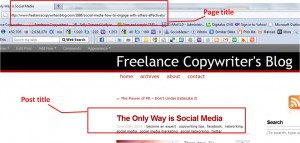
But the key to optimising your SEO is to make these different. Many platforms, such as Word Press, allow you to easily alter your page title to something that will carry more SEO weight.
What does that mean?
Well, to make sure your post comes up in relevant search engine results make sure you include your keywords in the first half of your page title. You will only have 65 characters to play with so make sure you make every one count by creating a page title that is meaningful.
This is something that should be done for any website, not just a blog.
But select your keywords carefully – don’t cram them all into your page title because that won’t make sense. Use the word(s) that’s most relevant to that page and then create something that answers the searchers question.
So, for example, if they were searching for a site to help with dog behavioural problems, a site with a title such as “Dog Behavioural Problems – Advice and training videos” will show that that website probably has the answer they are looking for.
Another common mistake is to repeat the page title in the META Description. Remember your page title is for SEO; your META Description is there to attract the click-through. It should convince the searcher that your site is the one that will help them so make sure it is meaningful.
Getting your page titles (or title tags) right is vital for a successful SEO campaign. After all, if you don’t clearly tell the search engines what your website is about, how can it list you in the appropriate search results?
Open a new page in your browser and open your website or blog. What is your page title? Is it really working as hard as it can?
This simple change really can make a huge different in your website’s effectiveness.
Author: Sally Ormond, professional freelance copywriter with Briar Copywriting.