Entries Tagged 'social media' ↓
September 7th, 2011 — facebook, social media, social media marketing
 Most businesses today have embraced social media.
It makes sense because that’s where their customers hang out, so if they want to engage with them, they’ve got to join the club.
One aspect of social media, Facebook, has become phenomenon.
- It has over 750 million active users worldwide
- There are 900 million pages, groups, events and community pages that people can interact with
- Over 30 billion pieces of content are shared every month
(Statistics from Facebook.)
So it’s little wonder that so many businesses now have a page on Facebook. But the question remains, how do you direct your fans back to your website?
Your Facebook page is great for SEO and to interact with your customers/fans, but you will also want these people to use your main brand website too.
How to drive Facebook fans to your website
Many businesses are too concerned with building their number of Facebook fans and don’t give any thought as to how they are going to get those fans to interact with them through their website.
After all, it’s through your main website that you will sell to them, so you have to devise some tactics to encourage them to visit your site.
Ben Pickering wrote a great post recently on socialmediaexaminer.com that looks at this issue. In 5 Tips for Driving Facebook Fans Back to Your Website, Ben looks at the following methods:
- Use of tabs
- Sharing blog posts and articles
- Using teaser content
- Running contests on your brand website
- Special offers on your brand website
As you read about these in more detail, you will see that each not only adds to the value of your Facebook page, they also actively encourage your fans to visit your main website through various calls to action.
This ‘two way street’ of information adds to the users’ experience and so continues to add value to your relationship with them.
Integrating this approach into your social media activities will also strengthen your SEO strategy so everyone wins.
Over to you
Are you already using some of Ben’s techniques? Do you have your own method of driving fans back to your main site?
Leave a comment below and share the techniques you use to link your Facebook fans to your website.
Sally Ormond – freelance copywriter, Tweeter, blogger and Facebook fan
August 22nd, 2011 — Google analytics, social media, social media marketing, social networking
For years you’ve benefited from Google’s analytics to track the activity on your website.
It’s been a God send for internet marketers giving an invaluable insight into where your traffic comes from, which keyword brings in the most, what pages they visit, how long they stay etc.
This handy little tool has helped thousands of people improve the SEO and user experience of their websites.

From your dashboard you can discover all sorts of handy statistics which can be used to continually enhance your website’s performance and so boost your ROI.
That’s great for measuring and assessing web traffic, but what about your social activities?
Getting more social
As more and more businesses are utilising social media to market their business and communicate with their customers, wouldn’t it be great if there was a way of tracking this activity like you can the traffic to your website?
Well those clever people at Google have found a way.
Recently Google has become more social. It has introduced Google + and the Google +1 button and now offers Google Analytics Social Interaction Tracking.
With this new addition to the Google family you can track the social interactions on your website, blog or your Facebook fan page.
To learn more about how to set this up, take a look at this SocialMediaExaminer post – How to Track Tweets, Facebook Likes and More with Google Analytics. It provides a step by step guide on how to set up your analytics.
This process does involve playing with HTML in your web pages files so if you’re not overly comfortable with code tweaking you may want to seek some help.
Over to you
Do you already use social media tracking? If so how useful do you find it?
Perhaps, after reading this, you’re going to give it a go. If you do, bookmark this post and come back, leave a comment and let us know how you got on.
August 12th, 2011 — marketing, networking, PR, Press releases, social media
 What do you think of when you think PR?
- Air kissing
- Extremely expensive magazine/newspaper columns
- Glossy magazine adverts…
Believe it or not, PR doesn’t have to break the bank. In fact sometimes it won’t even touch it.
Being in the know
A lot of your PR can cost you virtually nothing. All you need it a bit of time to get to know people and build a few relationships.
Let’s look at press first. There’s bound to be an industry magazine you can contact or perhaps your networking group has a magazine or e-newsletter. Either way they are a great source of free PR.
Get in touch with the editor and find out what they’re looking for. If you have a great story (and we all love real life stories), pick up the phone and have a chat with them – tell them what you have to say. If they like it, write it down and send it in. But make sure it’s ready to go (without any typos etc) because if they can just cut, paste and print they are more likely to use it.
Being seen
Getting in front of people is another great way to boost your exposure.
Whether it’s having a stand at an exhibition (yes that will have a cost attached to it), giving a talk at an event (that won’t), chairing a committee or attending events, you will gain great exposure and meet interesting and potentially useful people.
In other words, get out there and network.
Being bold online
You don’t have to be seen in the flesh to gain great PR.
Social networking is everywhere – Twitter, Facebook, Google+, not to mention all the online forums.
Get out there, start interacting and offering advice.
Of course you can also blog. Having a blog that concentrates on your expertise (I’m a copywriter and marketer so that’s what this blog is all about) enables you to write posts that help people and that will position yourself as an expert in your field.
Be yourself
Everything you do (within reason) can be used to further your PR.
If you do daft things for charity, publicise it.
If you’re launching a new look website, tell people
If you’ve moved premises, shout about it.
If you’re taking on new staff, tell the world.
Basically anything you do that is newsworthy can be turned into a press release.
So you see, PR doesn’t have to cost the earth. Virtually everything you do has an element of PR in it, you just have to learn how to leverage it.
What do you do to help your PR? Leave a comment below and share your best piece of free PR or any other PR tips you find that work for you.
August 8th, 2011 — social media, social media marketing, social media training, social networking, twitter
 The biggest mistake most people make with social media is that they treat it like an advertisement channel.
Once they have their accounts up and running they are like a mini marketing machine. Tweets and posts fly around with their latest offers or details of what they do.
But there are a few problems with that:
- People will get very bored of you very quickly
- You will be unfollowed left, right and centre
- You’re not adding value
Basically, you’ve missed the point of social media altogether.
Engagement is the name of the game – listening to others, asking questions and joining in the conversation.
Making the most of social engagement
There are a few easy ways you can make the most of your social media engagement that will help you enhance your relationships with your followers. As with most things in life, you only get out what you put in – so if you sit back and wait for others to come to you, you could be waiting an awfully long time.
1. Targeting your geographical area
You can enhance your local networking by searching for people in your own geographical area by using www.search.twitter.com . The advance search facility will also allow you to search for people tweeting about topics you’re interested in, hash tag discussions etc.
Using this facility you can tweet smarter by finding the people you want to engage with.
2. Questions
Asking questions (and answering them) is a great way to build interaction and engagement. Twitter is an amazing tool for finding information. If you have an IT problem, want to find a particular product, need some advice or a local supplier just send out a tweet and people will respond.
But don’t forget you must give as well as take. Be helpful and respond to other people if you want them to help you.
3. Fountain of knowledge
It’s unlikely you’ll be able to answer every question you see asked so set up searches for things you can help with. For example, I’ve set up searched for people with copywriting queries. Then when a question is asked, I get to see it and can respond.
So if you are a property lawyer you can set up searches related to property, if you’re a chiropractor you can set up searches for people looking for help with back complaints.
4. Don’t automate
There are a lot of people who automate their social media activities. You may think that’s a smart thing to do because it saves you time, but it’s not that smart.
Social media is about being social so automating your tweets could be like sending a video of yourself to a party rather than being there in person. If someone sends you a tweet and you’re not there, how can you respond to it?
The only automated tweets I send are the ones that give links to my blogs because I have the blog RSS feed linked to Twitter. Everything else is me so I can be responsive to any tweets I receive.
After all if a customer rang you, would they rather get an answer phone or speak to you in person?
5. Patience
If you think that setting up a load of social media accounts is going to suddenly launch you into the social stratosphere, think again.
Building a following and getting to grips with social media isn’t going to happen instantly. It will take time and strategy.
Be patient, watch, participate and learn.
It’s very easy to be tempted to use social media as an advertising channel but if you do you’ll just hack off a load of people.
Social media is real life interaction – it just takes place online.
Think of it as virtual networking – if you walked into a room of strangers and tried to start selling to them you’d soon be given the cold shoulder. Networking, in all forms, is about listening, chatting, asking and answering questions and generally getting to know people.
Do that in a social media environment and you’ll start to engage and build relationships.
August 5th, 2011 — Google +, social media, social media marketing, social networking
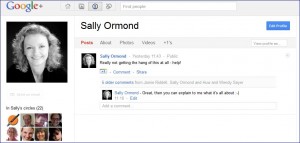
There’s a new kid on the block in the social media world.
Google + is the mighty search engine’s answer to Facebook, Twitter and just about every other social platform you care to mention.
And of course, with a new platform there’s a new language to learn. There are:
- Circles – which is the way you organise people you’re connected to
- Sparks – a bit like Google Reader as it brings in content automatically based on your interests
- Hangouts – these are virtual rooms for video chats with people in your cirlces
- Huddles – this is group messaging to people in your circle
Confused?
Me too – which is why I think you should take a look at these posts and videos put together by Chris Brogan:
- Google Plus – First Look
- Getting started with Google Plus
Thanks Chris!