Entries Tagged 'copywriter' ↓
April 7th, 2010 — copywriter, copywriting tips, freelance copywriter

A big part of producing copy that sells is understanding what your reader wants to hear.
The problem is everyone is different. We all have different dreams, wants and goals, so how can you produce a piece of sales writing that is going to appeal to everyone?
You can’t please all of the people all of the time
You really can’t.
If you try to perform this particular miracle your writing will become confused and unfocused.
My elder son recently returned from a school French exchange trip. Before he left, he was busy practicing a few phrases. His great plan (and that of most of his class mates) was to come up with a conversation that would take place once they met their French families. It went something like this:
Robert: Bonjour
French family: Bonjour, avez-vous fait bon voyage?
Robert: Oui mercie. Êtes-vous bien?
French family: Oui, et vous?
Robert: Très bien, merci, mais je suis un peu fatigué
(Please excuse my French, it’s been a number of years since I studied the language.)
In his mind this was perfect; it would work like a dream and get his exchange trip off to a flying start.
Sadly, I did have to point out that, although it was a great idea to be thinking along the lines of what he was going to say to the family, as being as no one has told them of this cunning plan, the likelihood of the conversation panning out like that was remote.
As predicted, after practicing said conversation with his friends prior to arriving in Arras, once they got off the coach and met their families, one of two things happened: they either totally forgot what they were going to say, or the family threw in a curved ball and asked them something they hadn’t practiced.
The one way conversation
As a copywriter, I find the most effective way to write is conversationally. But that doesn’t mean like the example above. I don’t have a two way conversation going on in my head as I write.
It is rather the style that is conversational. In other words the language that I use is informal, my vocabulary is simple to understand and my sentence construction simple to follow.
Using this style helps build rapport with the reader; it makes the information I am giving them accessible. If you think about it, what would you rather read? Something that is easy to grasp or something that you have to go over several times to understand the gist of what’s being said?
Of course, there are some occasions when a slightly more formal approach is called for, but again by using language that is accessible to all, you are increasing the chances of your copy having the desired affect.
So if you want your copy to hit the spot every time, remember:
- Write to your audience
- Talk to them – use ‘you’ and ‘your’
- Keep your language simple
- Don’t use jargon
- Make sure your sentence construction is easy to follow
- Don’t make assumptions
- Keep it conversational
- Use story telling techniques
- Ask questions
Why do you need to know this?
If your sales copy is going to sell, it has to make a connection with your reader.
Over my career as a freelance copywriter, I have written for numerous industries and audiences. The one common factor in all of my writing is keeping it simple.
A frequent conversation I have with clients involves this exact feature. Often they believe that a copywriter is there to make them sound very grand and impressive.
Wrong.
Your copywriter is there to sell your products and services. And the best way to do that is by keeping the copy simple, strong and striking.
April 5th, 2010 — copywriter, freelance copywriter, SEO copywriter, seo website copywriter

There you go, probably the shortest blog post in the history of blogging.
But, I guess you’re going to want more than just a resounding YES; you’re going to want evidence.
If you’re sitting comfortably, I’ll begin
There have been various debates about whether SEO copywriting is really so different to your normal, run of the mill website copy. Some people say there is no difference, whereas others say there is a vast difference between the two.
From my point of view, yes, search engine optimisation copywriting is very different from normal website copy.
For a start you are writing for two audiences simultaneously – your reader and the search engines. But the trick is to write your copy in such a way that your reader doesn’t pick up on your SEO.
Case Study: Landspeed
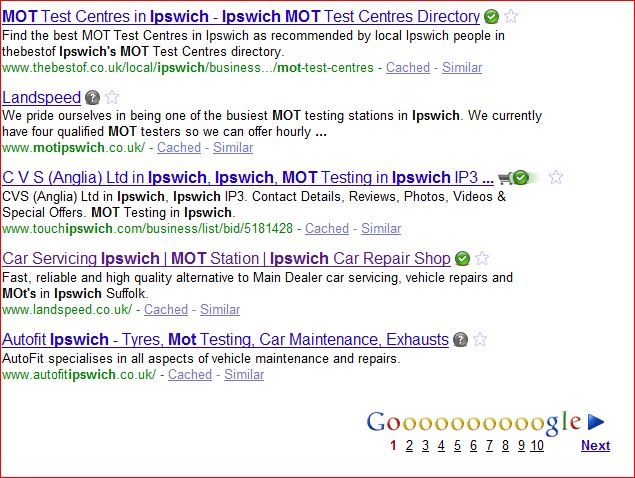
I was recently asked to write SEO copy for Landspeed’s new website. Landspeed is a car MOT and servicing centre based in Ipswich. They wanted copy that was easy to read, interesting and written to help their on screen SEO.
The copy had to target various keywords such as Ipswich MOT, Car servicing Ipswich, MOT Ipswich, Ipswich car servicing.
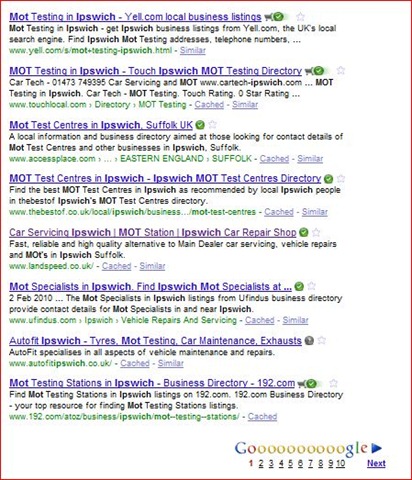
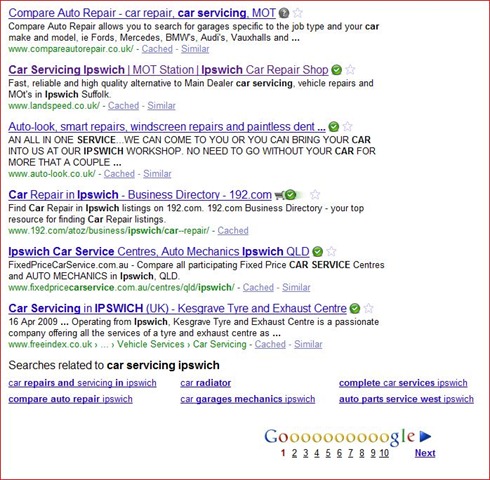
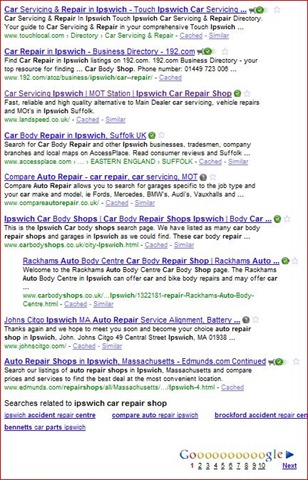
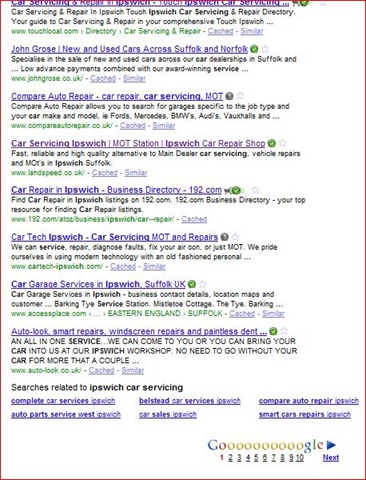
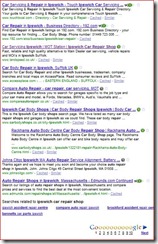
Less than a week after the site going live, it was on the first page of Google for all these terms (as at 1/4/10) – want proof?
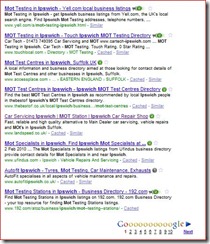
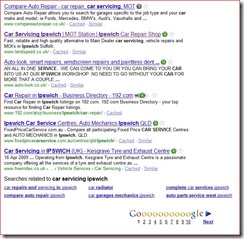
Ipswich MOT Car Servicing Ipswich
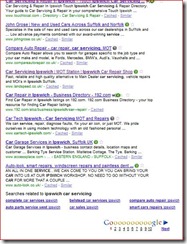
Ipswich Car Repair Shop MOT Ipswich
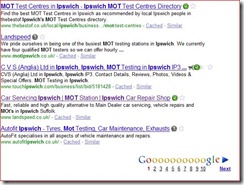
Ipswich Car Servicing
And, that was achieved without doing any link building.
Take a look at the site…

…unlike the sample I showed you in my last blog post about how not to do SEO, the copy isn’t crammed full of keywords. It is readable, simple copy that tells the reader exactly what the company does. The keywords have been used where they are most effective – headings, sub headings and as internal hypertext links.
When writing SEO web copy another key aspect that your copywriter should know about, is the value of the title tags (or page titles). Getting your keywords in here (but in a natural way, not stuffed) will help your rankings no end.
Now I’m not saying that every website I’ve ever written ends up on the front page of Google within days. SEO can take time. It all depends on how competitive the terms are that you’re trying to rank for. Something as generic as freelance copywriter will take longer than a more localised term such as Suffolk freelance copywriter.
That’s not the end
But even when you do achieve front page rankings through your copywriting, it doesn’t stop there. You have to consolidate that position by building quality, inbound links to your site through:
- article marketing
- blogging
- inclusion to relevant directories
There’s a lot of competition out there. When you reach the top of the Google pile, someone will be waiting to knock you off. SEO is a constant process and one you can’t take your eye off for a second.
April 2nd, 2010 — copywriter, facebook, social media
What’s right for you?
 A little while ago I wrote post about whether Facebook can help your business.
I set up my own fan page for my business as a freelance copywriter and I have to say that the jury is still out at the moment.
But whether Facebook is right for your business or not, you have to consider the best way to represent yourself.
Page or group?
With Facebook you have the option to set up a Page or a Group. But how do you know which is going to be right for you and your business?
A great place to start looking is this post I came across on Mashable – Facebook Pages Vs Facebook Groups: What’s the difference?
Howard Greenstein discusses the differences between pages and groups and their advantages and disadvantages to help you decide which road you should go down.
As with any social media marketing tool, Facebook will suit some businesses more than others. But the only real way to know whether it will work for you, is by trying it out.
Give it a go and let us know how you get on.
March 31st, 2010 — copywriter, freelance copywriter, search engine optimisation, SEO copywriter
I’ve often talked about the importance of search engine optimisation when creating website copy.
Keyword stuffing is a frequent practice that was done to try and attract the search engine spiders. Web site owners researched their keywords and simply used them as many times as possible within their text.
The hope was that the search spiders would jump for joy because of the number of keywords. And the site would then appear in the top listings because it was deemed highly relevant.
That might have been the hope but the reality was somewhat different. Although sites like these may well have achieved good rankings, their conversion rates were lower than half the teenagers trousers are these days.
The problem is that stuffing your copy with keywords renders it unreadable to people. If they can’t read it or it doesn’t make sense, they’re not going to hang around.
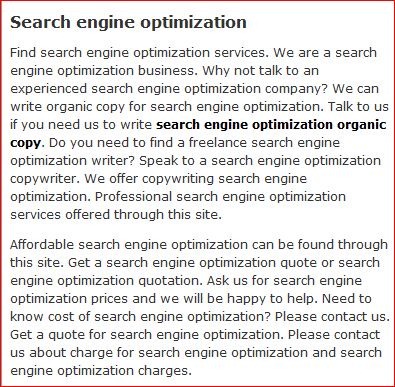
A classic example of this was recently highlighted in one of Nikki Pilkington’s tweets:
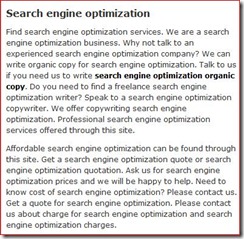
This has come from an actual site – a copywriting site! This single snippet contains the phrase ‘search engine optimisation’ no less than 17 times!!!!
Eek! Now do you see what I mean by unreadable?
This is an extreme example and I find it unbelievable that any copywriter would think that this sample of their ‘writing talent’ would convince a client to buy their services.
SEO done correctly will look like normal text. The keywords may not even be obvious because they appear naturally within the copy. After all if you sell orange dog collars, the likelihood is that that phrase is going to pop into your copy anyway.
The position of your keywords is far more important than their frequency.
SEO is a game
The game of SEO is about playing by Google’s rules to achieve good rankings. It’s about patience and research – things won’t happen over night. And above all it’s about understanding what your customer wants.
Unlike other marketing methods that are pushed in front of the reader (such as adverts, newsletters etc.), you can’t push your website in front of someone. Instead you have to make it attractive enough for them to find it.
Therefore you have to understand them and work out what they are searching for. Then, and only then, can you optimise your site and continue tweaking until you get great rankings.
Why do you need to know this?
Don’t get ripped off. If you approach a freelance copywriter to help you with your on page SEO, check out their website:
- Do they rank for their keywords? (if you found them through a Google search and are in the organic listings rather than sponsored links, the answer is yes)
- Is their site readable?
- Do they understand SEO?
- Do they ask you for your keywords?
If you answer no to any of the above they probably aren’t right for you.
If they start harping on about keyword density and their site looks like the one above, run away as fast as you can.
SEO copywriting is an art as much as it is a science – make sure you hire someone who is a Jedi Master in both.
March 29th, 2010 — copywriter, copywriting tips, freelance copywriter, twitter

How can a little social media tool like Twitter possibly improve your writing?
Very easily.
As this great post on Copyblogger by Jennifer Blanchard shows – How Twitter Makes You a Better Writer.
As the Twitter literate out there will know, Twitter messages are limited to 140 characters. And that does mean characters – so every space, punctuation mark and letter or number accounts for one character.
Therefore your writing has to be tighter than, well, a tight thing. There’s no room for adjectives or excessive prose – you have to wrack your brain to find the most succinct way of getting your message across.
Just like when you write sales copy. A copywriter has to keep their writing pithy and to the point. As soon as airy-fairy language creeps in, your reader will walk away.
It takes time to master this, but once you have you’ll discover your Twitter writing will help your copywriting. Your copy will become tighter, punchier and more compelling. You’ll start to take note of every word you use and you’ll be questioning them to ensure you’ve used the most concise and powerful combination to get your message across.
So, put your reserve aside and if you’re not already Tweeting, get started.
If the thought of it still makes you shudder with anxiety, help is at hand. One of the great Twitter Gurus, Mark Shaw (@markshaw), has put together an excellent eBook to help get you started. He’s kindly given me permission to offer it here to anyone who wants it.
So if you want a copy, drop me an email and I’ll send it to you. You can also follow me @sallyormond – why send me your most creative 140 character tweets?
Sally Ormond – freelance copywriter
sally@briarcopywriting.com