September 9th, 2011 — conversion, copywriter, copywriting, freelance copywriter, freelance copywriting
 When I was growing up, the most annoying thing anyone could say to me was “Ah, but you wouldn’t understand.”
As if anything was going to be so difficult I couldn’t even grasp the basics.
Admittedly, had it been something along the lines of Quantum Physics, I doubt I would have understood. But the most irritating thing about that sentence was the assumption that I wouldn’t understand.
Surely, if they explained it clear enough I would.
Where’s this going? Well, copywriting is a funny thing. It involves a skill we all have – the ability to write – and yet, it is something few people can do well.
That’s not to say that if you hired me to write your website copy or brochure copy, I would immediately turn round and tell you that you can’t write the content because you don’t have the relevant skills and that’s why you need me.
If I did, you’d probably show me the door.
So why would you hire me?
Copywriters add value and a whole new perspective
You and I have one major difference (OK, probably more than one, but for this blog post I’m only going to talk about this particular one).
You know your company inside out and I don’t.
Believe it or not, that gives me an advantage.
As a professional copywriter, I add value to your team because I can look at your business and its products/services from your customers’ point of view.
Let me explain.
You already know your products/services and think they are best thing on the market (if you didn’t, you wouldn’t be selling them). You would, without doubt buy them yourself. Therefore, you think all your customers think the same way and would also buy them – why wouldn’t they?
I look at your products from your customers’ view point. In fact, I become your customer.
From that perspective I can discover the true benefits of your offering. They are not to be confused with their features. Your customers don’t really care how many colours they come in, they want to know how they will:
- Improve their lives
- Save them money
- Save them time
- Make them more desirable…
By stepping into your customers’ shoes, I see your products as they do. That means, you have to convince me to buy – and I’m not easily convinced.
By throwing every buying objection possible at you, eventually we’ll drill down to the golden benefits that will make your customers say yes.
I will admit that this won’t work on everyone. Customers will constantly hurl buying objections at you. Plus, when it comes down to it, not everyone will want or need your product.
But by placing your customers at the heart of all your marketing materials, you will maximise your sales opportunities.
Over to you
If you normally write your own sales copy, try a copywriter next time. Compare the results you get and discover why customer-focused sales copy is so important.
Perhaps you’ve already done this and seen an improvement in your conversion rates?
Leave a comment below and share your experiences.
September 7th, 2011 — facebook, social media, social media marketing
 Most businesses today have embraced social media.
It makes sense because that’s where their customers hang out, so if they want to engage with them, they’ve got to join the club.
One aspect of social media, Facebook, has become phenomenon.
- It has over 750 million active users worldwide
- There are 900 million pages, groups, events and community pages that people can interact with
- Over 30 billion pieces of content are shared every month
(Statistics from Facebook.)
So it’s little wonder that so many businesses now have a page on Facebook. But the question remains, how do you direct your fans back to your website?
Your Facebook page is great for SEO and to interact with your customers/fans, but you will also want these people to use your main brand website too.
How to drive Facebook fans to your website
Many businesses are too concerned with building their number of Facebook fans and don’t give any thought as to how they are going to get those fans to interact with them through their website.
After all, it’s through your main website that you will sell to them, so you have to devise some tactics to encourage them to visit your site.
Ben Pickering wrote a great post recently on socialmediaexaminer.com that looks at this issue. In 5 Tips for Driving Facebook Fans Back to Your Website, Ben looks at the following methods:
- Use of tabs
- Sharing blog posts and articles
- Using teaser content
- Running contests on your brand website
- Special offers on your brand website
As you read about these in more detail, you will see that each not only adds to the value of your Facebook page, they also actively encourage your fans to visit your main website through various calls to action.
This ‘two way street’ of information adds to the users’ experience and so continues to add value to your relationship with them.
Integrating this approach into your social media activities will also strengthen your SEO strategy so everyone wins.
Over to you
Are you already using some of Ben’s techniques? Do you have your own method of driving fans back to your main site?
Leave a comment below and share the techniques you use to link your Facebook fans to your website.
Sally Ormond – freelance copywriter, Tweeter, blogger and Facebook fan
September 5th, 2011 — copywriting tips, newsletter, proofreading
 Writing a monthly newsletter is a great way to keep in touch with your customers and add value to your relationship.
You can use them to share information, give tips and offers.
But generating great content on a regular basis can seem like a daunting task. But it doesn’t have to be. All you need is:
- A great looking template
- A simple process to write content-rich material that can be repeated again and again
The template you use should reflect your business image. Something in line with your website’s design would be ideal. Just make sure it’s a clean, unfussy design that won’t detract from the information it contains.
But what about the simple process I mentioned? Well, below is an example to show how easy it can be to write your newsletter when you have a system in place.
Newsletter writing process
This 5 step writing process is a great way to kick start the creative process every month. The number of topics you pick will determine the length of your newsletter.
- Choose 3 topics for the main body of your newsletter
- Choose 3 topics for your side bar
- Interview industry experts or research a specific topic
- Write and edit your articles
- Proofread your newsletter
1. Main topics
These articles will make up the body of your newsletter. You can choose as many topics as you like, but the more you have, the longer your newsletter will be.
They don’t have to be long articles (approximately 300 – 500 words) and can cover things that have happened in the news (or your industry) recently, what’s happening now and what’s coming up.
2. Side bar
The side bar is for quick bits of news so they’re not as in depth as the main topics you’ll write about.
It also gives you the opportunity to add regular pieces such as a book of the month, announcement of forthcoming events, tips, and offers.
3. Interviews and research
Conducting an interview or writing a research-based article can add real meat to your newsletter.
The interview would act like a magazine Q&A session. In it, you could get an expert’s insight into a particular hot topic that your readers are interested in.
The same can work for the research article. Find out what’s important to your readers and write about it. But make sure you include links to the external articles you used for your research so they can read around the subject if they want to.
4. The writing process
This is the part many people dread. But writing well rounded, interesting articles is easy.
Make sure you write in the second person (i.e. ‘you’) to instantly build rapport with your readers. As mentioned above, use hypertext links to direct your reader to more information. This will add value to them and show you really do understand your subject.
Another important feature within your newsletter is your call to action. It could be a link back to your website, an instruction to email for more information or a competition. If you want to make your newsletter marketing a two-way street, you must ask your reader to do something.
Of course, they can only get in touch if you include your contact details. Never hide away from your customers. As with your website copy, make sure your postal, email and phone details are easily available otherwise it looks as though you have something to hide.
The final part of the writing process involves leaving your newsletter alone. Put it to one side for a few days before reviewing the content to make sure it provides the messages you wanted.
5. Proofread
This is the final and most important part of the process.
The last thing you want to do is hit send only to find a glaring typo.
Putting the newsletter aside for a few days before reviewing it will help with the proofreading process. Ideally, you should get someone else to proof it for you. But, if that isn’t possible, giving yourself a few days grace before checking it through should help you spot any mistakes before you send it out.
Over to you
Done well, a regular newsletter can help build and cement relationships with your customers. By adding value and maintaining regular contact, your newsletter can encourage sales.
Do you send out a monthly newsletter?
Have you found it beneficial?
Do you have a process you follow each month like this one? Please leave a comment below and share your newsletter experiences with us.
September 2nd, 2011 — conversion, internet marketing, online marketing, website copywriting, website design
 Does your website work?
Do you get regular traffic?
Are you getting regular leads from your website?
When, at a networking event, I asked those three questions to a businessman and website owner, this was his response:
“I don’t have an ecommerce website, so that doesn’t apply to me. I have a website because everyone expects me to have one. It’s not as if businesses like mine sell through their website – that’s impossible.”
Unfortunately, thinking like that, he’s never likely to sell through his website. And if he isn’t getting any leads from it that would suggest his website is poorly built and poorly written.
An easy-to-use structure and well-written site will boost your conversion rate (assuming your SEO strategy is targeting the correct keywords). But there is another factor that is often ignored – the speed at which your website loads.
A slow loading website could lose you 7% of your potential conversions
According to a recent post on Bryan Eisenberg’s blog, a 1 second delay in your download speed could result in:
- 7% fewer conversions
- 11% fewer page views
- 16% decrease in customer satisfaction
There are several factors that can affect your load speed, for example image size, social media buttons or the size of your website.
The optimum download time is under two seconds (this will help improve your rankings significantly). So how do you get your site to load faster?
- Check your speed
If you don’t monitor your speed, you won’t know how well you are performing. Use tools such as Google Analytics to help you with this. Bryan also suggests a couple of his favourite tools: The Web Page Speed Report, Yahoo’s YSlow plugin, Google’s Page Speed plug-in, Loads In and WebPagetest.
There are others available but this will get you started.
Remember for every button and image you add to your website, you’ll be increasing the time it takes for your website to load.
- Coding
This one is for your web designer to look at for you. The coding of your site (HTML, CSS and JavaScript) can also have an effect on download speeds, so it’s best to chat to your designer about what can be done to tweak it.
- Images
Images and graphics look great on websites. They can be used to illustrate your products or they can make your text more impactful. But the more you use, the higher your load time.
Condensing your images, using the right format for the right task and reducing the overall number will help.
Why you need to know this
If you have a website, you would have invested heavily in it. Therefore, why would you not expect to see a return on that investment?
A website isn’t an online brochure. It is a powerful sales tool. Available 24/7, it offers potential customers a means to get to understand your company and what you can do for them.
Every businesses website should sell. It should bring in leads – in essence, it should be your 24 hour sales team.
If you’re not getting leads from your site ask yourself why not? Review the structure, content, load time, keywords and analytics.
A business with a website that isn’t performing is like a High Street store that keeps its door locked all the time.
Review your website today and make sure it’s working for you.
August 31st, 2011 — search engine optimisation, seo, SEO copywriter, seo website copywriter, website copywriter, website copywriting
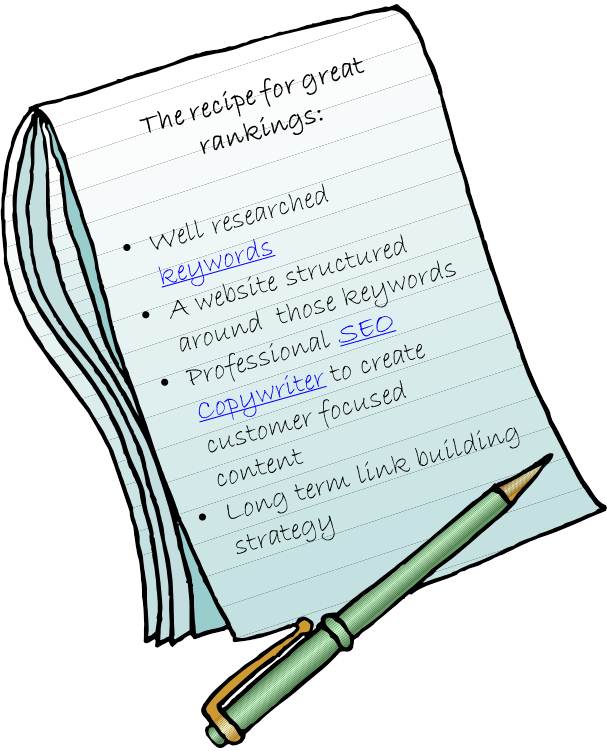
From that list of ingredients, this post will look at the power of SEO copywriting.
When done well it will help your search engine rankings, attract readers and convert them into sales.
Done badly it could harm your rankings, repel customers and won’t convert a sausage.
So how can you make sure you get it right?
5 signs of good SEO copy
1. Write for your reader
There is a popular misconception that SEO copy has to be written for the search engines.
Wrong.
When writing your copy, always write it for your reader. Forget about keyword density – Google is more concerned with the amount of text, the topic you’re writing about (i.e. that your keywords in your title tags etc., are aligned with your content) and how hot the competition is for your particular keywords.
Always, always, always write to your reader first and foremost because they are the ones you want to read your copy and they are the ones you want to buy from you.
2. Don’t be repetitive
How many times have you read a website only to constantly hear the keywords being repeated?
Don’t stuff your copy with your keywords so it gets repetitive. After all if that was the only factor Google was interested in, all your competitor would have to do is insert one more keyword than you to rank higher.
And if that happened, the internet would be full of keyword-stuffed gibberish.
3. Don’t forget to link out
You already know the benefit of links into your website as part of your SEO strategy but don’t forget to link out too.
Linking out to authoritative articles not only adds to your reader experience and keeps Google happy; it could also help you attract inbound links.
4. Structure
Writing for the web is just like writing for anything else.
Your copy must be structured and attractive to the eye if you want people to read it.
Make sure it has a beginning, middle and an end with a strong headline. Split up your text into small paragraphs using sub headings as sign posts to help your reader skim the text.
Also, headings and subheadings are the ideal places for your primary and secondary keywords.
5. Be natural
There are loads of software programmes out there than can automate or spin articles for you. But they are no substitute for a well-considered, well-structured and well written article.
Don’t be tempted to use shortcuts.
So the moral of this post is to forget keyword density when it comes to your SEO copy. The most important thing to remember is to write for your reader. They are the ones you want to attract and they are the ones who you want to buy from you