October 3rd, 2011 — conversion, landing pages
 Landing pages are a great way of creating a web page that is totally focused on one thing – buying, signing up for a newsletter, or collecting email addresses in return for free reports.
The key word in the paragraph above is focus – so the content of your landing page will be dependent on what you’re trying to achieve.
So, as an example we’ll look at…
Landing pages for freebies
Offering free reports or white papers is a great way to build your marketing list.
If you want to capture email addresses, you have to give people something (of value) in return. Information is the cheapest option and, let’s face it, people love to get free advice.
So, how do you make sure your landing page remains focused on its task – getting people to enter their email address in a capture box in return for your report/white paper?
1. Above the fold
I’m sure you’ve heard that phrase before. Above the fold basically means keeping all your important information in your readers’ immediate eye line.
After landing on your page, they are unlikely to want to start reading reams of text, scrolling down until they find out what they need to know.
Therefore, it is important all the vital information is above the fold, including your opt-in (data capture) box.
2. Don’t confuse
Your landing page has one reason for existing, and that’s to grab hold of your readers’ email address. If you add unnecessary navigation and links to your page, you run the risk of them wandering off before they’ve signed up for your report.
All you need is a single page, without links, directing them to enter their email address into a box. That’s it, nothing else.
3. Benefits
Simply adding the title of your report/white paper next to your sign up box isn’t going to convince anyone to enter their email address.
Add some short, benefits-led copy above the fold. List the benefits in a bulleted list to show them, quickly, why they should sign up.
4. Quick!
If you give your reader time to think, they’ll probably wander off without signing up. Tell them the offer is limited to a certain time period. If they don’t sign up straight away they’ll miss out on this vital information.
5. Make it scanable
People don’t have time to read every word you write, so use white space, bulleted lists and sub headings to make it is easy for them to find the information they want. A graphic pointing the way to the sign up box is also a great idea.
Landing pages are great if they remain focused on the task in hand. Giving your readers too much choice is like showing them the door. Tell them what you want and make it easy for them to comply, without distraction.
Over to you
Do you use landing pages in your marketing? If so, leave a comment below and tell us your experiences and what you’ve found works.
Sally Ormond – freelance copywriter, blogger and social media addict
Briar Copywriting
T:@sallyormond
F: www.facebook.com/freelancecopywriting
September 30th, 2011 — blog, blogging, blogging for business
 This post follows on from a talk I recently gave at my local WiRE (Women in Rural Enterprise) group in Ipswich (it’s quite long so you might want to grab a coffee).
If you search through this blog, you’ll find numerous posts about various aspects of blogging. There are so many things you need to think about it can become overwhelming. So, for this post, I am concentrating on what to do once you have your blog set up.
There you are, sat in front of your computer staring at the Dashboard of your blog. What do you do next?
Let’s start at the beginning…
Why are you blogging?
You’ve decided to take the plunge because you know blogging is:
- Great for your search engine optimisation activities
- A way of positioning yourself as an expert in your field
- A way of continually adding fresh content to strengthen your web presence
That’s great, but before you launch into writing, you must establish a blogging strategy that’s going to work for you.
Getting started
First of all, you must think about how often you’re going to blog. The frequency you choose must be sustainable.
As your readership grows, people will get to know how often you post and they’ll expect to see posts at that frequency. If you suddenly stop for some reason, or reduce the number of posts you make (or just post at random intervals), your readers won’t know where they are and go and find another blog to read.
Secondly, you have to find your niche and stick to it. Writing about copywriting one moment and landscape gardening the next is going to leave your audience very confused.
Thirdly, consider the types of posts you’ll write. Mix them up a bit and use:
- ‘How to’ posts
- Top 10 lists
- Hints and tips
- Comment on industry news
- Comment on relevant news items
Now all you need is some ideas.
Generating ideas
Inspiration for ideas can strike at any time, so it’s well worth keeping pen and paper close to hand. Great ideas can strike at the most unlikely times:
- Walking your dog
- Watching TV
- Reading a newspaper or magazine
- Conversations with friends and colleagues (and even customers)
- While you’re browsing your social media channels
Just remember, if you are using other blogs, newspapers or magazines as the source of your inspiration, always link back or reference the original article/post.
Writing great blog posts
The first thing to remember is you are writing for the web. People browsing blogs don’t have loads of time to sit down and read ‘War and Peace’. Keep it punchy, keep it concise, keep it relevant and make sure it’s interesting.
Before you start to write, make sure you inject your own personality (don’t try and copy someone else’s style) and write from the heart.
Then, make it easy to read:
- Create a great headline – this is your hook, but also think about SEO and make sure your keywords are in there too
- Make your headline relevant to your content – don’t promise something and then fail to deliver
- Use sub headings and short paragraphs to create a lot of white space to make it easy to read and make it scanable
- Use bulleted lists to add interest and highlight important points
- Always use simple language – absolutely no jargon
- Write for your audience – in terms of content and using the second person (i.e. lots of you and no we)
- Check and re-check before publishing to make sure there are no typos
- Add a call to action at the end – such as leave a comment and have your say
- Link out to other relevant articles or to your website, but only if the link adds value to the reader, otherwise you’ll be seen as blatantly self-promoting
Sounds easy, doesn’t it? So why isn’t your traffic increasing?
Common blogging mistakes
No one is perfect (no, not even you) and we all make mistakes. So, if you’re merrily blogging away but you’re not seeing your traffic grow and you’re not getting any comments, here are some of the mistakes you might be making:
- Not knowing your audience – you’re not giving them what they want
- Blanket writing – you’re ignoring your niche
- Being inconsistent – don’t let your standards slip, always focus on quality not quantity
- No commitment – if you’re not sticking to your blogging schedule, you’ll lose readers
- Writing for yourself – you have to write what your reader wants, not what interests you
- Poor headlines – if they aren’t strong, no one will read your posts
- No engagement – don’t talk at people, involve them and write as though you were having a conversation with them
- Unresponsive to comments – if someone takes the time to comment, reply to them and show them you care
- No promotion – you have to let people know your blog’s there, so put links to your posts on Twitter, Facebook and LinkedIn
Blogging is hard work, but it can be rewarding if you stick with it. If you generate great content on a regular basis, you could be picked up by one of the many websites and pro-bloggers out there who love to produce their ‘top blog’ lists. One link from a website like that can do wonders for your rankings.
Why not give it a go? When you get into it, blogging is also great fun.
Over to you
Are you a seasoned blogger? If so, leave a comment below and let us know why you do it and what you get out of it.
If you’ve not taken the plunge yet and have any questions, post them below as a comment and I’ll do my best to answer them.
September 28th, 2011 — conversion, marketing, online marketing
When it comes to deciding whether to offer a guarantee or not, most people’s thought process goes something like this…
If I offer a guarantee, loads of people will use it as a way of getting their money back, which will cost me a fortune.
In truth, yes some will take advantage, but it will be a very small percentage.
But offering a guarantee (especially a no quibble money back one) will offer you far more benefits that not offering one.
The advantages of a guarantee
There are so many internet scams about people have grown very suspicious of online retailers. They want to be sure their money is exchanged for quality goods that will meet their expectations.
When they buy from the High Street, they have their receipt and the ability to return to the same store should something go wrong. But on the internet, they aren’t afforded that luxury and many companies make it difficult for the customer to get in touch with them when they experience a problem.
By offering a guarantee you will:
- Remove one of the many barriers to purchase. If someone can see you offer a money back guarantee, they know that if they are dissatisfied they can get their money back.
- Build trust – it won’t make someone trust you unreservedly, but it will certainly help to build trust. It shows you are a genuine company that wants to give them great value.
- Stand out from the competition so if they are torn between your product and one of your competitor’s, but they don’t offer a guarantee, they’ll more than likely go with you.
- Increase your focus on quality. It’s only natural that you won’t want to have to deal with complaints or demands for refunds, so you’ll be even more focused on making your product the best it can be.
Why you should offer a guarantee
In a nutshell, you should offer a guarantee because:
- You could gain sales
- You’ll build trusting relationships with your customers
- You’ll be seen as a ‘good’ business
Above it, it won’t cost you anything to do.
At the end of the day, you are in business to provide your customers with the best product you can. If they are dissatisfied, it means you have failed to do this. So by offering a guarantee you will ensure you do everything in your power to be the best you can be.
Over to you
What’s been your experience?
Do you offer a guarantee or did you decide not to?
Leave a comment and share your feelings.
September 26th, 2011 — copywriting tips, marketing, website copywriting
 The whole world is going mobile – well, it seems like it.
According to Ofcom, 27% of UK adults and 47% of teenagers own a smartphone. So it’s hardly surprising so many companies are looking to the mobile market and tailoring their online marketing accordingly.
You could be forgiven for thinking that users will simply browse your website through their handset so there’s no need for additional investment in a mobile website. But that’s not what a recent study would suggest.
The study by the marketing technology provider Unica (link to PDF), suggests that according to their research:
- 33% of companies are already using mobile messaging, applications and websites as part of their marketing strategy
- 24% plan to use these tactics within 12 months
- 13% plan to use them in more than the next 12 months
- 20% had no plans
- 10% didn’t know
The need for mobile websites is created because of the way mobile users use their smartphones.
Creating powerful mobile website copy
I, as a copywriter, know all too well that readers can get very easily distracted. So the copy has to be succinct, precise and easy to understand.
The problems are that mobile users are even more distracted than PC browsers. They will be interrupted by phone calls, texts, and push notifications. So your information has to be fast and easily absorbed.
They are probably surfing for research, for specific information or to compare products. But whatever their reason, they will need information quickly.
Because of the small screen size they’ll be viewing your content on, your copy has to be:
- Tightly focused
- Short
- Easy to understand
Although all copy should have these traits, you have more leeway on a normal website. Your mobile copy must concentrate on the goal of that page and strip everything else out. A short paragraph on your computer screen may cause a mobile user to scroll for eternity to reach the information they need.
Writing mobile more copy is more akin to Twitter or texting. You have to get your message across quickly and in as few words as possible. Of course, you must never forget to include your call to action.
More and more people are browsing the web through their mobile devices so it’s imperative your marketing strategy takes this into account.
Over to you
Do you already have a mobile website? Are you thinking about investing in one soon?
Whatever your experience of mobile browsing, leave a comment below and share it with us.
September 23rd, 2011 — keywords, marketing, online marketing, search engine optimisation, seo
When you start working on your SEO strategy, the most important decision you’ll have to make is what keywords you will target.
The decisions you make will determine how effective your overall strategy is, which is why it is so important you get it right.
But time and time again, mistakes are made that cause frustration because the desired results are not seen.
The main thing to remember is that the keywords with the highest number of searches aren’t necessarily the best ones to target.
Mistake #1
The first mistake people make is going for glory – or at least the keyword that generates the most traffic. The problem is the competition for these words is very hot.
The problem with that is if you’re looking for short to medium term results, these highly competitive words will be beyond your reach.
When selecting your keywords, they must be specific. So rather than ‘camera’, go for the make and model because that’s what people will be searching for.
If you want to target a generic and highly competitive keyword, you just have to remember that it will take time, energy and money to get ranked for it. If you are looking for short term results, go for something less competitive:
Lower traffic & lower competition = quicker domination and an increase in traffic
Mistake #2
This mistake happens early on in the process. 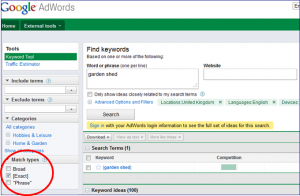
When using the Google Keyword Tool, people make the mistake of looking at the broad match rather than exact match. Broad match is selected by default, so it’s important you check the exact match box.
For example, when searching for ‘garden shed’, under broad it displays 135,000 local searches per month. But under an exact search, that figure drops to 6,600 – quite a difference.
If you get this wrong, it could have a serious effect on your predicted ROI and traffic.
Mistake #3
Many people target plural keywords, such as garden sheds. The problem here is that people tend to search for singular terms.
Let’s face it, if you were looking for a new lap top, you’re more likely to look for a lap top as opposed to lap tops.
Mistake #4
A lot of people already have preconceived ideas about what they are going to target. The problem here is that preconceived ideas are favoured rather than looking at the evidence of what people are really searching for.
This results in being listed for words that simply don’t convert because they are not the ones people use to search for your product. Sometimes, it may be better to target a set of keywords, rather than just one, to widen your chances of being found.
Mistake #5
Another problem is taking words out of context.
If you targeted the word ‘ink’ people could be searching for printer ink, pen ink, how to remove ink stains etc. So the chances are a high proportion of your traffic won’t actually be looking for what you’re offering.
That’s why it’s so important to be specific in your keyword choice.
Mistake #6
SEO isn’t static. Many people believe it’s a painful process they’ll only have to go through once. But the truth is you must continuously monitor and analyse the effectiveness of your keywords.
Just because one is performing well now, doesn’t mean that will still be the case in the months to come. SEO is about constant adjustment and refinement.
Researching and identifying your keywords is incredibly important. It’s vital you do it right and continue to monitor it. Your SEO strategy will constantly evolve so you have to be prepared for regular reviews and tweaks as and when necessary.
What has your experience of keyword research been?
Have you made any howlers or had any particular successes?
Leave a comment below and share your experiences.
 Landing pages are a great way of creating a web page that is totally focused on one thing – buying, signing up for a newsletter, or collecting email addresses in return for free reports.