November 7th, 2011 — search engine optimisation, seo, SEO copywriter, social media, social media marketing, social networking
Have you ever wondered how some people end up everywhere on the web?
If you Google their name, reams and reams of listings appear. How do they do it? How do they make themselves so visible?
The answer is good old fashioned search engine optimisation.
If you’re thinking I’ve finally lost it because surely, SEO is surely just for websites, let me put your mind at ease. No, I haven’t completely lost it. SEO is just as important for your social media profiles as it is for your website.
The whole point about filling in your profile on sites such as Twitter, LinkedIn and all the other social networking sites, is to make yourself visible to potential clients or business partners. So if you’re not making the most of them, why bother?
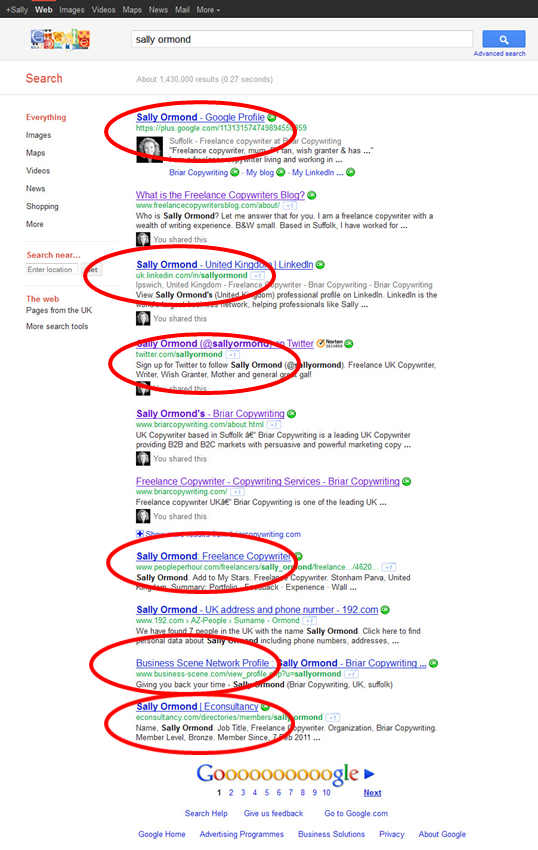
To illustrate my point, after Googling ‘Sally Ormond’ the first page of search results alone show 6 social media/networking profiles.
So not only does my website and blog appear, but anyone searching for information about me will also see my name splattered all over the web with numerous profiles (and blog posts and articles) detailing all the great work I do for my clients.
That’s pretty powerful stuff.
OK, I hear what you’re saying – Sally Ormond is my name as opposed to a search term that I would optimise for.
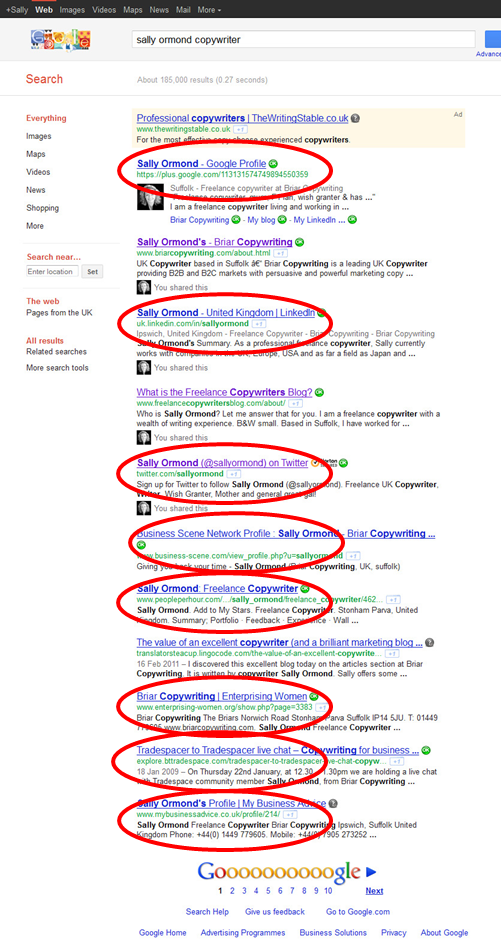
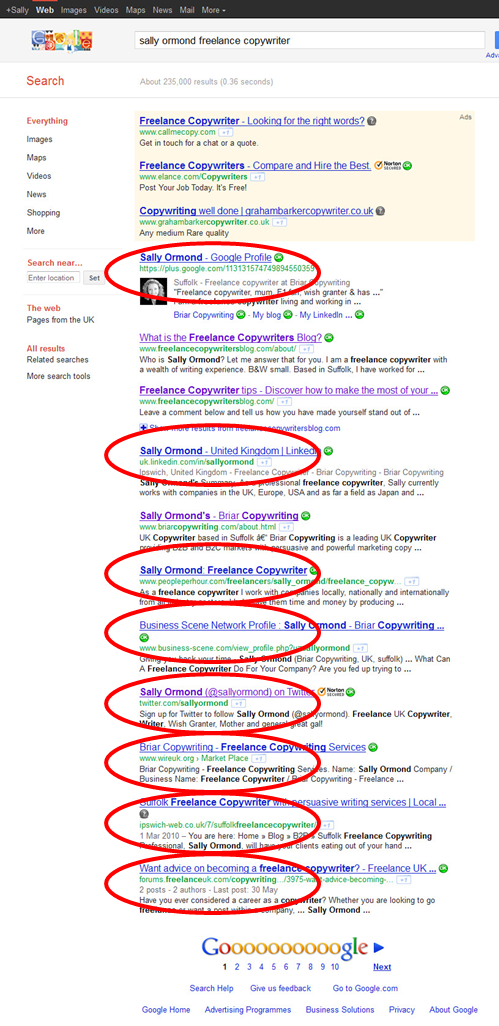
So what if I amended my search to ‘Sally Ormond Copywriter’ or ‘Sally Ormond freelance copywriter’?
Well….
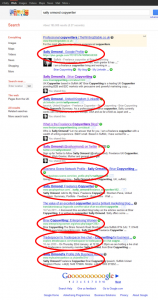
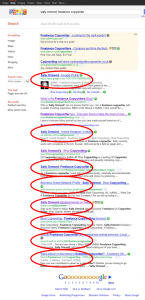
As you can see, in both cases even more social media sites appear.
So there you go – this is why it’s essential to make your profiles stand out. That doesn’t mean you have to cram them with your keywords. But make sure your keyword (which is probably your primary business activity) appears near the beginning of your description.
Filling the web with great information about you and what you can do for your clients is essential if you want to position yourself as an expert in your field.
After all, it’s becoming more common for people to Google other people so they can find out a bit about them. If nothing shows up (or very little), what does that tell them?
November 4th, 2011 — copywriter, copywriting tips, effective copy
Can you really tell whether copy is good or bad just by looking at it?
The answer is yes and no.
It rather depends on what the copy is, what it’s meant to do and what form it takes.
For example if it’s SEO copywriting and it’s very obvious what the targeted keyword is, like in the example below…
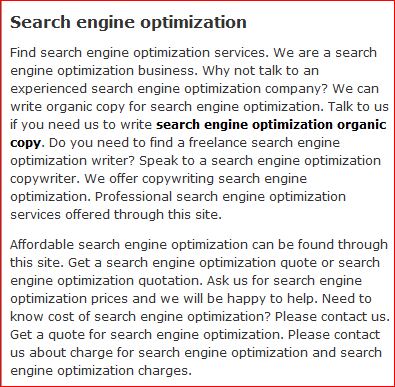
…then it’s pretty safe to say it’s bad copy.
The problem is a section of text can be very well written (grammatically correct and no spelling errors) and yet, from a sales perspective, it’s about as useful as a chocolate teapot.
That’s why it’s not always easy to spot bad copy.
It’s probably easier to look at this from a different angle and think about what makes good copy.
The traits of good copy
Luckily there are 5 characteristics that good copy has. No matter which format it’s written for or what it’s trying to sell, good copy will always:
- Grab the readers’ attention immediately
- Be clear and unambiguous
- Answer all the readers’ questions and so counter any buying objections they may have
- Build trust and rapport with the reader
- Motivate the reader into taking a specific action through a strong call to action
What it comes down to is this – copy is written for a purpose (generally to sell something) but if it doesn’t fulfil that purpose it’s not doing its job.
Selling through text alone is difficult. You don’t have the personal contact with the customer; you can’t think on your feet to counter their buying objections and you can’t shake their hands.
Your copywriting has to do every thing:
- Inform
- Build trust
- Convince
- Convert into a sale
That’s not an easy thing to achieve.
What are your thoughts? Can you think of any more traits you find in good copy? Why not share them here along with any shocking examples of copy you’ve come across.
November 2nd, 2011 — Customer service, social media, twitter
 Despite the number of blog posts and articles you see about Twitter, I was flabbergasted to read a recent post on The Drum.
Apparently 71% of companies are still ignoring consumer complaints on Twitter.
Social media has opened up communications between consumer and business. Now, someone can complain through Twitter about poor service or product quality and within seconds potentially thousands of people will know about it.
And yet, there appear to be an alarming number of companies who are not monitoring Twitter effectively.
According to the article, in a survey by Maritz Research, only 29% of those who tweeted a company with a complaint received a reply. This shows a worrying trend – namely, businesses are still not ‘getting’ Twitter.
The post goes on to say that…
The American research looked at 1,298 consumers over the age of 18 who frequently tweet and have used the micro-blogging site to complain about a specific product, service, brand or company.
- 49% of respondents had expected the company to read their tweet
- 64.9% of older tweeters (aged 55+) expected a reply
- 38.4% of younger tweeters (18-24 year olds) expected a reply
Of those who received a response from a company, 34.7% were very satisfied and 39.7% were somewhat satisfied with the response.
While 86.4% said they would love/like it if the company had got back to them regarding their specific complaint, 63.3% said that they wouldn’t like or would hate it if the company contacted them about something other than their complaint.
The power of a tweet
Once upon a time, if a customer was unhappy about something they would pick up the phone and have a rant. But because they would be speaking with someone representing the company, in theory, their complaint wouldn’t go unnoticed.
But today, consumers have the ability to tweet their anger. Not only would this be directed at the company’s twitter name so (you would assume) they would get to hear about it and take action, it would also be seen by all their followers.
Whether companies like it or not, Twitter (and other social media channels) is the new ‘social telephone’.
The above research shows that most people (84%) liked it when companies got a response form their tweet. Just by listening, a company could greatly improve its customer service satisfaction levels.
Monitoring the noise
If a company is going to use social media, it must ensure it has the resources to use it effectively.
A Twitter account must be monitored to offer timely responses to customer queries and complaints. If you quickly make contact and resolve the issue, you can turn a potentially bad situation into a positive. Your customer will see you as a company that cares about its customers and listens to them.
Make sure your company isn’t one of the 71%:
- Monitor Twitter for any mention of your brand
- Respond quickly to tweets you receive from customers
- Never get into a Twitter argument
- A quick response will turn a bad situation into a positive outcome
Over to you
Does your business use Twitter?
How are you making sure you monitor it?
If you have any tips to share to help other businesses get to grips with the ‘social media telephone’, leave a comment below.
Sally Ormond – Freelance copywriter
October 31st, 2011 — copywriter, copywriting tips, freelance copywriter, Interview techniques
 This is a guest post written by Tom Albrighton, a freelance copywriter and founder of ABC Copywriting. He writes regularly on copywriting issues for the ABC Copywriting blog.
Of all the ways to obtain source material for your copywriting, interviewing must be one of the easiest and most productive. A half-hour phone chat or meeting with a client can easily generate enough material to write a thousand-word brochure, or develop a really strong tagline. But you have to do it right – so here are a few tips for getting the most out of interviews.
Preparation
It’s always worth writing a set of questions in advance. Even if you end up wandering way off topic, they’ll provide a useful structure to your interview and help you remember the points you want to cover.
Interviewees are reassured when you send them questions in advance, particularly if they’ve never been interviewed before. They can also spend some time thinking about their answers, or getting hold of data to back them up. (In my experience, material promised during the interview itself often fails to turn up, obliging you to chase your interviewee, which is awkward.)
Kit
Give yourself the best possible chance of hearing every nuance of your interview by investing in some decent recording kit.
For in-person interviews, I use a good-quality tape recorder. It’s not advanced but it gets the job done, and I like the reassurance of seeing the reels revolving. You might prefer to use an electronic recorder – certainly, having the interview as an MP3 is handy.
For phone interviews, I use a device called the THAT-2, which is connected between the handset and the phone (so you need a phone with a plug-in handset). You can connect it either to a tape recorder or to your computer, where you can record with an application like Audacity.
For quick and easy transcription of MP3s with iTunes on the Mac, use something like Sizzlin’ Keys, which lets you play, pause and skip backwards and forwards using keystrokes. Personally, I always use headphones, to get as close as possible to the original experience.
Questions
For copywriters, interviews are about exposition, not inquisition. You’re looking to get your interviewee to open up and give you everything they’ve got.
To achieve that, ask open questions, which typically begin with either ‘what’ or ‘how’. For example, ‘what does this product do?’ or ‘how will this service benefit customers?’
Listening
In person, it’s important to physically signal your interest by making eye contact, leaning forward attentively, nodding and so on. But that doesn’t work on the phone, so it’s worth making little affirmatory interjections like ‘mm’, ‘yeah’, ‘uh-huh’. ‘sure’, ‘right’ or whatever works for you, so the interviewee knows you’re still listening.
Don’t be afraid to ask for more information if you need it. Many interviewees feel self-conscious when talking for a long period, particularly if they are natural introverts. Reassure them that you’re still interested by saying ‘Can you tell me a little more about that?’ or something similar.
Make sure everything you say is oriented towards getting the interviewee to express themselves, rather than impressing them with your knowledge. Even the cleverest observations must be suppressed – this isn’t about you.
Reflecting
Sometimes, people get hung up on making a particular point that’s very important to them. Signals include rephrasing it again and again, or using more than one example to explain it. To show them you’ve understood, rephrase the point and say it back to them, starting with something like ‘So as I understand it, what you’re saying is…’
I also find this a very useful way to capture potentially useful phrases that come to me while people are speaking – for example, metaphors that might liven up the finished copy. By throwing them into the conversation, you make sure they’re in your recording.
Digressions
Sometimes, interviewees ramble badly, leaving your intended topic far behind. This can be frustrating, but you just have to wait for your chance to gently guide the conversation back on course.
The classic problem for copywriters is getting the client to think about customer benefits rather than the features of the product or service they’ve created. But sometimes, people just have to get all that feature stuff out of their heads before they can translate it into benefits – so give them some room.
Only interrupt the interviewee as a last resort – if you’re running out of time, say, and don’t have what you need. If you talk over them by mistake, say ‘sorry, go on’ and let them have the floor.
Wrapping up
Always thank the interviewee for their time and, if appropriate, give them the opportunity to review and approve what you write. Some people will ask for this up front, as a condition of being interviewed. In my experience, 95% of people will rubberstamp what you write. But be prepared for the exception who takes the opportunity to rewrite the whole thing – badly.
Transcription
When you transcribe, don’t be afraid to either (a) use the interviewee’s words verbatim or (b) chuck them out and use your own. People sometimes use the perfect phrase in conversation, but would never write it down – your job is to give them the authority to use it. Conversely, people’s own pet phrases might be completely inappropriate for the task at hand – but, after all, that’s your job!
October 28th, 2011 — Google +
A short while ago I wrote a post directing to you to Christ Brogan’s videos about how to get started with Google+.
Well, as with all social media platforms, Google+ is changing fast. If you’re like me, you’ve probably managed to upload your profile and make a few connections, but that’s about all.
When it comes to circles and the such like, I’m still rather in the dark. I find it’s just another social media platform to get my head round that I really don’t have time for.
Well, if you’re like me and could really do with some more help in getting to grips with it all, take a look at this post (click on the image below) from socialmediaexaminer.com.
Grab a coffee and head over there to read about:

Thanks guys, what would be do without you!