December 23rd, 2011 — copywriting tips, Customer service, internet marketing, marketing, online marketing
 If your business sells goods online, your ‘shopping experience’ must be exceptional.
Why?
Well, for many people, shopping online is still dabbling in the unknown. If they buy something from a High Street store, they can speak with staff, see the product, pay for it and take it away there and then.
But shopping online is a completely different experience:
• There is no one to ask questions of immediately
• The can see a picture of the product but not the real thing
• They can’t touch the product
• Although they can pay for it, they have to wait for it to be delivered
Effectively, they are giving a faceless company their hard earned cash for something they’ve not yet received.
It’s hardly surprising so many online transactions are never completed.
Don’t lose sales through ‘what if…’ syndrome
What do I mean?
• What if I can’t get back to the webpage I want if I click this link?
• What if I don’t like the product when it arrives?
• What if the company goes bust?
• What if they sell my details on to another company?
These are just a few of the ‘what ifs…’ that could be flying through your customers’ heads right now.
So how can you alleviate their fears?
How can you make them feel safe while shopping with you?
Give reassurance every step of the way
The key is to reassure them at every stage of the buying process – from the moment they land on your website, right through to their sale confirmation email.
1. Testimonials
An old one, but a good one. Showing real customer testimonials on your website will help reassure your customers. If they can see other people were satisfied with your products and service, they are more likely to buy.
If you don’t have any, get some. Ask past customers to rate your service.
2. Privacy policy
People are, quite rightly, concerned about the possibility of their details being passed on to third parties.
Reassure them this won’t happen by telling them and providing a prominent link to your privacy policy.
3. Simple ordering
If you want someone to buy from you, your ordering process must be simple. And I don’t just mean so you can understand it.
People of all IT abilities are going to be potential customers, so when you design your ordering process, get your Aunt or other member of the family (non-tech savvy) to do a dry run for you. This ‘test drive’ will help you iron out any ambiguities.
4. Reputable payment
People don’t like to input their sensitive information online, such as bank details and card numbers. Give reassurance by only using reputable payment partners.
5. Guarantee
Everyone loves a guarantee, especially the ‘100% of your money back, no questions asked’ type. It shows your commitment to your customers and your faith in your products.
6. Let them know where you are
There’s nothing more off putting than seeing a website without an address.
If you are genuine, surely there’s no reason to hide your postal address.
7. Click points
All over your website there’ll be various ‘click’ points for navigation. Do a full review of them (call in your Aunt again) and make sure they are all clear. If not, add a line of text to explain what your customer needs to do.
8. Awards
If you have won awards for customer service or for your products, display them on your website. Sight of those will provide an extra layer of confidence for your customers, making them more likely to buy.
There you go, 8 very simple ways you can avoid the ‘what if…’ syndrome.
Over to you
Can you think of anymore? If so, leave a comment below.
December 21st, 2011 — Imposter syndrome, Interview techniques, marketing

Regardless of what business you’re in, conducting a meeting is bound to be part of your marketing process.
Whether you are meeting a new client, pitching an idea to a new investor, or conducting an interview, you will be on your own, selling your business.
The vast majority of people fall into one of two camps in these situations:
- They thrive on it and relish the challenge, or
- They’d much rather find a dark cupboard somewhere and hide
If you are in the second group, how can you overcome your nerves?
You could try hypnotism, or you could just act.
Imposter Syndrome
No, I haven’t just made that up. It’s something I was first introduced to at a course I recently attended run by Andy Maslen:
Imposter syndrome…is a psychological phenomenon in which competent people find it impossible to believe in their own competence.
Although anyone can experience it, it’s especially true of women.
Picture this – you’re in a meeting, you’re answering questions competently, your audience is nodding in an encouraging way, they’re sold on what you’re telling them and yet, deep down, you feel like a fraud, just waiting for them to see through you.
STOP!
If you have those feelings, there’s one sure fire way of getting over them (or at least keeping them under control)…
And the winner is…
It’s time for your Academy Award winning performance.
That’s right – if you act in a confident manner, you’ll come across as being confident. Deliver your pitch with conviction and you’ll be believed.
But if you stand there dithering, fidgeting and stumbling, no one is going to take you seriously.
So, what can you do to create an air of confidence?
- Prepare for your meeting, don’t try to wing it
- Practice your pitch in front of the mirror
- Dress to impress
- Visualise a successful presentation or outcome
- Don’t make it up – if you’re not sure or don’t have an immediate answer, tell them you’ll find our and get back to them (just make sure you do)
And then, give the performance of your life.
You can be confident if you stand tall and deliver your well-rehearsed pitch. No one in that room (apart from you) is going to know how many hours you’ve spent in front of the mirror practicing your delivery.
So, when the time comes for your next meeting, presentation or pitch, if you can’t be yourself, be someone else – the confident, smart and competent you.
Over to you
Has this struck a chord with you?
How do you prepare for meetings?
Do you have any special rituals that get you through?
Leave a comment below and share them with us.
December 19th, 2011 — Google, keywords
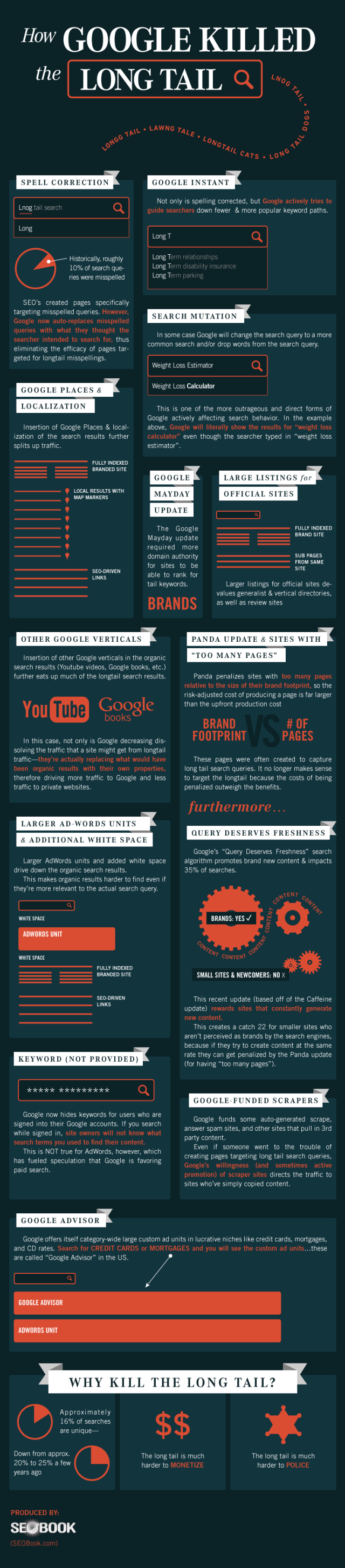
This infographic on SEObook.com caught my eye today.
It’s all about how Google killed the long tail keywords because, over the years, they’ve moved to consolidate search volume against fewer keywords, making it easier for them to match ads against them – take a look, ’tis rather interesting.
Infographic by SEO Book
December 16th, 2011 — copywriting tips, marketing, online marketing
 More and more companies are moving away from the traditional forms of ‘outbound marketing’ such as cold calling, print advertising, junk mail and unsolicited emails.
As people begin to see the light they are starting to understand that consumers don’t like to be ‘sold’ to in this way. They prefer a more subtle approach and the opportunity to build relationships.
This type of ‘inbound marketing’ focuses on the customer finding the supplier through search.
Understanding how to attract customers has been the focus of 2011 for many companies, which is why I thought you might be interested in seeing this fabulous post that appeared on Hubspot Blog a short while ago.
It looks at the top 10 marketing infographics in 2011 and is really worth a look.
You can see if here: The Top 10 Marketing Infographics of 2011
Thanks guys.
December 14th, 2011 — copywriting tips, effective copy, freelance copywriter, freelance copywriting, marketing
The written word is a powerful tool when used correctly.
The effectiveness of all your written marketing communications, whether they are web pages, blog posts, white papers, case studies or brochures, relies entirely on engagement.
If they don’t strike a chord with the reader they will have little or no effect.
Writing marketing materials within your organisation can often lead to text that is full of jargon, unclear and downright boring, which will reflect the reader’s perception of your company. And that’s not good.
Yes, I know what you’re thinking – you’re a copywriter, you’re going to say that aren’t you.
Yes I am, and I make no apology for it. And that’s because over the years I’ve seen a lot of marketing materials produced in-house and, pretty much all of it (with the odd exception), is like that.
The problem is, when you are part of a company, you are usually too close to your product or service to see it objectively. It’s almost impossible to mentally remove yourself from what you know and write about it from your customers’ perspective.
That’s why writing with a copywriter can really help – because they are trained to write compelling copy that will engage your readers.
Different writing tasks
When writing something, do you actively think about what you need to produce and tailor your writing style accordingly?
Probably not.
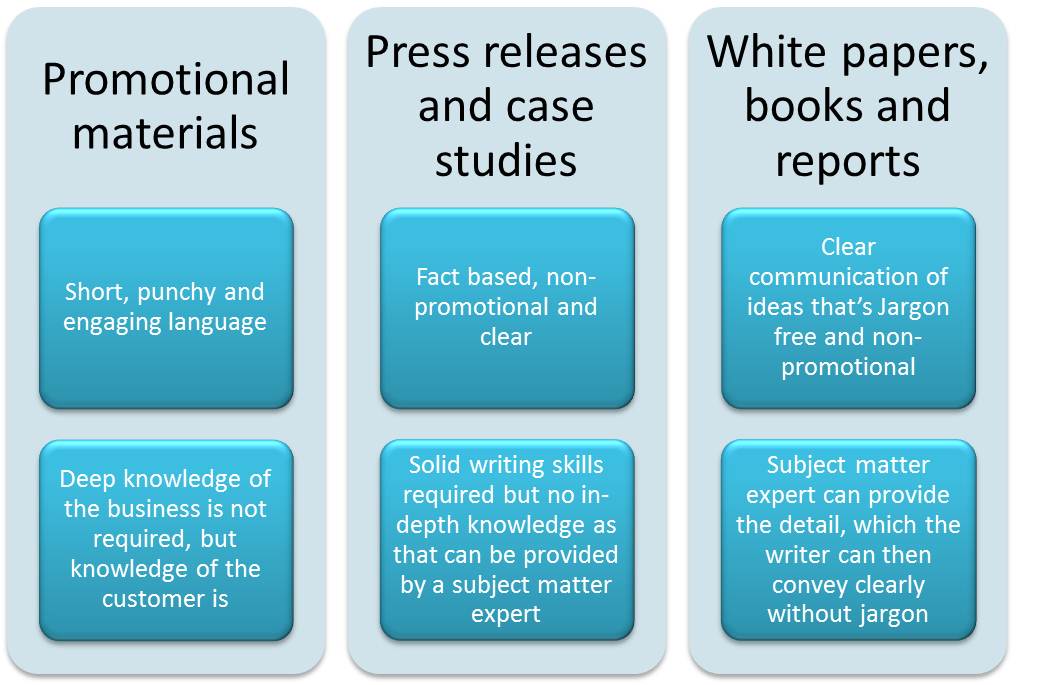
You see, every type of writing demands different disciplines:
Working with a copywriter
First off, let’s get one thing straight – it’s not the copywriter’s job to know everything about your company.
You’re hiring them because they are professional writers and can put across your ideas and information in an interesting, engaging and compelling way.
Therefore, you will need to help them by providing them with background information and other materials to help them get to grips with your business and brand (including your style and tone of voice).
Plus, make sure you give them time to absorb all the information.
The copywriter/subject matter expert relationship
If this is going to be successful, it’s essential everyone knows where they stand from the outset and what they are to bring to the table:
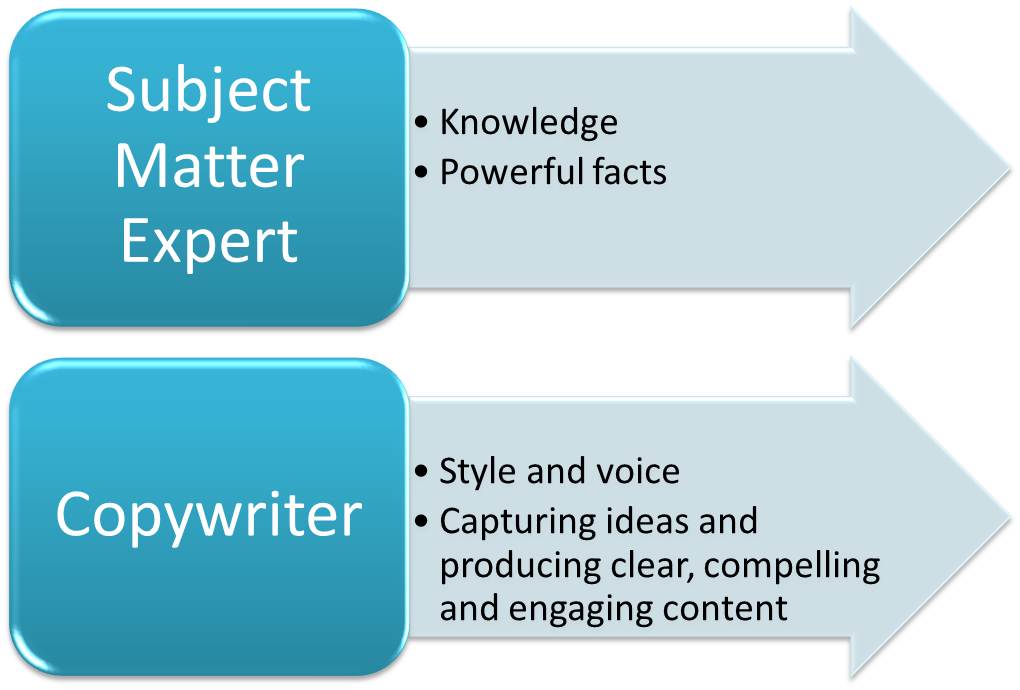
Only by working together can they really do justice to your products and services by shaping and developing great copy.
So next time you engage a copywriter to help you with your marketing materials, remember they can’t produce miracles alone.