January 16th, 2012 — blogging, blogging for business, copywriting tips, White Papers
The humble white paper is a great way to help people make decisions.
If you’re unsure what a white paper is, basically, it’s a document that describes a problem and shows the reader how to resolve it:
• It begins by discussing a challenge experienced by its readers
• Gives a compelling case as to why you should use a particular approach to solve the problem
I guess you could say they are a cross between a brochure highlighting the consumer benefits of a particular product or service and an educational magazine article, therefore conveying technical information within a marketing format.
But happens once they’re published?
The information within them is valuable marketing collateral so it seems a waste to allow it to gather dust.
Make the most of your white papers
White papers can be anything from 6 to 50 pages in length; that’s a lot of information.
Whether you publish them online or produce them as print materials, there is a way to get a bit more mileage out of them.
One such way is to repurpose the content for your corporate blog. After all, how many times have you found yourself scrabbling round for blog posts?
There are only so many times you can pester your subject matter experts within your company to write something for you. Plus, (no disrespect to the technical bods) their writing tends to be too complex for your blog readership who are looking for short posts packed with easily digestible information.
Whether you have the time and expertise within your own company to do this, or you hire in an outside copywriter, a single white paper can create a series of interesting posts.
All you have to do is:
• Re-write the content with your new readership in mind
• Devise a way of splitting the content down into individual sections (a 15-20 page white paper should generate about 7 blog posts)
• Find new ways of presenting the information (e.g. info graphics as well as text)
Before you know it, you’ll have generated a whole new series of marketing collateral.
In this way, a single white paper that would normally have been forgotten about can be converted into fresh, vibrant content that will reach out to a whole new market whilst providing you with an endless stream of blog posts.
January 13th, 2012 — social media, social media marketing, social media training, social networking, twitter
For many new tweeters, that is probably the first question that springs to mind.
After setting up your account, you probably searched for friends, family and colleagues and then came to a grinding halt.
What happens next? How do you find new followers?
Let Twitter give you a helping hand
If you go to your Twitter page, you should see something like this:
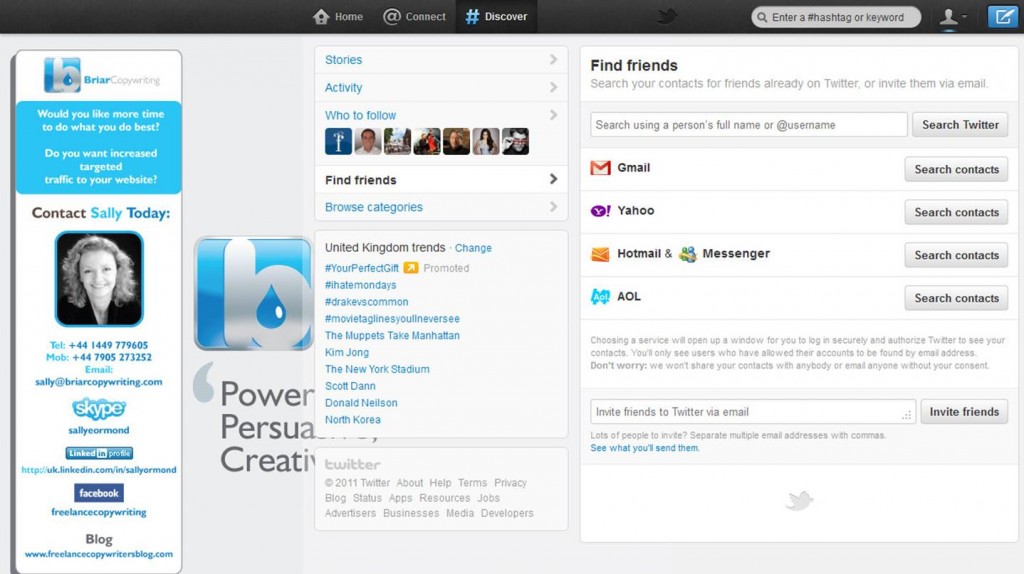
At the top of the screen you can see #Discover, clicking on this brings up this screen. As you can see, it gives you the options ‘who to follow’ and ‘find friends’.
But what happens when people follow you?
Should you automatically follow them back?
The simple answer is no. Take control of your Twitter stream and follow only those people you want to follow.
Here are 5 very simple ways to make sure you get value out of your Twitter experience:
1. Say farewell to spam
When someone follows you, take a look at their tweets. Are they excessively promotional? If so, they are more than likely going to be a spammer. Unless you want your stream full of their plugs, don’t bother following them back.
2. What are they saying?
Someone’s Twitter feed will tell you a lot about them. Take a look at their past tweets – do you find them interesting? If so, follow them, if not, don’t bother.
3. OTT
Tweeters come in all shapes and sizes; some have a lot to say, others very little. If someone follows you who is a prolific tweeter think carefully before following them back. Do you really want them to be filling your Twitter stream 24/7?
If what they’re saying is interesting, go ahead and follow. But if you’re not so sure, it may be better to pass.
4. Silent night
Twitter is all about being social and that means interacting. If you’ve been trying to engage with a particular follower and they’ve just been ignoring you, you’re not really getting any value out of that relationship so it may be time to unfollow and find someone who’s a little chattier.
5. Bio and interests
The best way to find out a bit about your followers is through their biography. Personally, if there is no avatar (i.e. uploaded their own rather than using a generic one), or there is no bio (or a very poor one) I won’t follow back.
Your bio is where you can add details about you, your likes and dislikes. It’s the best way to work out whether you have something in common with your follower or not. If you do, you are far more likely to enjoy a great Twitter relationship.
At the end of the day, Twitter is about being social. It’s not about a band of silent stalkers that don’t interact with each other.
Choose who you follow carefully to make sure you get the most out of your experience. By following these 5 very simple ‘quality checks’, you’ll be able to ensure your Twitter followers will add value to your social media activities.
Sally Ormond – Copywriter and Tweeter
January 11th, 2012 — marketing, online marketing, search engine optimisation, seo

This post was first published back in 2009, but still remains as relevant today as it was back then.
To get 2012 off to a great start I though it worth while pushing this one ‘out there’ again to help you get one step ahead this year…
Everyone has heard of SEO.
But not everyone understands how to utilise it to promote their websites. Many still believe that over stuffing their website copywriting with keywords is what SEO is all about – wrong.
Many believe that by simply listing all the keywords they can think of on their webpages is right – wrong.
And as for those who still insist on using ‘black hat’ strategies – well, we’re not even going to go there.
Understanding SEO and how to use it to get Google to love your website is key in the online world.
At the end of the day, if you’re an online marketer, you’ve got to get to grips with SEO if you want your website to survive and thrive.
Therefore, to help you stay one step ahead, here’s a fantastic guide from those amazing people over at Seomoz.org. They have put together a list of the important and not so important aspects of SEO to help you demystify search engine optimisation – Search Enging Ranking Factors.
It’s a worth while read and will make a world of different to your online marketing.
January 9th, 2012 — b2b copywriter, b2c copywriter, Call to Action, copywriting tips, marketing
What is a copywriting motivator?
Well, before I answer that, think for a moment about what it is that makes you decide to buy something.
First off, you’ll have a need (whether you’re conscience of it or not). Whether it’s a party coming up that you need a new dress for (and shoes, bag, make up etc.), or a problem with your business that you need a solution for, something will trigger a potential buying decision.
Last week, I was leaving my Accountant’s office at about 5pm. It had been a long day and I’d not had a lot to eat. As I walked back to my car, my stomach was beginning to complain bitterly about the lack of food it had seen that day. To reach my car, I had to walk past a new Indian restaurant. The smell was absolutely heavenly – so you guess what I had for tea that night.
In that instance, my motivator was hunger and the solution I was presented with was the aroma of Indian food.
Hitting the right spot at the right time
Generating sales through copywriting motivators is all about identifying your audience and being in the right place at the right time.
The motivators you identify are going to be pressure points that when pressed, encourage your customers to buy.
Therefore, as well as identifying your target market, you’ve also got to convince them they must buy your product or service, because if they don’t, they’ll be missing out on an excellent opportunity.
For arguments sake, let’s say you have an email marketing solution to sell.
You’ve identified your target audience as being SMEs who are looking for an automated solution to help them reach a wider audience via email.
Your copy shows all the benefits of your product; they know they want to buy it because it will help them market their business more effectively, but they’re still hanging back. So, it’s up to you to give them the motivation to buy.
Becoming Mr or Mrs Motivator
OK, it’s time to bring on the big guns.
What is it going to take to make them buy your product?
You’ve already sold them on the benefits and they know your product offers them all the features they’ve been looking for. So how do you get them to take the final step and buy?
It’s time to get motivating:

Whether you use a limited discount, offer a free service (for a limited time only) or limit your product in number (scarcity = desirability), these motivators will encourage your customers to make their buying decision quickly – after all, no one likes to think they’ve missed out on a great deal.
It’s human nature to hang back before parting with our hard earned cash. Every now and then we need a little push to sign on the dotted line.
We all love that feeling of getting something for nothing (or at least a discount), so offering a motivator, like one of the above, will help you get your sale and your customer the service they need.
Over to you
What motivators have you used in the past?
Have you found some to be more effective than others?
Leave a comment and share your experiences.
January 6th, 2012 — Uncategorized
In business, sooner or later you will be faced with presenting a pitch. 
For some people, that isn’t a problem. But for many, they would rather poke their eyes out with a red hot poker than face a potential new client.
As soon as the date is arranged they go into panic mode – hundreds of ‘what ifs’ pour into their head followed by sleepless nights and the inability to eat without feeling nauseous.
So what can be done to help you prepare for the pitch?
Preparation is the key
If you were hoping for a magic formula or a pill to take your anxiety away, then I’m going to disappoint you.
The only way to be confident is to prepare.
1. The phone call
During the phone call with the potential client, try and find out as much detail as possible about what they’re looking for. As a copywriter, I would ask what the project was, who was their target audience, what will the review process be, what format would it take etc.
But don’t just ask questions about the project, also ask:
• Who will be at the meeting?
• Where will it be held?
• Is there any car parking at the site?
• Are they meeting with any other copywriters (it’s always good to know if you’re up against any competition)?
Basically, at the end of that call you want to know as much information as possible about the project and the client.
2. A day or two before the meeting
Next is the research.
Take a look at their website. What sort of marketing are they doing? What is the style of their communication?
See what information you can find out about the people you’ll be meeting – not in a creepy stalker kind of way, but take a look at their previous experience.
Work out what you want to ask them – a great way to start your meeting is by asking an open question to get them talking. This will not only unearth a wealth of information for you, it will also give you chance to catch your breath and ease yourself into the meeting.
3. Before you set off
Check to make sure you either know where you’re going, or that your SatNav is charged up and working.
Have the name and phone number of the person you’re meeting in your phone so, should you get held up, you can ring and let them know.
Leave yourself plenty of time so you arrive calm and collected and make sure you have pens, paper etc.
Most importantly, before you leave, tell yourself you are the right person for this project. You are the writer they need.
4. The meeting
Once you’ve arrived (suited and booted), be calm, polite and confident.
Offer a firm handshake (but not one that will leave them with a crushed feeling), make small talk and then get to down to your first open question and let them tell you everything you need to know to show them you’re the right person for them.
5. Close
Often, you’ll meet with someone who is unable to make a decision there and then because it has to go to the board.
But if that’s not the case, close the sale there and then. If you leave them pondering you could be walking away from the money.
Once they say yes and agree to your payment terms, tell them exactly how you will proceed and what they can except to happen – and make sure you stick to it.
6. Yippee!
Congratulations – you got the contract and kept your nerves at bay.
Reflect on how you presented yourself and your business and remember the success for future meetings.
Finally, grab yourself a large glass of champagne – you deserve it.
Client meetings and pitches don’t have to be scary. A few nerves are good for you, but not to the point your stomach is in knots. Preparation is the key – granted, you can’t win them all, but being ready for anything will help your confidence grow.