February 8th, 2012 — facebook
You could be forgiven for thinking that Facebook is taking over the world.
After all, that’s hardly surprising with stats like these:
- 800 million active users
- 50% of active users log on everyday
- 80% of users are outside the USA
- 7 million apps and websites are integrated with Facebook
This is why more and more companies are looking for Facebook for advertising. But how can you be sure your advertising is generating the kind of ROI you’re looking for?
Firstly, you must have a goal to your advertising campaign and then you have to measure it.
To give you head up on how to achieve that, take a look at this post that recently appeared on the HubSpot Blog.
It is an excerpt from their eBook How to Create Killer Facebook Ads.
So, before you start your next Facebook ad campaign, take a few minutes out and take a look at the 20 Facebook Ad Metrics Marketers Should Know.
Thanks HubSpot.
February 6th, 2012 — blogging for business, Content marketing, Content writer, copywriting tips
What’s the Point of Content Generation?
You all know how important it is to produce a continual stream of content.
But under no circumstances is that content to be a blatant sales pitch.
What? I can’t sell? Then what’s the point?
If you generate content that is just all about selling, no one is going to read it and people will be turned off your company because of it.
But, if you generate content that is full of cracking information that people love, you’ll draw them to you. Mind you, just because you can’t directly sell through your content doesn’t mean you can’t use it to gently persuade them to take a specific action.
What I’m talking about here is to get your reader to do something you want them to do (other than put pounds in your till), such as signing up for your newsletter, downloading your latest report or white paper, following you on a social media platform (e.g. Twitter, Facebook, Google+) or subscribe to your blog RSS feed.
By giving them information in exchange for a relatively minor thing (well, minor in their minds), you can enhance and build your relationship with them.
How to get them to do what you want them to do
There are 2 ways to achieve your goal:
- Through your readers’ fear
- Through your readers’ desires
What do I mean?
Well, everyone is motivated either by having a problem they need to solve, or wanting something that’s going to improve their life, income or general well-being.
In either case, the method to go about convincing them you’re the company they need is to use the following format:
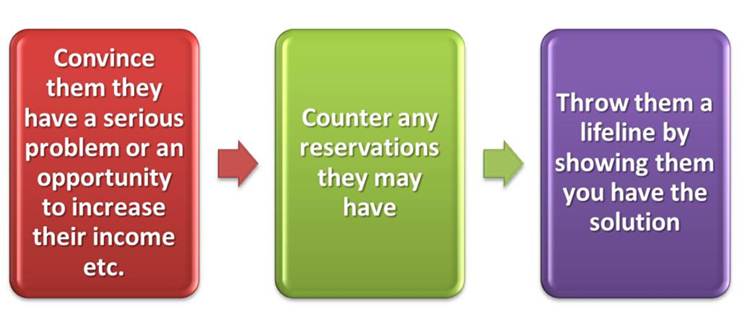
First, convince them they have either a serious problem (this will be particularly relevant if you are a company that helps solve problems) or that they will greatly benefit from you. For many companies, they will fall into both categories, i.e. being a problem solver and a benefits giver.
Secondly, you must counter any potential objections the reader may have, such as price etc.
Thirdly, once you’ve established the fear or desire the reader is feeling, you can offer your product/service as the life line they’ve been looking for.
So, there you go.
Every piece of content you produce must convince your reader to do something, but without overtly selling to them.
Next time you write a blog post, create some web copy or post on a social media platform, think about what you want to achieve from your writing and make sure it has a purpose.
Over to you
Does your content always have a purpose?
Have you found any great methods that work for you?
Leave a comment below and share your successes.
Sally Ormond, Copywriter
February 3rd, 2012 — Achieving goals
 In a departure from my usual copywriting and marketing posts, I wanted to spend a bit of time talking about how to achieve your goals – whatever they may be.
For many people, they know where they want to go, but feel it’s too difficult to get there and so don’t bother.
But for others, the desire to achieve their goals is so strong they make them happen.
So, which one are you?
Setting goals
The key to personal development is to set goals, but you must ensure they are achievable.
For example, if I decided that by this time next year I would be a multi-millionaire, although it would be very nice, it is also unlikely to happen.
Why?
Well, unless I won the lottery, it would be highly unlikely to achieve that level of success in such a short space of time.
But, if I came up with something a bit more manageable…
To illustrate this, last year life began for me (yup, I hit 40). I’ve never bought a brand new car and have always wanted to go into a showroom and order the exact car and specification I wanted. So, I decided that my business goal in the run up to my birthday was to earn enough money to be able to buy my car.
It was hard work, and at times I didn’t think I was going to manage it, but, on my birthday, I went to the Mini showroom and picked up the keys to my new Cooper S.
Now, goals don’t have to be cars. They can be anything from securing 10 new clients to taking a luxury holiday – whatever you want. But having something to focus on like that will help you get to where you want to be.
Achieving your dreams
When we’re kids, we all have dreams of what we want to be when we grow up.
Few of us actually realise them, but they never go away.
I always wanted to be an author and, although being a copywriter I write for a living, it’s not quite as the fiction writer I’d envisaged.
But, after clearing my office ready for its make-over, I came across a manuscript I’d written a few years ago.
It had just been sitting on a shelf gathering dust.
Several years ago I’d sent it to a few publishers and although I came close once or twice, I didn’t manage to find anyone to take it.
But it seemed such as waste seeing it sitting there. That’s when I decided it was time it saw the light of day.
So now, if you pop over to Amazon you can buy my debut novel, Mackerel Skies, for your Kindle.
Who knows – it could be my first step towards realising that childhood dream.
Over to you
You should never ignore your dreams and goals. Regardless of whether they are business orientated or a personal dream, you should always hang on to them and work towards them.
What about you?
Do you have any burning desires you’ve kept hidden?
Share them with us and who knows, you might just find someone to help you make your dreams come true.
Sally Ormond, Copywriter who still dreams of being an author.
February 1st, 2012 — Google, Google +, Google algorithms, Google search
Google’s constantly changing its algorithms to keep us on our toes. But the latest change to its search results is probably the most drastic yet.
“Search Plus Your World” will find content that has been shared with you privately along with matches from the public web, all mixed into a single set of listings, according to a recent post that appeared on Searchengineland.com.
At the moment it will only happen for those signed-in to Google.com and searching in English. For some it will make life a lot easier; however for others, it raises concerns about privacy. Although the private content remains just that, private, it may make the content more visible to friends and family.
Of course, Google’s search has been personalised for some time now, in fact since 2005, and has evolved constantly since then:
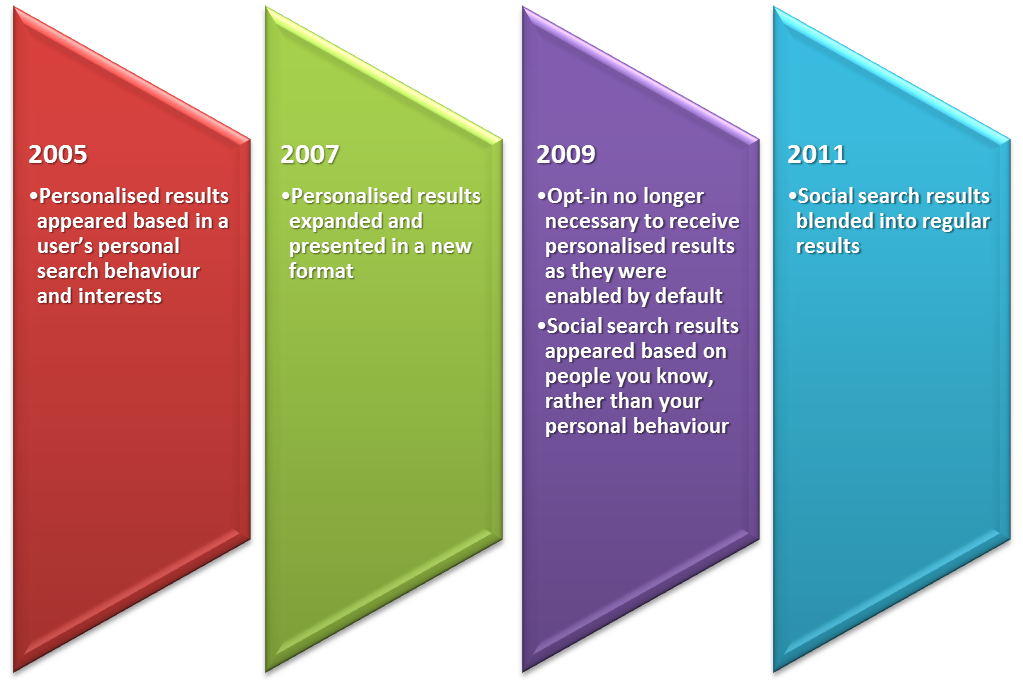
What will the new search method mean?
Your new personalised results will include:
- Listings from the web (general)
- Listings from the web (in relation to your personal behaviour)
- Listings from the web (in relation to your social connections)
- Public Google+ posts, photos or Google Picasa photos
- Private or limited Google+ posts, photos or Google Picasa photos shared with you
You search results will show you the number of personal results and the number of other results. Plus, a new button will appear on the right of your results that will enable you to toggle between your personalised and non-personalised results.
For more information about these changes, take a look at the full article and find out why Google’s results will get more personal with “Search Plus Your World.”
January 30th, 2012 — copywriting tips, Leaflet copywriting, marketing
 This article was supplied by Printed.com, suppliers of unbeatable quality digital flyer printing, and a shortlisted company for this year’s industry leading Print Week Environmental Company of the Year 2011 award.
The author’s views are entirely his own and may not reflect the views of FreelanceCopywritersBlog.com. If you are interested in producing a Guest Post for this blog, please get in touch with your ideas.
A flyer campaign can offer a high return-on-investment due to its ability to reach a targeted demographic with a specific, relevant message. Once you have written your flyer, or flyers, the main issue is how and where to distribute them for maximum effect.
Like everything else, the business world is dependent on the written word to communicate information about its products and services. No matter how many thousand words a picture is worth, text isn’t going out of fashion: there is simply no substitute for a paragraph, page or book of words to get your message across. Your own flyer is a case in point: flyers are an outstanding way to deliver a simple, brief and accessible pitch to potential customers. Although images can add a great deal to them, flyers stand and fall on the quality of their text.
Flyers as a calling card
Whilst the text on any flyer is critical, it takes on a new relevance when the service you are promoting is text-based. Here your flyer presents an additional opportunity and pitfall; it is not just what you are saying, but how you are saying it that will make an impact. As a copywriter, editor, proofreader, advertiser, scriptwriter, bid writer (the list goes on), the quality of the text on your flyer as well as the service itself will form a vital part of attracting new clients. At the most simplistic level, you have to be absolutely obsessive about detail; if you are offering a copywriting service, for example, your potential customers will not have much confidence in you if your flyer is littered with minor errors – something that might be forgiven in a different industry. Conversely, if your flyer is well designed and laid out, and the text is compelling and letter-perfect, this in itself serves as an advert for the service you are offering. The flyer is an advert and portfolio sample in one.
Distributing your flyers
Once you have identified a need or niche, and composed your flyer accordingly, you need to make sure it reaches the right people. One of the biggest advantages of a flyer campaign is that they can be used to target certain demographics. Local businesses with a broad appeal (such as a restaurant, for example) might benefit from distribution to a particular post code. Other services, probably including your own, will require a different approach.
Fortunately, this is relatively easy with a little research. You will know from experience that flyers are distributed in a variety of ways – direct to your door, in magazines and other publications, and displayed in public places. The only task is to establish which of these are most relevant to your business and will provide the best ROI. That way, you need send out comparatively few flyers, knowing that the people they reach are likely to be interested in the service you provide. Specialist and trade publications are a good place to start, since you know that these are industry-or interest-specific. You may also be able to purchase mailing lists of people who have used or expressed interest in similar services in the past.
Conclusion
Some forms of advertising (such as newspaper ads or radio commercials) aim to reach a large number of people representing a cross-section of the population. Consequently, this is best for businesses that have a broad appeal. Flyers, on the other hand, typically reach a smaller number of people with a specific message that – with a little research – can be tailored to their needs. This is why a flyer campaign can offer such a high ROI: flyers are very cheap to produce, and can be sent to the people who will most likely respond well to your message. For a text-based service, there are a wide range of opportunities to distribute your flyer to potential and relevant customers, due to the large number of publications aimed at different business sectors.