Your home page is probably the most important page on your website.
Creating content to make it effective takes time, skill and quite a lot of know-how.
So, where do you start?
Well, although your home page is probably the page visitors are most likely to arrive on, it isn’t a main sales page.
If you think about it, when you walk into a department store (or any store for that matter), all the goods are set out in relevant departments to make it easy for you to find what you want. Your home page should be the same; it is the place that directs the visitor to the section of your website they need.
Before you begin creating the content for your home page, you must decide what your objectives are. Do you want your visitors to:
Buy something?
Sign up for a newsletter/report?
Fill out a contact form?
This will determine how you write and lay out your home page.
Let’s take a look at a few of the essential elements that should appear on your home page.
1. The content
This must talk directly to the reader (i.e. be written in the second person) and tell them what your website is about. It should be obvious from the start what you do and, more importantly, what you can do for your customers. In other words it must show your audience how you are going to make their life better.
2. Establish trust
If you want someone to do business with you, they have to be able to trust you.
How do you create that trust?
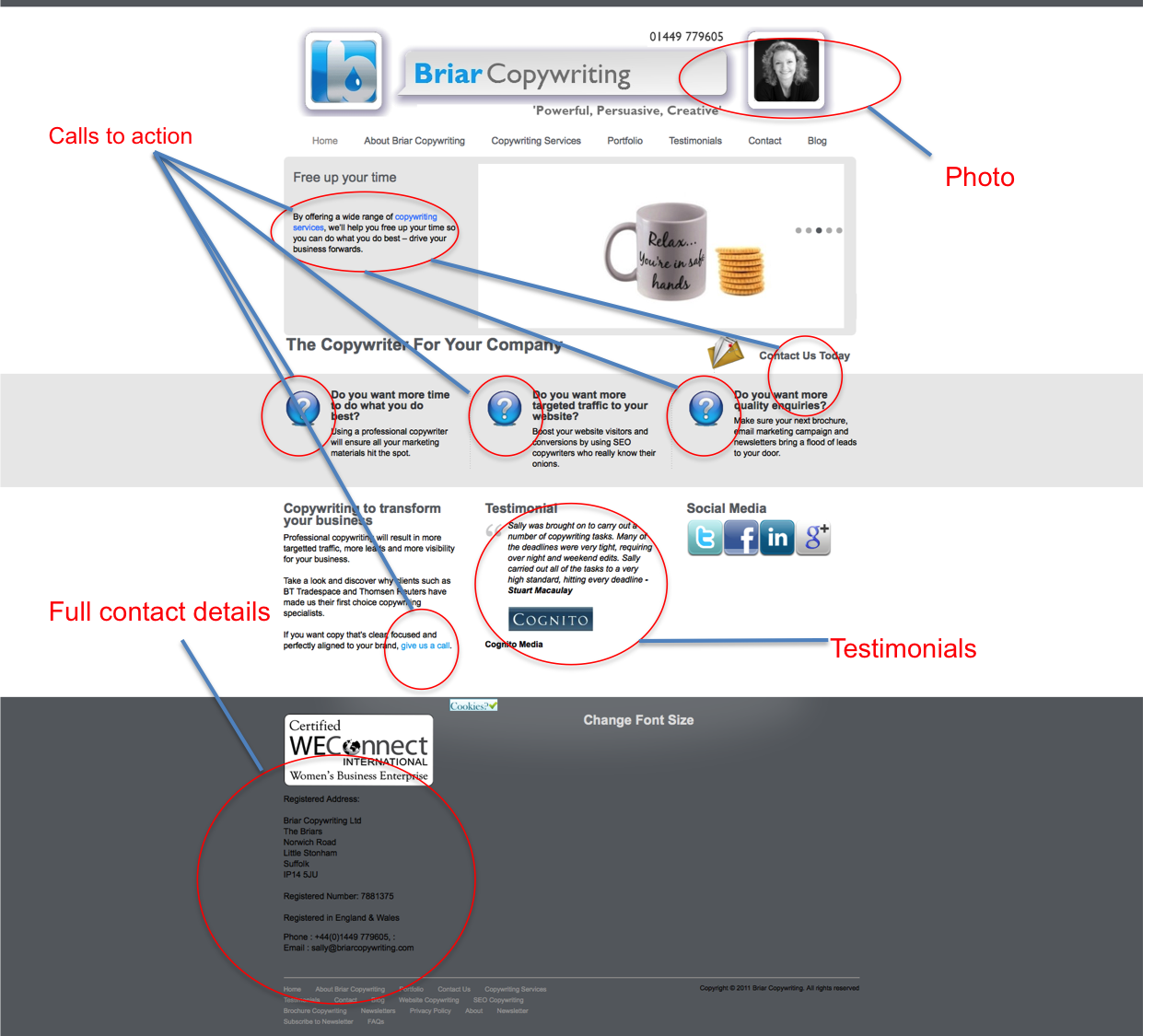
Simply by being transparent – show your full contact details (email, postal address and telephone), have a photo of you so they know whom they are dealing with and show testimonials from past clients.
If that sounds a lot for one page, take a look the home page for my copywriting company:
3. Calls to action
You can also see in the above illustration the calls to action.
These are vital to make sure your visitor is taken to the area of your site that is relevant to their needs. You can have more than one, but make sure they are clear and not overwhelming.
4. Clear navigation
Although your content will contain calls to action that will take your readers further into your site, it’s also important to have clear navigation at the top of your home page (and all your pages) so users can easily get to other pages within your site.
5. Links
Your links are like the transport infrastructure of your website so it’s essential to test them to make sure they work. Broken links won’t do anything for your reputation and may lose you potential clients.
There are other elements you could also add in such as search boxes and videos etc., but the elements listed above are really the bare essentials you need to create a good impression, help your visitors find what they want and ultimately, make it easy for them to buy from you.
Over to you
What other elements would you consider essential for a home page?
Let’s face it dealing with phone calls takes time. Unless you have multiple phone lines, you can only answer one customer at a time leaving the others hanging on in frustration.
That’s also why so many customers like to deal in email rather than waiting in phone queues. That’s a bonus for you because you can sit back and deal with each email as it comes in.
But how you deal with them will say a lot about your company and your customer service.
So, how can you make a good impression?
1. Make sure you have an email address shown on your website
More and more companies just have contact forms on their websites. There’s nothing wrong with that so long as you make sure they are working and that they are monitored.
I’ve lost count of how many companies I’ve tried to contact this way only to never hear anything.
If you also list an email address, it offers reassurance to the reader that you’re a real company that wants to hear from its customers (the same goes for the inclusion of a telephone number and postal address).
2. Answer promptly
Even though they sent an email, your customer will still want a quick response. At the very least this should be the same working day, but preferably within the hour.
If you know it’s going to take a while to look into their query, at least send an email to reassure them that their email has been received and that you are looking into the matter and when you will get back to them. If you keep them updated in this way they at least know their query is important and is being looked into.
3. Name
Make sure you use their name in your response. There’s nothing worse than sending a company an email that included your name (in your signature and email address) only to receive a reply that started ‘Dear Sir/Madam’.
4. Thank you
It might sound obvious, but start off your response by thanking them for their email. Even if they were complaining about something it’s important to show them that their correspondence is important and valued.
5. Answer everything
Many emails will ask several questions, so make sure you answer everything. There is nothing more frustrating than receiving a reply to your query only then having to send another email because part of your initial question wasn’t answered.
Before you hit send, re-read your response to:
a) Make sure answered everything
b) Make sure there are no spelling or grammatical errors
6. Get straight to the point
The recipient of your response doesn’t want a great long essay turning up in their in box, so make sure you get straight to the point and answer their query.
Oh, and always end with something along the lines of ‘If we can be of further assistance, please get in touch’.
Although each of these points appears to be common sense, you’d be amazed at how many are ignored.
Over to you
Do you have any other tips you can add about using email as an effective customer service tool? If so, leave a comment below.
“OK, this is it lads. We’re going to create a viral video for our latest project. Any ideas?”
Well, if that’s how you think the process starts to create viral marketing for your business, you couldn’t be more wrong.
For a start, you can’t make something go viral – that’s the public’s job.
What is viral marketing?
Well it’s a way of using social networks to promote brand awareness (or boost sales) through a self-replicating viral process. Which means that you create something others love and feel compelled to share with their friends…who then share it with their friends…who then share it with their friends…who then share it with their friends….you get the idea.
And that is precisely why you can’t ‘make’ a viral video, image, eBook etc.
Qualities of viral marketing
The only way you’re going to make your piece of marketing go ‘viral’ is by creating an emotional connection with your view/reader.
Someone isn’t going to share your collateral just because you ask him/her to; it has to resonate with them and compel them to click the share button or talk about it to their friends.
There are no rules to say it has to be funny, gimmicky or super clever – it just has to evoke an emotional response.
OK, that kind of leaves the door wide open, but quite often the simplest ideas are the best.
That means studying your audience, studying your product (and the relationship between the two) and then working out which emotional connections your brand needs to make to kick-start the immediate ‘need to share’ reflex.
With the country gripped by Olympic fever, this has to be my favourite video on YouTube at the moment. OK, it’s not a product or a sales pitch, but it captures the excitement of a nation:
Reaction of the BBC commentary team as Mo Farah wins with 10,000 metres in London 2012.
What’s your favourite?
We’d love to compile an ‘all time favourites’ list of viral marketing, so leave a comment below with details of the one that captured imagination – and tell us why.
Do you want to see your website in Top 10 position in Google or other major search engine?”
Day after day I receive umpteen of these emails from SEO companies (and others) telling me they can get my website into a top 10 position in Google.
First, this is obviously a blanket email, because if they’d done any research they’d realise that my website was already on the front page for my chosen keywords.
And secondly, it’s addressed to ‘Sir/Madam’, so they haven’t bothered to take the trouble to personalise their email.
Not a great start then.
We’re all used to getting these types of emails, but it’s essential that you don’t fall into a similar trap when undertaking your own email marketing.
To spam or not to spam, that is the question
A little while ago I posted on the UK Business Labs forums about email marketing and how to get the most from it by offering relevant and targeted emails to your own, home-grown opt-in marketing list.
This caused a furore as it was intimated by a reader that email marketing was spam regardless of whether you use an opt-in list or a bought list.
However, provided you follow a few basic courtesies you should avoid alienating any of your customers.
Be clear from the start
The only way to gain trust and keep your customers happy is to be clear and upfront with then from the outset.
If you are cultivating your opt-in list to send out a newsletter, tell your customers how frequently you’ll contact them.
If you want to send a newsletter and occasional email marketing messages or offers, again let them know. If possible, offer a choice of messages so they can opt-in, for example, to your newsletter but not your other emails.
Giving them choice and being open and honest about what you intend to do with their email address will generate that all important trust that’s vital for strong and lasting customer relations.
Divide and conquer
As mentioned above, splitting your email marketing list and offering different communications that people can opt in and out of will help you target your marketing efforts.
That way, you won’t cheese off half your customers.
Get personal
Don’t send out generic emails addresses to ‘Sir or Madam’. Use their name and make your communications personal.
So, is using an opt-in list spam?
Not in my book.
People who want to receive your news and offers gave those email addresses. So, provided you stick to your promise of what you’ll send them and when, how can that possibly be seen as spam?
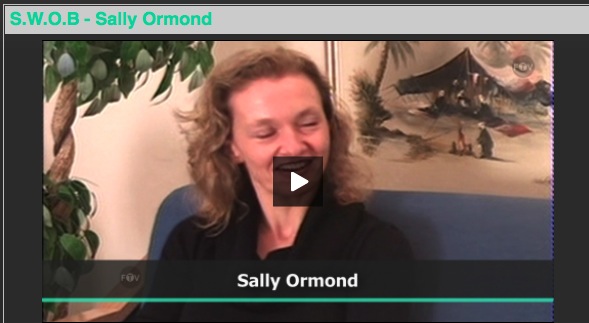
A short while ago I was asked to do an interview for Felixstowe TV for their Suffolk Women Owned Businesses (SWOB) channel.
If you’re slightly curious about how I got started, what I do and other bits and bobs about me, follow the link below, grab a coffee and watch the video.
Don’t expect an Oscar winning performance (I’m no Angelina Jolie), just a candid chat with a Suffolk copywriter.