The SEO writing world is an evolving matrix of content creation and it’s no secret that the practice of link building is deployed with the goal of getting ranked in major search engines. While link building is an effective strategy, like anything else, there are people who abuse the system. While Google does its best to limit manipulative link strategies, at base level it’s up to the writer to produce legitimate content and actually earn their link. It feels good to help a webmaster truly revel in your article’s meaning.
It’s a safe bet that algorithm updates will begin to be increasingly efficient as we push forward into a new internet frontier. The days of submitting spun articles to content farms and achieving first page results are becoming a thing of the past. Illegitimate SEO strategies have been thwarted by Google’s Panda and Penguin updates, the latest on May 22nd of this year, and it’s becoming imperative for guest bloggers to take more pride in their work.
Producing average content for average sites with the goal of achieving one of many average links is bad practice. It’s time for SEO writers to step up, play by the rules and help people. Not only do low quality articles and links pollute the internet, they suffocate the experience of the end user.
Below is a two-step checklist to utilize if you’re link building, whether you’re doing it for business visibility or individual authorship. It’s your obligation not only as an SEO writer, but also as a human being, to produce legitimate content. Not only does it enhance your visibility in the targeted SERPs, it never hurts to provide actionable knowledge to the end users scattered across the globe.
1. Is the content well researched?
Too often there are articles on the internet that don’t help anyone. With the internet being a multifaceted platform for information creation and transmission, content will always be king. No Google algorithm will ever compromise content with true integrity. This should be music to the ears of all guest bloggers. If you do your research and write informative articles for the greater good, you control your own fate in the industry.
This first step in your checklist is to determine if your article is well researched and if it has the potential to actually teach someone something. A guest post goes from a boring thread of words to a game changing article when adequate research is done. You should be an expert in whatever industry you are guest blogging about. If you aren’t, you better do some serious research.
Why a webmaster will appreciate you:
Any site owner will feel honored to post a piece of content that they feel is well researched and could provide true benefit to their readership. Guest bloggers often require the approval of a targeted domain; you need to embrace this approach and mentality. Make it worth it and your success rate, and your reward, will be much better.
2. Is the topic relevant to the site?
A relevant-first mentality when it comes to link building is a top priority when webmaster appreciation is concerned. Site owners want progressive material because it helps their domain authority and keeps their blog fresh.
Someone that operates a blog exclusive to NBA basketball doesn’t want an article on lacrosse. Furthermore, it’s a waste of everyone’s time to even pitch this idea. Even if a site owner accepts an off-topic article, it will end up hurting you more than helping when the next Google algorithm rolls out.
Backlink portfolios littered with irrelevant links are prime targets for penalization. An unrelated article also does nothing for the end user because their intention was to read content associated with the domain they searched.
This second step is meant to test your relevancy. Google has been cracking down on content that is just sprayed blindly over the internet. You need to be calculated and focused when you select a home for any article. Not only does it have to be well researched, the location of it needs to make sense. If you don’t take note of relevancy, someone will.
Why a webmaster will appreciate you:
Fresh, informative content is like a ripe blackberry to a site owner. Of course they want it, and yes, they will appreciate you. It’s important to view this on a human level and try and separate yourself from the SEO world in a certain sense. At the end of the day your goal should not only be to build links, but to teach people something that can enrich their life. The rankings will follow.
Link building, when done with relevancy, makes sense for everyone involved. If you’re promoting a business, it’s being promoted in the right place and in the correct fashion. If you’re trying to gain authorship in the basketball world and you write a stimulating article on LeBron James, your authority in the niche will skyrocket.
Link building, specifically when done through content creation, can be a beautiful system. Everyone in the world has authority and is an expert in some life experience. In life, teachers are obligated to be educated in what they teach. It’s just as important that SEO writers understand the industry they’re explaining and that they strive to gain the respect of both accepting webmasters and the resulting audience. Google does its best to create fair and genuine rankings, but the bottom line is that the integrity of link building is up to those participating.
Author:
Peter Buffington is a writer who’s been cage diving with Great Whites. When he’s not anticipating the next NBA playoff series he creates content for Page One Power, a relevancy-first link building firm based in Boise, Idaho.
One of the biggest barriers to content marketing faced by many businesses is ideas generation.
Many decide it’s not even worth considering because they don’t feel able to come up with the constant stream of information a content marketing strategy demands.
But it doesn’t have to be difficult to generate ideas; you just have to look at things a bit differently.
How do you go about coming up with content topics at the moment?
Do you just sit at your desk and stare into space hoping for a blinding flash of inspiration to strike?
That might happen now and then, but you can’t rely on that to generate the constant stream of ideas you need.
That’s where Google, Yahoo, YouTube, Quora, LinkedIn and your customers come in to their own.
Want to know more?
Google – the ideas machine
Google can help you in a couple of ways: through Google Suggest and its related searches results.
With Google Suggest, all you have to do is enter your keyword in the Google search box and then wait for Google Suggest to do its magic.
Below you can see that I entered ‘How to train a puppy’ as my keyword and then Google provided a list of alternative popular searches, providing me with a range of topics that I can write about.
As an added bonus, when you search for that keyword, at the bottom of the search engine results page Google then provides you with a further list of related search terms .
So, from one simple action I now have multiple ideas for content generation.
Yahoo! and Quora
I’ve put these two together as they work in fairly similar ways.
Yahoo! answers and Quora provide content marketers with a plethora of information. They are a great place to start your research. Browsing both sites, using your keywords, will throw up all sorts of ideas based on the questions being asked by users.
After all, if people are asking questions it means they are looking for answers, so they are the topics you want to be writing about.
YouTube
YouTube isn’t just a video viewing website, it’s also a great source for content ideas.
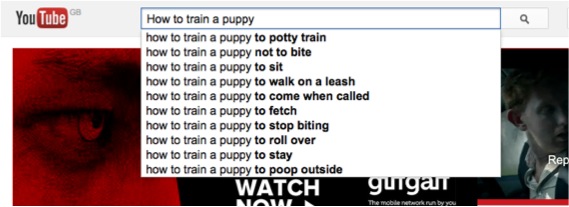
It works in a similar way to Google Suggest in so far as you enter your keyword into the search box and then YouTube will list other related searches.
As you can see I’ve used the same keyword as in the Google example, but here YouTube has come up with a different range of suggestions, so now, one keyword has generated several different content ideas.
LinkedIn groups
Are you a member of any LinkedIn groups? If so, you’ve probably seen the emails that are generated when someone poses a question. Again, these questions are a rich source for your content ideas. Use them to write informative articles that you can then post on LinkedIn, your blog and other article sites etc.
Customers
Last, but by no means least, are your customers.
What better source could there be? Talking to them directly, or monitoring their questions (via email and social media) will unearth a rich source of content ideas, giving them the information they want.
Generating ideas for your content marketing strategy is easy. All you have to do is decide on the subject area you want to cover and then do one or more of the above to generate a whole raft of ideas that you can write about.
Do you use any other methods to generate ideas? If so leave a comment below and share them with us, it would be really interesting to get your take on this subject.
No one is perfect (no, not even you) and that’s why proofreading is an essential skill for any writer.
Copywriting, blogging, emails etc., must all be error free if you want to build your reputation. Yes, sometimes, despite your best efforts errors will slip through, but it’s important to make sure you minimise this from happening.
To help you out, here are a few tips to improve your proofreading.
1. Not now!
However tempting it may be to proof your copy or blog post as soon as you’ve written it, don’t.
Leave it for at least an hour (preferably 24) before checking it, that way it should be easier to read what you have actually written as opposed to what your brain thinks you’ve written.
2. Hard copy
Yes, I know we’re supposed to be in a paperless age, but it’s a proven fact that reading from a hard copy is much easier than from a screen, maximising your chances of finding all the errors.
3. Silence
If you get distracted you’ll miss typos, so make sure you turn off your social media alerts, email and phone so you can concentrate on the job in hand.
Then read through slowly, marking the errors as you find them in red pen (just like school days). Make sure you mark where each correction is by adding an ‘x’ beside the relevant line in the margin.
4. Loud and clear
Read it out loud too. This will help spot any punctuation errors or typos you have missed and it will help you hone your conversational writing style.
5. Check details
If you have people or brand names in your document double check to make sure you’ve spelt them correctly. The same goes for any other details (facts and figures) and web links.
6. Last call
Once you’ve gone through all these steps and made the corrections to your document, give it one more read through before you publish it or, if it is a piece of copy, send it on to your client.
Granted, none of this is ground breaking stuff, but considering your reputation is at risk, it is essential.
I set up my business, Briar Copywriting in 2007 and have always done my own search engine optimisation.
Despite a few hiccups along the way, I have managed to maintain great rankings for my chosen keywords. But then Penguin came along, closely followed by Penguin 2.0.
This latest change was meant to weed out those sites with slightly dodgy links. As I have always done my own link building and have been very careful about it, it’s incredibly frustrating when I get hit despite not bending the rules. So I’m now left having to look through all my inbound links to see what’s causing the problem.
But that’s beside the point.
Why is search engine optimisation like riding a bike?
Well, I am currently training for an epic charity endurance bike ride – the RideUK24 Newcastle to London challenge that’s taking place this August (300 miles in 24 hours).
Over the weekend I cycled from Suffolk to Bedfordshire and back (stopping over night), which is total of 160 miles (carrying a rucksack – not advisable when cycling long distances).
Whatever happened I knew I had to keep going. If I didn’t:
My training schedule would go out of the window
I would have fallen off my bike as my shoes clip to the peddles
And search engine optimisation is the same. As soon as you stop promoting and link building, your website will start to plummet.
But as if that wasn’t enough to contend with, Google has the power to make or break a business over night (even those who have always abided by the rules – sorry, I’ll stop ranting and get on with the meat of this post) simply by tweaking its algorithms.
That’s great to get rid of the spammy sites so the results you see are the most relevant, but not so great when you’ve done nothing wrong and you still get hit (sorry, got back on the soap box again briefly).
So how can you make sure your site stays in favour with Google?
Well, up to last week I would have said link build naturally and carefully, never pay for links and if you exchange links, be very careful whom you do it for.
But then, I’ve always built links naturally and never bought or exchange links – so what’s the answer?
Perhaps Google can answer that one?
Over to you Google
I’d love to get a definitive answer to this one.
So if anyone at Google happens to stumble across this post, perhaps you’d be good enough to explain?
What about you reader? How have you coped with the algorithm changes? Have you had to recover from the updates? If so, how did you do it?
Leave a comment below and let’s find out what the effect of these algorithm changes really mean to business.