December 25th, 2009 — copywriting tips, freelance copywriting, website copywriting

Words can be a powerful force when used correctly.
In a novel they have to conjour up an image in your head so you can visualise the characters and scenes they are playing out. In the world of marketing they have to be direct, simple and to the point.
This is something I frequently have to remind my clients – not all, but a few.
A while ago, I was writing for one client and nothing I produced seemed good enough. It was frustrating because I knew what I had written worked. No matter how many times I explained my reasons for using certain layouts and words, it wasn’t good enough.
The reason…
“I thought you were supposed to make me sound more intelligent.”
Eeek! And there was me thinking the whole purpose behind copywriting was to generate sales.
So what does a freelance copywriter do?
Working as a freelance copywriter, it is my job to create great copy which will be interesting and sell – but without being ‘in your face’ super sales hype.
I write all sorts of copy from SEO website copywriting through to reviews and just about everything else in between.
Let’s take website copywriting as an example. If you could ask someone what their reaction was when they landed on your website, which scenario would you prefer?
Scenario 1
Reader – “Gosh, what a superbly written site. You are obviously incredibly intelligent and well edcated.”
You – “Why thank you, and what did you think of our product?”
Reader – “Product? Oh, were you selling something too?”
Scenario 2
Reader – “Amazing, that’s just what I’ve been looking for. It’ll solve all my problems.”
You – “Great. What did you think of the writing on the website?”
Reader – “Writing? Oh, I don’t know. I was too interested in your product and how it would help me.”
I think I know which one I would perfer.
Invisible writing
It sounds rather strange that your writing should be invisible to your reader, but that’s how it should come across. The words you use have one purpose only – to convince your reader the product you are selling is the one for them.
Becoming blinkered by your own writing ego is the fastest way to churn out redundant copy. If someone is reading your website or brochures, they are doing so for one reason only – they want to know if your product is a fit for their needs. If they can’t find that our quickly, they’ll move on to the next company’s product.
Clear, conscise and simple – that’s it. No frills, no sparkles and no sequins.
December 23rd, 2009 — copywriting tips, freelance copywriting, website copywriting
If you are a website copywriter or have a website and have dabbled in producing your own content, you’ll probably have used the HTML H1 – H6 tags in some way, shape or form.
But do you fully understand their SEO capabilities?
We all know that a solid block of text on your website isn’t going to attract anyone. Your reader will see it and head for the hills. It’s just like when you were a little kid getting excited about the mystery present under the Christmas tree with your name on it. Eagerly you’d run your fingers around the paper trying to guess what was inside. When your finger found a seam that wasn’t covered in sticky tape, you’d rip the paper away. As your excitement grew it suddenly faded as the book fell in your lap. Even worse, it fell open to show page after page after page of text – no pictures!
OK, I got a bit carried away but you get the idea. Solid text is about as welcome as an angry skunk in a phone box. If you want people to read your website, it has to have loads of white space and be divided into bite size chunks. And the best way to do that is by using headings and sub headings.
Where do I stick my H1 tag?
Tempting…
OK, being serious for a second, your H1 tag – if you’re unsure – is normally used in the main header of a web page because it creates the largest font size. But not only that but it takes precedence over other text types when the search engine spiders come crawling by.
Because of this the H1 tag should:
- Appear only once on your web page
- Be at the top of your page content
- Contain your most important keyword
- Help your reader understand what your page is about.
What about the other tags?
The H2 – H6 tags are given slightly less priority over H1 but are still important. You often see the H2 and H3 tags being used for sub headings in web pages. These therefore should contain your longer tail keywords.
Of course the added bonus in getting used to using these tags means you’ll break up your text into smaller sections. This will increase the amount of white space on your page and consequently make it easier to read.
Your headings will act as sign posts so your reader can easily scan your page to find the information they are looking for.
How do I add these tags?
You’ll probably be using a WYSIWYG editor to enter your text which looks a bit like this one:
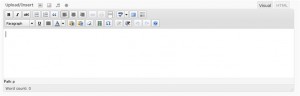
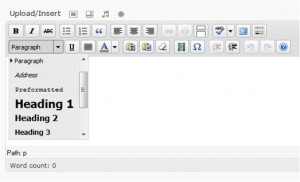
To choose your heading click on the button highlighted and you’ll see a choice of font types appear. Just type in your text, highlight it and then click on the text type you want.
Position is everything
You see, when you are preparing your copy for your website there is a lot more to think about other than what words you’re going to use.
You also have to consider what SEO features you want your site to have and exploit the positioning of your keywords to the max.
If you are using a freelance copywriter they should be able to advise you on this, but if you’re going it alone, hopefully this post will give you a better understanding of where to place your keywords and why.
The H tags are only a small part of on screen SEO but I hope that this blog post will help you review your current website and make a few changes to squeeze a few more drops out of your SEO.
December 21st, 2009 — copywriting, copywriting tips, freelance copywriting
 One question I am frequently asked is how I got started in the world of freelance copywriting.
Whether you’ve worked as a copywriter in an agency or company or whether you are looking to break into the industry from another direction, the thought of going it alone can be very daunting.
- Where do you find your clients?
- How do you get a steady stream of work?
- How do you find leads?
A bit about me
This is how I got started.
Before writing for a living I’d worked in the financial industry and charity world. Writing had always been a bit part of these roles, especially learning how to take on someone else’s voice. But it was my time with the charity that lead me to discover a talent for direct mail and persuasive writing.
While my children were small I did a BA(Hons) degree in English Language and English Literature with the Open University. That was the hardest 6 years of my life – trying to juggle studying with small children. But I graduated in 2007 with First Class Honours and it was at that point that I decided to take the plunge.
I wanted to work but, with a young family, I also needed to be around for them – becoming a freelance copywriter was a perfect fit.
How do you start without a budget?
Yes, I was in that boat too.
The one thing I realised (even with my limited knowledge of the internet) was that I had to be online if I was to succeed. All I had was a lap top. So I invested some time into building my own website – without any HTML knowledge – boy was that fun! Talk about a verticle learning curve (can you have a vertical curve?) but with a bit of perseverance I got there.
Then I began researching every freelance profile and directory site and listed my details anywhere and everywhere. I didn’t realise it at the time but this would help my SEO later because of all the backlinks I was creating.
Anyway, to cut a long story short, work began trickling through. And I do mean trickle – this suited me, I didn’t need a huge income straightaway. That wasn’t why I began this venture. For me, my copywriting business is about helping people – the money is almost secondary. I get a lot out of helping other businesses – especially when I can see how much better their website would perform if it was professionally written (or their brochures, emails, newsletters etc.).
As my business grew I was able to invest in a new website and the rest is history.![website [Compatibility Mode]](http://www.freelancecopywritersblog.com/wp-content/uploads/2009/12/website-Compatibility-Mode-300x235.jpg)
The word of the blog
It wasn’t long before I realised that the best way to build content and links was by blogging. My initial tentative steps into blogging was using a wordpress blog. That was fine as far as it went, but after a huge wakeup call courtesy of WordPress, I realised I needed to get my own blog with my own URL – hence this blog.
The effect was amazing. It had only been going for about 6 months when it was picked up by oDesk in their top 100 freelance blogs. The resulting link catapulted my website onto the front page of Google for several of my keywords.
My blogging and article writing had positioned me as an expert in my field. People could instantly see I knew what I was talking about and my business grew rapidly.
10 top tips to get started
So what are my 10 top tips to break into the world of freelance copywriting?
- Get online – make your website eye-catching and get your copy right. If your copy doesn’t sell you, how will you write powerful copy for your clients?
- Start blogging
- Submit articles to directories
- Build backlinks
- Join social networking sites and participate in forums
- Start tweeting
- Get out and network with local businesses
- Get to grips with SEO – it will help you and your clients
- Don’t be afraid to write for an industry you’ve no experience of – you’ll bring something fresh and new
- Grow a thick skin
That’s just my story. Today I work with companies all over the world over a vast range of industries. My leads come through this blog and my website plus referrals. I no longer have to go out and find work – it comes to me.
I’m thankful to be able to do something I love, get paid for it, and know that it is helping other businesses (of all sizes) succeed too.
A resource for new writers
Has my story inspired you?
You may also be interested in a guide I recently came across called Freelance Superstar by Monika Mundell and Gobala Krishnan. It is a complete guide to get started with freelance writing. If you are just starting out it will give you some handy tips on how to set up, find business and cope with the freelance way of life.
Good luck – and if you need any advice just drop me a line.
Sally
December 18th, 2009 — facebook, freelance copywriting, social media
Slower than most people, I have just started to get to grips with Facebook pages.
I use social media a lot in the marketing of my business. As a freelance copywriter the vast majority of my clients find me online, one way or another. So, utilising Facebook for business seemed the logical thing to do – after all it’s another web presence and another opportunity to build up content.
These ideas always seem great, but when it comes to putting things into practice, it gets a bit more complicated.
But I now have my freelance copywriting facebook page up and running. Why not pop over there now and take a look. If you like what you see become a fan.
I’m waiting to say hi!
December 16th, 2009 — copywriting tips, freelance copywriting

Because copywriting is sales writing it is designed to be read, persuade and sell.
Your writing has to emit a magnetic force that is so powerful it draws your reader in and holds their attention.
This isn’t a God given gift that only freelance copywriters have; it is something that anyone can achieve if they follow a few simple rules.
Want to know what they are?
Be direct
That doesn’t mean “Buy it!” will work.
People have a tendency to ‘over write’ because they think it sounds better – it doesn’t.
For example: “Most primary school children almost certain believe that Father Christmas still exists.”
Long winded or what?
“Most primary school children believe in Santa.” – Much better.
Repetition
This can be done in a good way to create a rhythm that’ll draw your reader in. Repetition can be good when done well. Repetition can be annoying when over used.
Active
If you use the passive voice in your writing you’ll use more words, appear lazy and produce something that’s not engaging. A passive sentence would be “the cat was stroked by the girl” but by swapping round the subject and object of the sentence you will make it active – “the girl stroked the cat”
Being active is much better.
Brief
When it comes to writing, less is most definitely more. When people read, they usually manage the first few sentences and then start scanning. Get your important information in early and don’t waffle.
Short sentences
Short sentences are easy to read. They are easy to understand. When you start getting complicated, and I think we can all be guilty of that at times, people begin to get bored and you run the risk of them deciding it’s not worth persevering with your overly long sentences especially as by the time they’ve reached the full stop they can’t remember what they were reading about anyway. (Gasp for breath!)
Debate
Don’t answer all their questions. Leave them wanting more.
No adjectives
Adjectives are nasty little suckers that sneak into your writing and dull your message. During your first editing read through be ruthless and banish them.
Story
Tell them a story about how your product solved someone’s problem. Understand what your product can do in a real life situation is very powerful.
Informal
Be conversational in your writing. Resist the temptation to write in a regional dialect – that really won’t work. Talk to your reader and they’ll respond; talk at them and they’ll walk away.
By putting these simple ideas into effect you’ll produce sales writing that’s readable and engaging.
Good luck.