August 4th, 2010 — copywriting tips, email marketing, freelance copywriter, marketing, twitter
 Email marketing has been a revolution for many businesses.
It has given them an opportunity to market to thousands of people simultaneously and in a very cost effective way. Not only that, but it is also measurable – you can see who’s opened your email, what they did after they read it etc.
But, as a copywriter, one of the hardest aspects of email marketing is coming up with a subject line that makes people want to open the email. It is the do or die. If you can’t get people to open it, you not going to sell them anything.
Creating subject lines takes a lot of work and in my previous post 10 Words That Will Make People Open Your Email I shared with you some powerful words that would help boost your open rate.
But the best way to determine the effectiveness of any subject line it to test it. Split testing is often used – send one group an email with one subject line, and then send another group the same email but with a different subject line. But how about using social media to test their effectiveness?
This, I will admit, was something I’d never actually thought of until I read a post on BlueSkyFactory’s blog. In How to use social media to boost email marketing open rate, Christopher Penn describes how he used Twitter to help determine the effectiveness of an email subject line.
If your Twitter following resembles the demographics of your email marketing list, why not try it out?
If you do, bookmark this post and come back and tell me how you got on.
August 2nd, 2010 — copywriter, copywriting tips, freelance copywriter, proofreading
 Like most people I’ve always dreamed of being a writer. When I was at school I had a pink hard back note book I used to write stories in. I used to think they were the best thing since sliced bread but I wouldn’t let anyone else read them; they were mine, something I had created and were for no one else but me.
I found that little pink book a few months ago and had a read. Boy am I glad I never showed them to anyone else! The sad thing was I thought they were good. They weren’t.
I’ve not given up on the writing dream and have written a novel and a half in my adult years (not published) – after the pink book scenario I’m even more wary of my writing. Mind you, in a funny way I have ended up earning a living through writing – being a freelance copywriter wasn’t exactly how I’d envisaged it but I love it. Watch out J.K. Rowling – one day…
The pink book taught me a good lesson about reviewing my work. During the writing process you become completely absorbed in what you are doing. You are so close you can’t see beyond the words you’ve written which makes reviewing it very difficult. But, over time (as with the pink book), your perception of your work changes making it easier to be more critical.
But, as a commercial writer, time is usually of the essence. You don’t often have the luxury of being able to put your work away for a few months (or longer) before reviewing it. So performing an effective critique on your own work is difficult.
To help you, I’ve put together five tips to review your work effectively which I’ve used over the years.
1. Leave it
As I said earlier, this one isn’t easy. Because of tight deadlines you won’t have the luxury of leaving your work for a long period. However I normally find that by working on several projects simulatneously, I can complete one task, leave it for 24/48 hours and then review it.
That is normally enough time (especially if I’m working on a number of things) for me to come back to it with fresh eyes.
2. Get someone else to read it
This one is going to depend on how you work. I work alone so it’s a bit difficult to get someone else to read things for me (although my husband has been known to be dragged in to read things for me). But if you can get a second opionion, that will help enormously.
3. Read it like a reader
This one takes practice. Even though you’ve taken the time to research and get to know your client’s business intimately to write about it, you now have to look at your copy as a reader would; someone without any prior knowledge of the product or company. Look out for sections that are irrelevant. Does it get to the meaty benefits quickly enough to keep your interest? Does it answer your questions? Does it tell you what to do next?
4. Read out loud
Number 3 will help you determine the effectiveness of your writing, this one will help ensure your English is correct and that it flows. I always feel a right Charlie sat in my office reading my work aloud, but it really works. Only when you can hear it with intonation, can you really asses its rhythm and voice. If you stumble over sections, re-write them until they flow easily.
5. Proofread
This is the last thing I do. Thorough proofreading is essential. The quality of your writing will speak volumes about you so you must make sure it’s perfect. I don’t know about you, but I find reading off a screen really difficult so I always try and proofread from a hardcopy. Plus reading backwards is a great way to find mistakes. Frequently, when you read something you’ve written, your mind will play tricks on you filling in missing words because you know they should be there or skimming typos. If you read your work backwards, yes it will take longer, but it will also force you to read every word making it much easier to find mistakes – try it, it works.
How do you review your work? Are there any tips you’d like to share? If so please leave a comment, I’d love to hear them.
July 30th, 2010 — conversion, copywriter, copywriting tips, freelance copywriter, website copywriting
 First off, when I say “The Importance of Telling Your Reader What to Do” I don’t mean that your copywriting should become prescriptive and demanding. That would just be silly. After all, a copywriter is supposed to build rapport with her readers; she’s supposed to get to know them, work out what makes them tick. She’s not supposed to shout at them and give them orders.
Or is she?
Softly at first
If you want your copy to work, you’ve got to build a realtionship with your reader. You must immediately show them that you understand what they are looking for. By telling them how your product/service will benefit them will show them that you care, you are willing to listen, and you’ll make their life better.
Aren’t you great?
By the time they’ve finished reading the inital paragraphs of your website they’ll be your best friend hanging on your every word.
Then what?
Well, now’s the time to build on your new found friendship. By now your reader trusts you and is ready to be lead by you to the next stage of the relationship.
But there’s a problem. You’ve told them how you’re going to improve their life. They love your product/service and realise that it is exactly what they’ve been looking for. But now, after doing all the hard work and convincing them they need it, you’ve left them high and dry.
They’ve read to the end of the page, ready to do whatever you ask, but there’s nothing. Zero. A big fat zilch. Just empty space.
Now they’re confused. They panic and hit the back browser and go to another website in the hope that will tell them what to do next.
So what did you forget?
You forgot one of the most important sections of your copywriting. It may only be a few words, but they could be the most important few words on the entire web page.
What’s the point in creating superb copy that has convinced your reader to buy if you forget the call to action?
“But they know they want to buy the product, why should I have to tell them to buy it?”
A very valid point, but if you don’t have a line at the bottom of your page that says Click here to buy now, or perhaps Call us today on 123 456 78 and book your appoinment, your reader won’t know what to do. Why should they go hunting round your website trying to work out what to do next if you can’t be bothered to tell them.
It might sound laughable that people forget to add a CTA but it happens all the time. I’ve lost count of the nimber of websites I’ve seen without one leaving the owner wondering why their conversion rate is so low.
Go and take a look at your website now – do you have a CTA? If the answer’s “no”, before you do anything else today add one to every sales page. Don’t leave anything to chance, if you want your reader to buy, tell them.
July 28th, 2010 — copywriter, freelance copywriter, search engine optimisation, SEO copywriter

In the red corner is your reader, in the blue corner are the search engine spiders – so who will win?
Well, sadly, when companies create their own website copy the spiders tend to win.
Every business owner wants their website on the front page of Google for their identified search terms. But the belief is still that this can only be achieved if you stuff as many of your keywords as possible into your copy.
Will this get you good rankings?
Possibly.
Will it get you loads of traffic?
Probably.
Will it get you loads of sales?
Most probably not.
How to get great rankings, more traffic and a boost in sales
Those three things are at the top of every businesses wish list.
But to achieve them you need a great website that is SEO friendly, loads of backlinks, and some great SEO copywriting. For the purposes of this post I will concentrate on SEO copywriting.
But before we even consider the SEO aspects of great copywriting, it’s time to go back to basics.
Q: Who will visit your website, read your content and use that as a basis to decide to get in touch and buy your product? Your readers or the search engine spiders?
A: Your readers.
So if you know that, why isn’t the content of your website written for your reader? When they land on your website the only question they want answered is “what are you going to do for me?” Therefore the type of information they won’t want to read about is:
- When your company was established
- How many staff you have
- What your premises are like
- Anything else that shouts about you
Your website pages have to be all about your reader and what you’re going to do for them.
Take a look at your website now. How many ‘we’s are there within your copy? If there is more than 1 there are too many. If you want your copy to resonate with your reader you must talk to them, and that means using ‘you’ and ‘your’. This writing style isn’t something that comes naturally but it is the only way to engage with your reader and drawn them in.
But if you stuff your copy with keywords your reader won’t be able make sense of it. It will come across as clumsy and unprofessional – not someone they would want to do business with.
Take a look at this example:
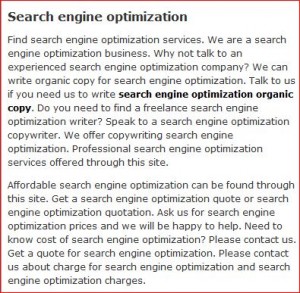
Can you believe it? This was taken from an actual SEO Copywriter’s website! They have squeezed the term ‘search engine optimisation’ into that small piece of copy 17 times! The result is unreadable. Would you want to do business with someone who writes like that?
Absolutely not.
Yes your keywords have to be present but not at the expense of clarity. The location of your keywords is far more important as any SEO Copywriter worth their weight in gold will tell you. They have spent many hours studying SEO and understand what it takes to write great copy that will ‘speak’ to your reader whilst providing enough tantalising keywords to keep the search engine spiders happy. So don’t take chances with the effectiveness of your website. If you’re serious about internet marketing and getting the most out of your website, invest in a good SEO Copywriter who really knows what they are talking about.
July 26th, 2010 — copywriter, freelance copywriter, social media, social media marketing
 Are you utilising social media marketing to promote your business?
Applications such as Twitter, LinkedIn, Blogging etc., are making it easier for businesses to build relationships with potential clients. Plus their marketing can how reach parts that traditional marketing simply couldn’t reach.
But blindly interacting through these applications without monitoring them is a bit like driving a Ferrari blind folded – your message is getting out there quickly but you could be about to hit a brick wall any second.
Once upon a time the only way you found out about a problem with your business was when you either received a letter of complaint or suddenly lost customers. By that time it was often too late to do anything about it. But with the advent of social media marketing you can now jump on problems and solve them before they get out of hand.
So why is monitoring a good idea?
- You can measure your effectiveness
- Find out what people are saying about you and your business
- Identify problems/opportunities and react quickly
- Discover who are the leaders in your industry and what they are saying
How to monitor what people are saying about you
I use two methods to find out what people are saying about me online.
Google Alerts
This is a great tool to find out what people are saying about you on the web. You can easily set these up to monitor any phrase – I use one on my name (Sally Ormond) and another on my business name (Briar Copywriting).
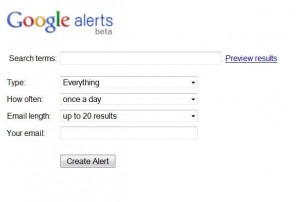
By simply completing the fields above, Google alerts will email you whenever your search terms are found on the web. This is a brilliant way to find out who is talking about you and what they are saying. Then, should anything be derogatory, you can act immediately and make a potentially bad situation good.
Social Mention
Social mention offers you real time social media search and analysis. It’s a bit like Google Alerts but for social media. Basically if anyone mentions your sepcified search term within social media, you’ll receive an email alert. This will help you measure the effectiveness of your marketing campaigns, alert you to any comments being made about your brand or company or even about you.

Again, Social Mention is very easy to set up. Just complete the fields with the information you want to monitor and create your alerts.
Why do you need to know this?
If you are going to use social media marketing to boost your business, it pays to keep one eye open. Numerous large companies are utilising applications such as Twitter to find out what people are saying about them and their brand. As soon as someone uses twitter, forums, blogs etc to tell the world about the problem they have encountered, the company is alerted and can act immediately.
This proactiveness is what will make you stand out from the crowd and show your customers you really do care.