March 23rd, 2011 — copywriter, copywriting, copywriting tips, website copywriter, website copywriting

Many businesses think their website copy has to be stiff and corporate.
They want to come across as professional so they must use language that impresses.
As they write their copy they thumb through the pages of their much loved thesaurus to find the most impressive words possible.
Oh boy.
How many times have I seen that? And you know what? They are the websites that under perform because no one wants to read them because they are boring. The language is stale – it’s not interesting, it’s not inspiring and it certainly won’t make the reader think “wow, I really want to do business with these people.”
Be a friend
The best way to get your readers on your side is by chatting with them.
Conversational copywriting will make your website more accessible. It gives your company a distinctive voice – something your readers can relate to.
It’s like slipping on your favourite slippers. They’ll stay longer and they’ll read more because you are talking to them and not at them.
So how can you achieve chatty copy?
- Find out who your target market are and use their vocabulary
- Use short, clear sentences to get your message across
- Don’t use big words – throw away the thesaurus and use language everyone understands
- Read your copy out loud to check it makes sense, has rhythm and doesn’t contain any errors
- Use real language, not a literary version of it
Basically write as you would talk – go over the conversation you would have with the customer if you were stood in front of them and write it down.
March 21st, 2011 — copywriter, copywriting, copywriting tips, freelance copywriter, internet marketing, marketing, website copywriter, website copywriting
 In the world of marketing you’ll soon discover that very few people like being sold to.
We want to be sure our decisions are our own and not influenced by someone else.
That’s why very few people will land on a website, think “Wow! I must buy that now” and eagerly get out their credit card.
Before any of us buy (yes, you included) we have doubts – is it really what I need? Can I really justify the cost?
The art of a good copywriter is to overcome those objections within their copy which means getting out their crystal ball.
Why?
Because you have to counter their objections before your reader has had the opportunity to work out what they are.
Copywriting that convinces
Whenever you are faced with a buying decision all manner of objections are going to pop into your head. The copywriter has to pre-empt these because copy isn’t about getting the consumer to say ‘yes’, it’s about preventing them from saying ‘no’.
Here are some common objections:
1. I don’t need it
Let’s face it there aren’t that many things we buy that we actually need. Needing something is about not being able to function with out it. To get round this one you have to change that ‘need’ into a want.
I don’t need the small mountain of shoes I have in the bottom of my wardrobe, but I want to look coordinated, stylish and modern hence I want lots of different pairs to go with my different outfits.
2. I can’t afford it
With the current economic climate there’s not a lot left we can afford.
But again if you can convince them they want it they’ll find the money from somewhere. Give them a good enough offer and they’ll just have to buy.
3. Perhaps tomorrow?
If you let them browse and then walk away, they are very unlikely to come back again.
You have to force them into a decision there and then:
- Create a time limited offer
- Tell them there is a limited supply
- Tell them they only have until midnight to place their order or miss out on the offer of a lifetime.
4. Why should I buy from you?
You know you are honest and trustworthy but the consumer doesn’t.
They have just stumbled across your website and don’t know you from Adam. Through your copy you have to convince them of your trustworthiness through:
- Testimonials
- Background information on your company
- Details of your longevity
Your copy must entice, convince and sell if you are to draw in the punters. Remember you have to dispel their objections before they have the opportunity to raise them.
March 18th, 2011 — blog, blogging, blogging for business, copywriting tips
 Adding comments to blogs is thought by some as a great way to gather back links to their own sites.
Well, I hate to burst your bubble but it doesn’t really work like that. You see blog commenting may drive traffic to your own site but only if you have something interesting to say.
Running two blogs I get my fair share of spam comments. Some are blatant spam full of links to other sites; others are seen as spam because of the content of the comments.
So how can you legitimately leave comments without being seen as a spammer?
4 tips to becoming a good blog commenter
1. Read it
If your comment is “Wow! Great post!” it will show the blog owner that you really haven’t read the post and may well be seen as a spammer.
If you’re going to take the time to read someone’s article and comment on it, at least make sure you’ve read it, understood it and leave a comment that’s relevant and intelligent.
2. Know who you are
When you leave a comment you are asked for your name – so use it.
Many people try to get a leg up by using their keyword as their name (so rather than leaving my name as the commenter, I would write freelance copywriter). If you do use your keywords you’ll probably be seen as a spammer and your comment won’t be published.
3. Forget link juice
Most people comment on blogs with high page rank (PR) because they think they’re going to get some link juice from their comment.
Think again. Most blog platforms will only give a nofollow link. You may get a bit of traffic (if you’ve left a well considered and intelligent comment) but you won’t be getting anything else.
4. Be relevant
Following on from number 3, those under the impression they’re going to get link juice only target high PR blogs, even if they have no relevancy to their own field.
Comment on blogs that are relevant to you. That way, assuming you’re leaving intelligent comments, you may get other people popping over to your website for a quick peak.
What it comes down to is this – blog commenting is not going to help your SEO. But, it will get your name in front of people who are either interested in your product or service or in the same industry as you. This kind of exposure could bring a bit of extra traffic your way.
March 16th, 2011 — copywriting tips, internet marketing, keywords, search engine optimisation, seo, SEO copywriter, seo website copywriter
 Keyword research (as opposed to keyword guessing) is vital if you want your search engine optimisation activities to bear fruit.
The words or phrases you decide to target will have a big effect on your website and its contents which is why it should be done before you begin the design process.
How can a few keywords affect your site?
Well quite easily. After all it’s not until you know what you’ll be targeting that you can:
- Create your on page text (SEO copywriting)
- Decide on your link building anchor text
- Work out your internet linking structure
- Decide on your site navigation
- Produce your page titles (title tags)
- Decide on your URLs
- Write your META tags
So as you can see it’s quite important that your keyword research comes first.
How to decide on your keywords
That’s all well and good but how do you begin the process of deciding on which words and phrases to target?
Here are 3 steps you can take to ensure you get the best possible match between your keywords and your target audience.
1. Be open to new ideas
Don’t go into the research blinkered to the ideas of others. You must remember that you are trying to find the words that other people search for to find your products and services, not necessarily the terms you would use.
The main thing is that the words you decide on must be relevant to your product or service. There’s no point in using a keyword that generates lots of traffic if it’s not pertinent to what you do. You’ll just end up with a lot of frustrated people.
2. Create word groups
Your starting point will be to generate a list of words that relate to your product/service.
Then, expand that list to incorporate names used in your industry for what you do. Expand this again with words used within the media for your product/service. Then, if you work in a specific locality, add in relevant geographical modifiers.
Then it’s time to use keyword research tools such as Google’s to further refine and expand your list.
3. Check competition and relevancy
The final step is to work out which are the best terms to go for.
Although you want to target terms that generate a lot of search traffic, you don’t want to pick something so competitive you won’t stand a chance of ranking for it.
This table below will help you determine which the best terms to try are:
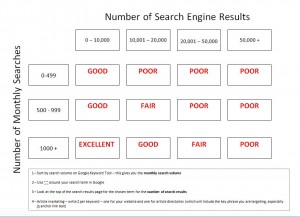
That’s why keyword research is so important. Make sure it’s the first think you do before starting your web design process.
March 14th, 2011 — blog, blogging, blogging for business, Content marketing, copywriting tips, online marketing, seo
 You know you have got to get to grips with SEO if you want your website to get noticed.
You also know a big part of that strategy will be the building of back links which means one thing – blogging.
The regular production of blog posts relevant to your business is essential to:
- Boost your link building activities
- Drive traffic to your sales site
- Add value to your customers
- Position yourself as an expert in your field
- Increase your online exposure
Whether you are a writer, designer, plumber or manager you can utilise the power of blogging to drive targeted traffic to your website.
But there’s always one thing that holds people back from giving it a go…
What on earth do I write about?
A blank mind coupled with the idea that you don’t have time to blog usually means you don’t try.
But there’s so much you could write about.
If you’re a copywriter like me you can provide tips on sales writing, marketing and using social media. If you’re a web designer you can talk about new thinking in your industry, how to structure a website, or how to get the most out of your site.
But what if you’re a manager, or supplier? You can still blog about your core business. Give hints and tips – if you are an intermediary to source gardeners for people, for example, you can blog about garden related issues, what to look for in a gardener – perhaps you could even get some of your gardeners to guest blog for you.
As long as what you are blogging about is relevant to your business it will help drive traffic if you utilise your keywords as anchor text back links (in the way I’ve linked the word ‘copywriter’ above).
How to get your ideas
That all sounds fairly straight forward but even I will admit to getting writers’ block now and then.
So when your mind goes blank what do you do?
Well, here are 8 tips to help you banish the dreaded block for good:
1. Fresh air brain storming
Get out of the office and go for a long walk. The fresh air and change of scenery will do wonders for your blankness. Take a note pad or Dictaphone with you so you don’t forget your blinding flash of inspiration when it strikes.
2. Write what you like
The best way to get the creative juices flowing is to write about something that interests you. You will already have the knowledge so no research is necessary and your passion for your subject will shine through.
3. What if…
Reading around your subject is a great way to spark ideas. Take a look at other blogs in your industry and see what other people are saying. If you find their writing interesting think about the subject from a different angle – that’s where the what if comes it.
4. Outline
It’s not very often someone can sit down and write an article straight off. If you have ideas buzzing round your head but can’t quite form them into an article list them as bullet points. This visualisation of ideas can often help you flesh them out into an interesting blog post.
5. Put it away
If you have managed to get a few ideas down but somehow it still doesn’t seem to gel, put it away for a day or two. Fresh eyes can often help craft it into an interesting and thought provoking post.
6. Magazine time
As with number 3, reading any sort of material can help the creative process – they don’t even have to be from your industry. An article in a magazine or newspaper can trigger an idea especially if a topical event can be seen to affect your industry.
7. Fancy a coffee?
Relaxing your mind will refresh it. Meet up with some friends for a coffee and a chat. Again you never quite know what will come out of your conversations; they could stimulate a great article idea. But if not, at least you’ve had time to recharge your batteries before returning to your desk and trying again.
8. Swipe file
No, I’m not talking about plagiarism! Your swipe file can be electronic or paper and should contain items you find of interest. As a writer, if I come across an effective sales letter I’ll save it, if I receive a brochure that’s particularly eye catching, I’ll save it. If I read a great article, I’ll save it. All of this is great information that can be used for inspiration when I need it.
Blogging is a great business tool and one that shouldn’t be ignored. Everyone can blog regardless of their industry or skill set. So give it a go – once you get the hang of it you’ll find that you really enjoy it.