April 4th, 2011 — search engine optimisation, seo, small business web marketing, social media, social media marketing, social media training, social networking
 You may have been trying to ignore social media but whether you think it’s for you or not, it’s here to stay.
Leveraging the social power of the internet is vital for any business today regardless of industry. Understanding how to use it correctly is the key to success so you must come up with a strategy before you dive in.
The most important aspect of any social interation is listening. Without listening you won’t know what your customers are talking about, what’s important to them, or where they’re hanging out. After all, what’s the point in using visual channels such as YouTube and investing a shed load of cash in video marketing if your audience use Twitter and Facebook?
Listen – Content – Socialise – Measure
Those four words are the key stages of any successful social media strategy as identified by Lee Oden in his post 4 Steps to Social Media Success on toprankblog.com.
If you want to develop a great strategy that works it’s well worth a read. Lee helps you understand the importance of listening to identify where your market hangs out, the importance and types of content you can generate, how to socialise effectively and, most importantly, how to measure your effectiveness.
This basic structure will help you develop a strategy that will promote your brand, develop relationships with customers and potential business partners and generate content that will also help make you stand out in the search engine rankings.
Social media is here to stay. It will constantly evolve so now’s the time to get on board.
April 1st, 2011 — copywriter, social media, social networking, twitter
 We don’t talk any more.
That’s what people are saying.
Today we communicate through email, text, Facebook, Twitter etc. The art of conversation is dying.
Is it really that bad?
Have advances in technology, and in particular social media, begun to change the way society interacts?
For some social media is killing conversation and personal interaction; for others social media is opening up new channels of communication and giving opportunities never before offered.
Which camp are you in?
It’s advances in things such as Wi-Fi that have really revolutionised our work and social lives. Now you can tweet, Facebook and blog practically anywhere which is changing the way we work.
I came across this entertaining and thought provoking post by David Murton on Convince and Convert – Is Wi-Fi Making You Anti Social? It’s well worth a read and addresses the way in which greater connectivity has made social media on the move easier and takes a look at how it could change society.
What are your thoughts?
Sally Ormond – Copywriter, blogger and social media addict
March 30th, 2011 — copywriter, copywriting tips, email copywriting, email marketing, UK copywriter
 If your business is new to email marketing working out how to get people to open your emails can be a real headache.
Mind you, you don’t even have to be a newcomer to email marketing to feel the frustration.
The problem is the success of your email all comes down to the recipient, the type of day they are having and the amount of time they have.
Little wonder then why it can seem an up hill struggle to get your emails opened and read.
Improve your email open rates
This is a short list of 5 very simple things you can do to give your email open rate a boost. Some of them may seem obvious but I think it helps every now and then to restate what many people over look.
1. When?
The day on which you send your mail will have a big effect on whether it’s opened or not.
Generally speaking Mondays and Fridays are not good days. On a Monday most people are wading through emails that weren’t cleared the week before, came in over the weekend or they just haven’t gotten into gear yet.
Fridays are bad because people are winding down for the weekend and they don’t have time to read your email.
So, in general, the best days to send are Tuesday, Wednesday or Thursday.
2. Subject line
Subject lines are difficult to write. Not only do they have to grab attention and make the recipient want to open your email, they also have to avoid spam filters.
Including things like ‘discounted offer’ or ‘free product’ or ‘free trial’ will get attention but you must test them to make sure they don’t trip any spam filters.
Another good way of drawing attention to your email is by using your brand name – especially if it’s one the recipient will instantly recognise.
3. How often?
When’s too much or too little?
Getting the frequency right is vital. As a general rule, once a month is ideal. If you bombard your readers with several emails a week they’ll soon get fed up and unsubscribe.
Equally if you send them only once every 6 months or so (or at random intervals) they may forget they’d subscribed in the first place and delete it.
4. List
Your list – who you email to – is vital which is why it’s always best to build your own rather than buy one in.
If someone has signed up for your emails there’s a pretty good chance they want to hear from you. if you buy in a list you are ‘cold emailing’ and they’ll probably end up being deleted.
5. Ask
Sending out emails willy-nilly is fine if you just want to fill them with stuff you want to say. But what about what your reader what’s to hear?
Every so often its good practice to ask them what they want to see so you can be sure the information you are passing to them is what they want to read.
Email marketing is great if you get it right but it takes time to perfect.
Sally Ormond – freelance copywriter
March 28th, 2011 — copywriter, copywriting, copywriting tips, marketing, sales writing, UK copywriter
Can you really tell whether copy is good or bad just by looking at it?
The answer is yes and no.
It rather depends on what the copy is, what it’s meant to do and what form it takes.
For example if it’s SEO copywriting and it’s very obvious what the targeted keyword is, like in the example below…
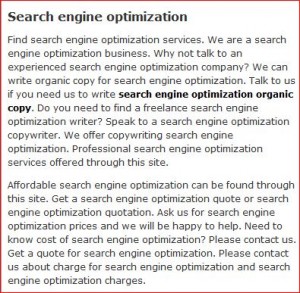
…then it’s pretty safe to say it’s bad copy.
The problem is a section of text can be very well written (grammatically correct and no spelling errors) and yet, from a sales perspective, it’s about as useful as a chocolate teapot.
That’s why it’s not always easy to spot bad copy.
It’s probably easier to look at this from a different angle and think about what makes good copy.
The traits of good copy
Luckily there are 5 characteristics that good copy has. No matter which format it’s written for or what it’s trying to sell, good copy will always:
- Grab the readers’ attention immediately
- Be clear and unambiguous
- Answer all the readers’ questions and so counter any buying objections they may have
- Build trust and rapport with the reader
- Motivate the reader into taking a specific action through a strong call to action
What it comes down to is this – copy is written for a purpose (generally to sell something) but if it doesn’t fulfil that purpose it’s not doing its job.
Selling through text alone is difficult. You don’t have the personal contact with the customer; you can’t think on your feet to counter their buying objections and you can’t shake their hands.
Your copywriting has to do every thing:
- Inform
- Build trust
- Convince
- Convert into a sale
That’s not an easy thing to achieve.
What are your thoughts? Can you think of any more traits you find in good copy? Why not share them here along with any shocking examples of copy you’ve come across.
March 25th, 2011 — copywriting tips, social media, social media marketing, social media training, social networking
 Do you need a parachute when you jump out of a plane?
Every business, if they engage in social media, needs a policy in place.
The social media channels you use are a direct line to your consumers (and competitors). Everything happens in real time – as soon as you hit send your message or tweet goes out to potentially thousands of people.
Get your message wrong and you could find yourself in serious hot water.
The implementation of a social media policy will help protect your company by:
- Ensuring you can avoid PR nightmares
- Making sure all your employees know what you expect of them
- Keeping you out of legal hot water
- Protecting confidential or sensitive information about your company
You must decide what your company’s line will be in the case of defamatory comments being made about it.
How will you react to positive comments?
Who will be monitoring your social media activity and who will be engaging with your followers?
Social media is an excellent tool for businesses to use but, especially for larger companies, it can be a potential mine field so you must ensure you have a social media policy in place before you begin to dabble.
Before you go any further check out this useful post on Mashable – 10 Must Haves For You Social Media Policy.
Engage and enjoy social media, but make sure everyone knows what they’re doing.