July 25th, 2011 — blog, blogging, blogging for business
 Blogging is great for positioning yourself as an expert, boosting your profile and, of course, search engine optimisation.
It’s really easy to get started – all you need is a blog (preferably self hosted with your own unique URL), some ideas and a bit of time.
But despite it being that simple many people are getting it horribly wrong.
Here are a few of the most common mistakes made by would-be bloggers:
1. Not understanding your audience
This is a fundamental requirement if your blog is to be successful.
How can you write stuff your audience will want to read if you don’t know who they are? Granted, anyone could find your blog but you have to keep in mind the people you are writing for and trying to attract.
What is important to them?
In this blog I write about all things copywriting, marketing and social media because the audience I’m writing for are (in general) small businesses looking for some advice when it comes to marketing their businesses. If I suddenly started blogging about my favourite recipes or what my dog did at the weekend, my readers would get fed up and look elsewhere for the information they want.
2. Ignoring your niche
A lot of bloggers want to be all things to all people.
That’s not going to work.
As I mentioned earlier, a powerful blog is one that knows its market and what they want. Writing about something you understand will result in informative blog posts that are relevant to your readers.
Find your niche and stick to it.
3. Blanket writing
This is what happens if you don’t stick to your niche.
Suddenly your blog becomes awash with posts about all manner of topics, none of which gel. You might think you’re doing your readership a great service by taking this ‘all encompassing’ approach but all you’re doing is confusing them.
If you start out writing a blog about photography and start to build a regular readership, those loyal readers will come back time and again because they know they are going to get great information on photography. But if you suddenly start adding posts about cats, cars, insurance etc., the continuity is lost. Because they don’t know if your next post is going to be relevant to them they won’t bother coming back.
If you want to write about 2 very different subjects, get 2 blogs.
4. Being inconsistent
Every post you write has to be written well. The quality of your work can’t slip.
When you start out, fired up with enthusiasm, your posts will be top notch. But as time goes on and you squeeze your blog writing between other things, you might become a little careless; errors will start to creep in and the general standard of your writing might slip.
That is the first sign of a dying blog. Quality is everything so you have to keep your standards high.
But as well as quality, you also have to be consistent with your frequency. Your readers are creatures of habit. If you blog 3 times a week, they’ll grow to expect a new post from you at that frequency. If you suddenly change it or miss a week they’ll be left wondering what’s going on and, ultimately, go and find a different blog that will meet their expectations.
5. No commitment
Just like a dog is for life, not for Christmas, your blog is for life and shouldn’t be started on a misguided whim.
When you’re sat in front of your computer writing your blogs you probably see each post as an unrelated entity. But your readers see them as a series of factual and interesting posts. They expect great things from you and on a regular basis which requires commitment on your part.
If you make the decision to blog, you must be 100% committed otherwise it won’t work.
6. Focus on quality
As I mentioned in number 4, the quality of your posts must be consistent.
To make your blog work well you should ideally be posting at least 3 times a week. Every one of those posts has to add value to your reader and must be thought through and written well.
The mistake many bloggers make is they are so conscious that they have to keep generating posts, it’s not long before quantity becomes more important than quality.
If the quality of your work slips you’ll get known for your bad writing rather than your great information and you really don’t want that to happen.
7. Writing for yourself
You are bound to blog on a topic you know well but you mustn’t lose sight of what’s important to your readers.
Writing about stuff you find interesting is OK but not if no one else is interested in it. If you want your blog to be successful, identify your audience, discover what they want to know and write about that.
8. Poor headlines
No matter how great your writing, if you come up with a lame headline for your blog no one’s going to read it.
Most people will just look at your post’s title. If it doesn’t immediately grab them they won’t read on. So make sure you come up with strong headlines for every post; something that will draw your reader in and make them what to find out more.
9. Blatant self-promotion
The whole point of a blog is to add value to your relationship with your reader.
If every single post you write is a thinly disguised advert for you and your products, your readers will see through you and walk away. So don’t write about your products and services; provide information that your readers can use to their benefit.
Sure, you can link out to your main website from your posts but only if it adds value.
At the end of the post you can always add an author bio with a link to your site.
10. No engagement
Every post you write must engage your reader and make a connection.
Don’t worry that’s easier to do that it sounds. All you have to do is write conversationally and in the second person (using you and your – just like I have done in this post). Your post will then be ‘talking’ directly to your reader, making it personal.
11. Unresponsive
When you start getting traffic to your blog you’ll start to get a few comments coming through.
You have a choice; you could ignore them and come across as someone who couldn’t care less about their readers. Or you could respond and interact with your readers.
It doesn’t take Einstein to work out which is the best option.
12. No promotion
How is someone going to read your blog if they don’t know it exists?
If you want your blog to succeed you have to promote it. Push an RSS feed through to your website, promote your blogs through Twitter and forums.
Basically shout very loudly to anyone and everyone about your blog and they’ll start to take notice.
There you go – 12 of the biggest mistakes new bloggers make. If you manage to avoid them you’ll be well on your way to being the owner of a successful blog.
Have I missed anything?
If you can think of anything else that could prevent a blogger making it big? If so please leave a comment below.
July 22nd, 2011 — Testimonials, twitter
“Oh no!” I hear you cry. “Not another post about Twitter.”
Bear with me on this one.
Yes, I love Twitter and yes, I have written about it a few times.
If you take a look at the Twitter archive you’ll find everything from using Twitter for business, how to build your followers, Twitter and a return on relationships to why you shouldn’t automate your social media activities.
But there’s one thing I haven’t looked at yet – and socialmediaexaminer.com beat me to it!
Twitter Testimonials
Testimonials are like gold dust.
Everyone knows they show potential customers what you’re like as a company to deal with. They can do wonders for your credibility and are a fantastic sales tool.
Most business owners will ask clients for testimonials or collect them through sites such as LinkedIn. But what about those you get through Twitter? Are you making the most of them?
What do you do when you get something like this?
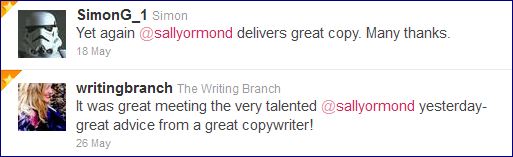
Do you just tweet “Thanks” or do you use them to your advantage?
Tweets actually make great testimonials.
At only 140 characters they are short and to the point. They are usually full of praise because people write them quickly in a moment of glowing enthusiasm and they’re written for the public domain so you don’t have to ask permission to use them as a testimonial for your business.
How to use them
You can save them by ‘favouriting’ them through Twitter and then those clever people at Twitter HQ have come up with a widget you can use on your website to show your ‘favourite’ tweets.
To find our exactly how to do it, take a look at this post on socialmediaexmainer.com – How To Embed Twitter Testimonials On Your Website – and make the most of your Twitter Testimonials.
July 20th, 2011 — article marketing, article writing, keywords, search engine optimisation
 Content drives the internet and therefore search results – that’s probably why many people are still writing articles for the search engines rather than for people.
If you fall within that category and believe strongly that your primary audience are the search engines because your articles are there purely to provide links to your website, let me ask you a few questions:
Why do you do article marketing?
- To generate links to my website
Why?
- So I can boost my rankings
Why?
- So more people visit my website
Why?
- So I can generate more sales of course
Aha! So you’re doing this to get more people to visit your website.
People.
So why exactly are you writing mainly for the search engines? You’ve just admitted you do article marketing to attract people – not search engines, people.
If your article is incomprehensible because you’ve stuffed it with loads of keywords do you really think someone’s going waste their time reading it?
Even if it is the number one search result, no one’s going to pay it any attention.
If someone does open your article and finds it unreadable are they really going to want to follow any links within it that will take them to your website?
I doubt it because they’ll think they are going to be faced with yet more incomprehensible drivel.
So the moral is, write for your reader first and the search engines second.
What to think about when writing your articles
Before you even touch your keyboard you must think about your reader.
- What’s important to them?
- How much do they know about your subject matter?
- What issues do they have that they’re looking for solutions to?
- What do they need to know?
It’s not until you have answered those questions can you start to create an informative and interesting article that someone will want to read.
But what about your keywords?
Just because you’re writing for your reader doesn’t mean you have to forget your keywords all together.
- Make sure they are in your eye-catching headline
- Break your article up into short paragraphs so it’s easy to read
- Create informative sub headings to help your reader scan your article
- Don’t fill it with links
To make sure it reads well forget about keyword density. When you write naturally about a subject you’ll automatically use your keywords and other words related to your subject.
Once you’ve written it read it out loud to check for rhythm, an easy flow and errors. If you find you are ‘tripping’ over your keywords you’ve probably included too many. Cut back within the body of your article but make sure they are present in your headings and sub headings.
At the end of the day, if you write with your reader in mind and not the search engines you can’t go far wrong.
Remember – when it comes to article marketing, your reader is king.
July 18th, 2011 — email copywriting, email marketing, marketing
 Hmmm…that sounds rather scary. Email marketing is for life – but that doesn’t mean you have to do it forever and ever even once you’ve retired to your Caribbean island paradise (I can dream).
The ‘life’ I’m referring to is the life cycle of your customer.
Yes, it’s great to have regular newsletters or email offers that go out updating your customers of new products, great advice and the occasional not-to-missed offer. But it would be even better if they received emails that reflected their relationship with you.
Matching your email marketing to relationship status
To make your emails resonate with your customers it is essential you send timely targeted emails. By that I mean your emails should be tailored to the stage in your relationship you are at with your customers.
Some examples would be:
1. Welcome
Once someone has signed up for your newsletter or made their first purchase from you, send them a Welcome email.
It doesn’t have to be a long communication just something that welcomes them, tells them the type of emails they’ll receive from you and perhaps an introductory offer – perhaps offering 10% off for one day only.
2. Conversion
You are bound to have customers who receive your emails but don’t take any action. Perhaps they’ve only ever made one purchase from you and you need to tempt them back to buy again. They may never have bought from you.
If that’s the case this email needs to encourage them to open their wallets and buy. A great way to break down the barriers that’s preventing them from buying is by making them an offer they can’t refuse. Perhaps a buy one get one free, or 20% off your next order if made within a week.
By making your offer time limited you’ll encourage them to take action quickly.
3. Come back
On your mailing list you will have a lot of people who have gone cold on you.
They probably signed up a long time ago but have never made contact or bought anything.
Many companies spend a lot of time and effort attracting new customers but don’t lose sight of your existing customers.
The best way to tempt them back is a win back offer – tell them they are important to you and you want them back. Make them an offer they can’t refuse, something so tempting they’ll just have to buy.
As you can see, tailoring your email marketing campaigns to your customers is a great way of developing relationships and showing your customers they are important to you.
Standard emails are all well and good but by tailoring your communications to each individual type of customer you will strengthen your relationship with them.
Remember to look at your marketing list not as one entity but as several different types of people. Work out where each person is within their marketing relationship with you and send them emails accordingly.
That may sound like a lot of work but many email marketing systems these days offer you the flexibility of running these types of campaigns.
Give it a try.
Perhaps you’re already splitting your marketing like this. If so, leave a comment below and share your experiences. Do you find it works?
July 15th, 2011 — search engine optimisation, seo, SEO copywriter, seo website copywriter
 There’s a lot of great SEO copywriting out there but there’s a lot of bad stuff too.
Once upon a time it was considered that the only way to get your website to rank well was to create content that was purely targeted for the search engines. Inevitably, this resulted in a mountain of websites (and articles) that were stuffed to the rafters with keywords rendering the text unreadable.
Such as:
Brian is an SEO copywriter. He has been working with SEO clients for many years and excels in producing SEO copywriting that works. Through SEO copywriting he gains exceptional rankings for his clients. His SEO copywriting skills have been applauded the world over with his SEO clients the first to recommend his talents. “SEO is the way forward” said Brian, “SEO is what helps my clients get in front of their customers. Without SEO many didn’t get great online sales but now I have worked on their SEO copywriting they are getting more traffic.”
Yuk.
The sad thing is there are still a lot of people out there who think this works.
As more and more people realise that content marketing (articles, blogs and website copy) is the best way to get noticed, more and more badly written content is appearing.
If you want your content to get ranked and attract readers, here are a few things to bear in mind.
How to get your content read
1. Write for people
You may well be scratching your head thinking “Who else would I be writing for?”
Well most people, who generate content like the example above, don’t write for people. They are writing for the search engines by over stuffing their copy with keywords.
Writing for your reader is the most important thing. Naturally, you will include your keywords anyway so there’s no need to stuff them into every sentence you write.
2. Don’t be boring
When you try to boost the frequency of your keyword within your article you end up with something repetitive and boring. Plus if great rankings came solely down to the number of keywords you’d included you’ll end up in a ‘frequency war’ to see who can add the most. Therefore nothing that appeared on the web would be readable.
Therefore it is much better to keep your writing natural and concentrate on getting your keywords into other prominent on screen areas.
3. Maximising on screen SEO
To explain that last statement in number 2, the key on screen areas are in your headings (H1 and H2 etc.) and ALT tags for images.
Basically that means breaking down your article by using sub headings.
This not only gives more prominence to your keywords it also makes your article easier and more attractive to read.
Remember, the search engines will read every word of your articles but your reader will skim read and look at the sub headings.
4. Link out
Although you are trying to generate inbound links to your website through your content, it’s always a good idea to link out to other information.
After all, to create your article you would have probably done some research so why not link to it? Providing your reader with this extra information will add value and enhance your status as an expert in your field. And, with a bit of luck, might encourage more inbound links to your site.
5. Be natural
Last but not least, be natural.
As stated in number 1, you have to write for your reader first and foremost. But make sure the way you write is also accessible.
If you write in jargon and industry ‘speak’ you’ll reduce the accessibility of your work. Writing in simple language and in the second person (so you actually address your reader directly) will make it easier to read for everyone.
At the end of the day, natural copy will always do better than obvious SEO stuffing. Use simple language, plenty of sub headings and talk directly to your reader if you want to create content that ranks and is accessible to your reader.