August 5th, 2011 — Google +, social media, social media marketing, social networking
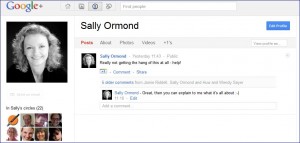
There’s a new kid on the block in the social media world.
Google + is the mighty search engine’s answer to Facebook, Twitter and just about every other social platform you care to mention.
And of course, with a new platform there’s a new language to learn. There are:
- Circles – which is the way you organise people you’re connected to
- Sparks – a bit like Google Reader as it brings in content automatically based on your interests
- Hangouts – these are virtual rooms for video chats with people in your cirlces
- Huddles – this is group messaging to people in your circle
Confused?
Me too – which is why I think you should take a look at these posts and videos put together by Chris Brogan:
- Google Plus – First Look
- Getting started with Google Plus
Thanks Chris!
August 3rd, 2011 — copywriting tips, email marketing, newsletter
You all know how great newsletters are. But do you really know how to write newsletters effectively?
They provide a way for you to keep in regular contact with your customers.
But what do you put in them?
Keeping your subscribers engaged and interested in your monthly mailings is essential. But how do you achieve that?
Timely
To ensure your content resonates with your reader, try to tie it in with topical events or seasonal subjects.
So in the summer months don’t start talking about Christmas!
By making your content relevant to what’s going on around you, you are showing your readers that you are a company that thinks – you’re not just emailing them to get them to buy. You will be providing timely and useful information.
Solving problems
Your newsletter shouldn’t just be about selling.
Adding an article that talks about ‘how to’ achieve something, how to solve a problem or one that offers general advice about something your readers are interested in, will add value to your relationship with them.
By offering this type of information they are more likely to remain subscribed to your newsletter. Plus talking about your field in this way will position you as an expert. So when they need help – guess who they’ll turn to?
Short and sweet
How long should your newsletter be?
It’s best to keep it short – no more than 400 words or so. That way you’ll keep your readers attention right to the end.
Send them something that goes on for eternity and they’ll delete it because they won’t have time to read it.
But it’s not only the length of your newsletter than should be short. By keeping your sentences and paragraphs short too, you’ll make it easier to read.
And of course, don’t forget your strong headline. If that, and the first couple of sentences don’t grab their attention, you would have lost them.
Link
OK, so you’re keeping your newsletters short but this month you want to talk about something in more detail because you feel it’s particularly important to your readers.
That’s where linking comes in; write a short piece outlining the main issues and then link out to more information. This could be a blog post or article you have written or an external news story.
This technique keeps your newsletter short and sweet and still provides your readers with the information they need.
Have fun
Your newsletter also has to be enjoyable to read.
That will not only come down to its content but also how it’s written.
Be human with your writing; conversational copy is far more readable than formal, staid language. Inject a bit of humour if you can and keep it light. Above all, let your personality shine through.
Newsletters are an amazing tool. They enable you to keep in regular contact with your customers and enhance that relationship by offering news, tips and offers.
Do you send out a regular newsletter? If so why not leave a comment below and tell us how you use it. You might have more tips for us all to follow.
August 1st, 2011 — seo, SEO copywriter
Nick Cobb is a freelance copywriter, online marketing consultant and the founder and Managing Director of Write For You Ltd. His principal website, My Freelance Copywriter, provides a wide range of copywriting services to domestic and international businesses, while his sister site. Red Hot Sales Letters, is dedicated to producing profit-pulling sales copy for online marketers.
The author’s views are entirely his own and may not reflect the views of FreelanceCopywritersBlog.com. If you are interested in producing a Guest Post for this blog, please get in touch with your ideas.
 The concept of SEO copywriting has taken on a huge amount of significance in recent years. More and more companies are realising just how important a role it plays in pushing their website higher in the search engine rankings. But like anything else, there’s a way to do it right, and a way to do it wrong!
Do it correctly, and you’ll end up with beautifully crafted, search engine optimised website content that appeals to both human beings and the search engines alike. Do it incorrectly, and you’ll end up with an incoherent mess that will have your readers clicking away in seconds.
So if you’re new to the concept of SEO copywriting but can’t afford to hire a professional to do it for you, here are some useful tips to bear in mind…
Don’t Stuff Up
Back in the day, people used to believe that the more keywords you included in your website, the more relevant your site would become, and the higher it would rise in the search engines for your main keyword(s). This resulted in the practice of “keyword stuffing”, which only succeeded in creating ugly and incomprehensible content that repeated the same words over and over again! Google soon cracked down on this and started to penalise sites that did it.
So if you’ve read about the importance of “keyword density” recently and were planning on loading your web pages with your main keywords, think again. By all means, use your keywords in your content, but make sure that your copy makes sense and reads well.
Always remember that good quality content is the most important factor, because not only will it convert visitors into buyers, but it will also have more chance of being linked to, which will ultimately boost your search engine ranking anyway.
The Crowbar Effect
Whatever product or service you’re selling, the headline (or H1 tag) is crucial. This is where you’ll grab your prospect’s attention and pull them further into your website or sales copy. Get this wrong, and you may lose them for good.
So first things first, your headline needs to be intriguing, powerful, and of course, persuasive. And in order to achieve this, it needs to make sense! There’s no point crow-barring your keyword into your H1 tag if it don’t read so good! So think about your readers first. Write the headline or H1 tag with human beings at the forefront of your mind, rather than the search engines. Of course, be sure to include your main keyword, but not at the expense of clarity.
License to Kill
With many sites being built on WordPress these days, more and more people are being given license to change and update their website content. This can be a god-send when designers take 3 days to add a full stop to the end of a sentence, but it can also give people a little TOO MUCH power!
For instance, internal linking can be a great way to boost your search engine ranking, as it allows you to make your site more relevant to your major keywords. Likewise, putting your keywords in bold and italics can also help a little.
However, upon discovering this, I’ve seen many site owners adopt a policy of turning every single one of their keywords into internal links, or putting them all into bold and italics! This has the effect of making the copy extremely difficult to read, which will only serve to drive visitors away. So remember, internal linking is good. Putting your keywords in bold and italicizing them can be of benefit. But don’t go overboard, because you’ll lose potential customers if you do.
July 29th, 2011 — marketing, Testimonials
 Testimonials are a very powerful marketing tool.
They instantly show potential customers what you are like, how you work, how trustworthy you are and how your customers perceive you.
And that’s why it’s so important to ask your customers for testimonials.
But a simple “thank you, we were happy with the service you gave” doesn’t really tell you anything. The best testimonials have substance to them. So how do you make sure you get what you need?
Asking the right questions
The easiest way to ensure you get what you need is by asking them to answer specific questions in your email request.
Outline that their feedback is vital to help you and your company continue to improve and that you would be grateful if they would take the time to answer a few questions. Of course, you should also make them aware that their responses may be used as testimonials on your website and marketing materials.
So what do you ask?
Well, how about:
- What made you decide to choose [company name]? Was there anything that made them stand out above their competitors?
- What did you need from [company name]?
- Did you have any concerns about choosing [company name]?
- How did they help you with your challenge?
- Were there any specific features of the service that you particularly enjoyed/found useful?
- Would you recommend [company name] and why?
- Would you like to add anything else?
By asking specific questions like this you will gain detailed testimonials that give potential customers a great picture of what you are like as a company.
When should you ask for a testimonial?
If at all possible, you should ask for testimonials from every client. Of course, for many companies that’s just not practical.
You should aim to ask for as many you can and, if you offer a range of products and services, try and get them for different aspects of your business to give a rounded picture.
Regularly updating testimonials on your website will not only help you show off your credentials, it will also help you add fresh content.
Remember, a good testimonial is worth its weight in gold so make sure you ask for them regularly and ask specific questions to really make them work for you.
Sally Ormond, freelance copywriter, blogger and social media addict
July 27th, 2011 — blog, blogging, blogging for business
 Have you ever wanted to guest blog for someone?
Do you know how to go about it?
Well, what you are about to read is how not to do it.
Why guest blog?
For many people, writing as a guest blogger is a great way to raise their profile. They are motivated by wanting to add value to the blog in question and its readers.
Very noble.
For others, guest blogging is all about links and promoting their products and services.
How to kill your chances
The best way to screw up any chance of getting your guest post accepted is to:
1. Send a spam pitch
You should always email the blog owner to find out if they are open to the idea of accepting a guest blog post.
But many people send something that is obviously being sent to numerous blog owners in the vain hope that one of them will bite.
If you want to stand a chance of being accepted, make your pitch personal. Show them you’ve studied their blog and understand their audience.
2. Get the name wrong
There’s nothing more infuriating than getting an email addressed to Sammy when you’re name is Sally.
Using the wrong name is another great way to get rejected immediately. But if you want them to consider your proposal it’s a good idea to do a bit of research and address your email using the right name.
3. Waffle
Don’t worry about the length of your email; the blog owner is bound to have loads of time to wade through your ramblings.
But if you want them to take you seriously it’s wise to keep it short and sweet and just come right out and ask.
4. Don’t research
This one is great for guaranteeing a rejection. You don’t have time to read through all those blogs to find the one that’s best suited to your writing and subject. Who cares if you write about insurance and you offer your post to a home furnishings blog?
Mind you, if you did want to get it published it might be a good idea to have a read through the blog so you can get a feel for the type of thing its readership wants.
5. Lashings of soft soap
Starting your email with loads of flannel about how amazing the blog owner is, how amazing their writing is, how amazing they are as a person…is bound to work. After all, who doesn’t respond well to flattery?
Mind you the only thing they want to know is that you’ve researched their blog and are offering a post that would enhance it. So maybe the grovelling should be forgotten about.
How to get rejected
We’ve looked at how to kill your chances of being asked to guest blog, now let’s take a look at how to get your post rejected.
The following 5 tips will ensure your post gets rejected:
1. Stuffed links
Most blog owners are happy to provide a link to your website in your author bio or maybe even one in the body text.
So if your post arrives stuffed to the rafters with links it will be rejected.
2. Typos
The blog owner will read your post before deciding whether to publish it or not. Sending it in full of typos is a pretty good way of getting it thrown right back at you.
3. Bad information
Writing inaccurately or about, shall we say, dodgy content (such as promoting black hat SEO techniques) will get you rejected.
4. Poor quality
The blog owner isn’t stupid. If you’ve written the post purely to get back links it’s going to be obvious. Your writing has to be of a high quality otherwise – you guest it – it’ll be rejected.
5. Bad fit
Researching the blog you want to write for is more than just taking a quick peek at one post.
If your article bears no relation whatsoever to the general subject matter of the blog it’s going to be rejected.
So there you have it – if you write badly, fail to research or are motivated purely by back links, you’re unlikely to make it as a guest blogger.
But if you want to discover how to write guest posts and how to get asked back you might want to take a look at this post.