Entries Tagged 'freelance copywriter' ↓
June 8th, 2012 — Achieving goals, copywriting tips, freelance copywriter, freelance copywriting
For many, working for yourself is a dream come true:
- No more annoying bosses calling the shots
- You can work the hours that suit you
- You only work for the people you want to work with
Within reason, you can do what you want, when you want.
Of course, there is always a flip side in that you also have to be Jack of all trades – Managing Director, Finance Director, Operations Director, Customer Service, Sales Director etc.
But all that aside, there is one very important thing you have to do when starting out as a freelancer, and that’s deciding who you are.
Finding your niche
When you start your business, it’s vital you understand what you are and what you offer.
It’s very tempting to say…
“I am a copywriter. Design? Sure, I can put something together for you. Run your social media accounts? Sure, no problem”
…because you don’t want to appear inflexible, but that could be your downfall.
Defining yourself and what you offer will help you focus your marketing activities to make sure you get in front of the right clients.
Think marketing
Even though you’d probably love to be able to say ‘yes, I can do that’ to any job that comes along, just think for a moment about how you would marketing yourself.
If your materials and website listed umpteen different skills you could be watering down the effectiveness of your sales campaigns.
When I started out in 2007, I decided I would market myself as a copywriter. To some, even that was too wide and I was advised to specialise in a particular industry.
But I knew that wasn’t for me.
Why?
Well, the main skills of a copywriter are to put yourself in the shoes of your client’s customers to discover what it is they need to know to make them buy. Then you have to learn enough about the business to be able to sell its products or services. And you have to adapt your writing style to fit in with their existing brand and tone of voice.
To me, they aren’t industry specific skills.
And it worked. I knew who I was, how I was going to position myself in the market, and, 5 years down the line, business is great.
Where to start
So, if you’re about to head out into the world of freelance, here are a few things to think about:
- What are your main strengths?
- Are your skills niche?
- Who would be your ideal client?
- What will be your primary service?
Did you notice I mentioned primary service there?
Once you’ve established yourself and have been in business a while, there’s nothing from stopping you realigning your skills to your market. Perhaps it will become apparent that your clients also need another skill you offer (perhaps PR)? In which case, there’s nothing stopping you from adding that to your services list and marketing it to your new and existing clients.
What it all boils down to is that you must work out what you are – once you know that, shout about it.
Over to you
If you’re already freelancing, what was your experience when starting out?
If you’re just thinking about it, what are your plans?
March 26th, 2012 — Content marketing, Content writer, freelance copywriter, freelance copywriting
Kevin Cain of OpenView Blog has kindly agreed to allow me to re-post his blog Deploying the Troops: 5 Tips for Using Freelancers Effectively in Content Marketing on Freelance Copywriter’s Blog.
Kevin Cain oversees content strategy at OpenView Venture Partners, a Boston-based venture capital firm that invests in expansion-stage technology companies. With expertise in corporate communications and content marketing, Kevin has spent the past ten years working with large international financial services companies and consulting firms. Learn more by checking out his content marketing blog or following him on Twitter @kevinrcain.
In my last blog post, I described the important role that freelancers can play in executing a content marketing strategy and provided some tips for building a freelance team. Of course, assembling a team of great freelance talent is just the first step. You then need to figure out the best way to use that talent to get the results you need. While there’s no single right answer, following these rules of the road will help:
1) Put them to the test, onboard the best
Any time you’re working with new freelancers — no matter how impressive their credentials or how highly they’ve been recommended — always start off with a test assignment. The idea is to start them off with a small project that either isn’t a high priority or that you have the time to redo if necessary.
This approach may seem a little counter-intuitive at first — after all, if you’re paying for their time, you want to get something out of it. Even so, you’re much better off testing the waters, rather than finding out that the very important content you’ve entrusted a new freelancer to write needs to be completely redone at the last minute. Your strongest freelancers will quickly prove their worth, and from there it’s easy to start engaging them on meatier projects.
2) Go broad, then get organized
Always try to have a variety of freelancers in your network with different backgrounds, skills, and expertise. Doing so will make the team much more valuable and allow you to create a broader range of content.
Use a spreadsheet to help not only keep track of important logistical details, such as your freelancers’ rates and availability, but also to catalog the types of projects they are best used for and any specific strengths or weaknesses they may have. This is also the place to keep tabs on their performance. I assign a grade to every freelancer I work with, so I know who to send my most important projects to (the A-listers), who are best suited to handling the low-hanging fruit (the B-listers), and who I probably won’t use again (everyone else). Unlike in school, when it comes to creating great content, a C isn’t a passing grade.
3) Provide Structure and Guidance
Freelancers aren’t mind readers or magicians. If you want them to create good content, you have to position them to do so. Set clear expectations, ensure that they have access to the right tools and resources (such as your company’s editorial style guidelines), and make yourself available to talk through ideas and answer questions. While you don’t want to micro-manage, any time you engage a freelancer, be collaborative and invest the time necessary to ensure that you are both on the same page from the start.
4) Use Flat Fees if Possible
Negotiating flat fees for specific projects often makes the most sense. Doing so, rather than simply letting your freelancers bill you for however many hours they work, encourages them to manage their time more effectively and keeps everyone’s expectations in check. That said, there can always be unexpected hiccups that significantly increase the time it takes to complete a project, so offer to adjust fees accordingly. Trying to nickel and dime your freelancers, even when budgets are tight, is rarely a winning strategy.
5) You’re the Boss, Act Like It
It’s up to you to enforce deadlines and standards, provide honest and constructive feedback, and to take action when a freelancer isn’t performing. It’s important to build great relationships with your freelancers, and one of the best of ways to do so is by always providing leadership and direction.
March 19th, 2012 — Achieving goals, freelance copywriter, freelance copywriting
Guest Post: Ella Davidson of couponing website Coupons.org provided this article. Coupons is a leading savings and deals site that strives to save consumers money. They offer electronic coupons, Amazon coupons and many other retailer coupons.
The author’s views are entirely their own and may not reflect the views of FreelanceCopywritersBlog.com. If you are interested in producing a Guest Post for this blog, please get in touch with your ideas.
Starting out as a freelancer in any industry (such as copywriting) can be daunting. In her post, Ella shares her tips on how to get your freelance career started.
When a person is a freelancer, they are self-employed, and do not have any long-term alliance with any specific employer. Sometimes freelancers work entirely on their own, while a company represents others. There are many different fields that people freelance in, such as website development, writing editing and journalism. Freelance positions have the benefit of being very flexible, where the freelancer has more control over their work and commitments than is normally present. Landing a freelance position can sometimes be difficult, as there are many people competing for the same work. Here are four tips to help you in securing the position that you desire.
1. Read the ad
Read it twice and make sure you understand what the employer is asking for. Many people applying for freelance jobs use the same format, or the exact same text for every job that they apply for. While this is a means of saving time, employers are often looking for specific things, and no one wants to hire someone who couldn’t take five minutes to find out exactly what the work they were applying for entails. Reading the ad also gives you a good indication of what approach to take with the employer. For example, sometimes a formal approach is best, while on other occasions a casual application may be more suitable.
2. Follow the instructions
Follow even the silliest instructions to the letter. Employers are often inundated with responses to their positions, and they do not want to hire someone who will not follow their instructions. After all, if a potential employee won’t do what they are told before they are hired, how likely are they to do so after they get the position. Often employers will ask for samples within the application, if this is the case, don’t tell them you will send samples if they request them, they already did.
3. Take a chance
If you don’t have exactly what the employer is asking for, but you are very good at what you do, it is worth making the effort and applying. Often the level of experience and training that employers ask for is an ideal level rather than an absolute minimum. Present yourself well and tell the employer why they should choose you, what your strengths are and show them that you can do the work well.
4. Be confident, but realistic
The level of confidence that you show when applying for a position is often a key factor in whether you land the position. If you approach the employer by saying that you hope you have what it takes and you think you can fulfill the role, odds are, they won’t be very interested in you. If you don’t have confidence in what you can do, why should they? Rather, tell employers exactly what you can do and what your strengths are. However, don’t oversell yourself. Don’t tell employers that you can do something that you can’t, because if you do get the position, it won’t last if you can’t live up to the expectations you have created.
Landing a freelance position can often be difficult, and you may experience many rejections before you are successful. However, as you develop your skills both in your field and in applying for positions, your success rate should increase. Keep trying, and be optimistic. It may take time, but eventually you will find what you are looking for.
December 14th, 2011 — copywriting tips, effective copy, freelance copywriter, freelance copywriting, marketing
The written word is a powerful tool when used correctly.
The effectiveness of all your written marketing communications, whether they are web pages, blog posts, white papers, case studies or brochures, relies entirely on engagement.
If they don’t strike a chord with the reader they will have little or no effect.
Writing marketing materials within your organisation can often lead to text that is full of jargon, unclear and downright boring, which will reflect the reader’s perception of your company. And that’s not good.
Yes, I know what you’re thinking – you’re a copywriter, you’re going to say that aren’t you.
Yes I am, and I make no apology for it. And that’s because over the years I’ve seen a lot of marketing materials produced in-house and, pretty much all of it (with the odd exception), is like that.
The problem is, when you are part of a company, you are usually too close to your product or service to see it objectively. It’s almost impossible to mentally remove yourself from what you know and write about it from your customers’ perspective.
That’s why writing with a copywriter can really help – because they are trained to write compelling copy that will engage your readers.
Different writing tasks
When writing something, do you actively think about what you need to produce and tailor your writing style accordingly?
Probably not.
You see, every type of writing demands different disciplines:
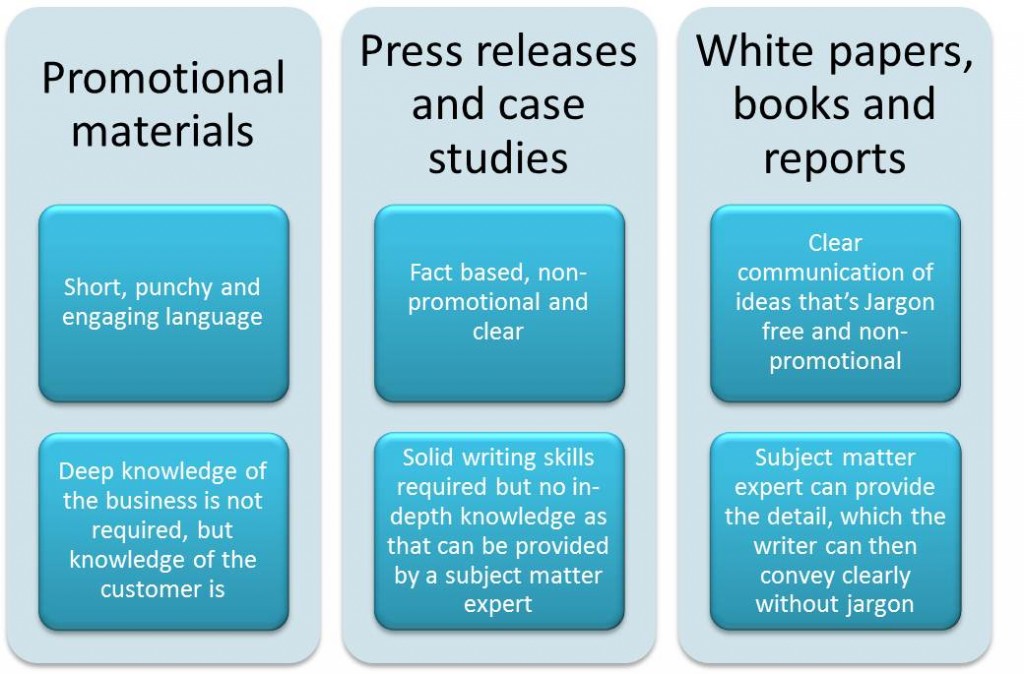
Working with a copywriter
First off, let’s get one thing straight – it’s not the copywriter’s job to know everything about your company.
You’re hiring them because they are professional writers and can put across your ideas and information in an interesting, engaging and compelling way.
Therefore, you will need to help them by providing them with background information and other materials to help them get to grips with your business and brand (including your style and tone of voice).
Plus, make sure you give them time to absorb all the information.
The copywriter/subject matter expert relationship
If this is going to be successful, it’s essential everyone knows where they stand from the outset and what they are to bring to the table:
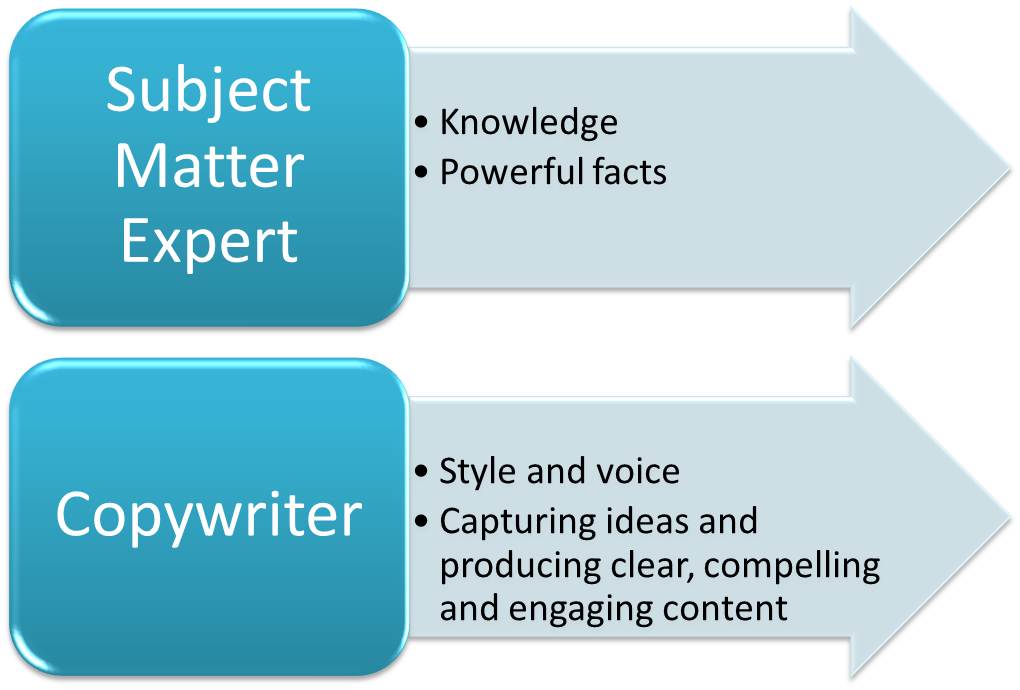
Only by working together can they really do justice to your products and services by shaping and developing great copy.
So next time you engage a copywriter to help you with your marketing materials, remember they can’t produce miracles alone.
October 31st, 2011 — copywriter, copywriting tips, freelance copywriter, Interview techniques
 This is a guest post written by Tom Albrighton, a freelance copywriter and founder of ABC Copywriting. He writes regularly on copywriting issues for the ABC Copywriting blog.
Of all the ways to obtain source material for your copywriting, interviewing must be one of the easiest and most productive. A half-hour phone chat or meeting with a client can easily generate enough material to write a thousand-word brochure, or develop a really strong tagline. But you have to do it right – so here are a few tips for getting the most out of interviews.
Preparation
It’s always worth writing a set of questions in advance. Even if you end up wandering way off topic, they’ll provide a useful structure to your interview and help you remember the points you want to cover.
Interviewees are reassured when you send them questions in advance, particularly if they’ve never been interviewed before. They can also spend some time thinking about their answers, or getting hold of data to back them up. (In my experience, material promised during the interview itself often fails to turn up, obliging you to chase your interviewee, which is awkward.)
Kit
Give yourself the best possible chance of hearing every nuance of your interview by investing in some decent recording kit.
For in-person interviews, I use a good-quality tape recorder. It’s not advanced but it gets the job done, and I like the reassurance of seeing the reels revolving. You might prefer to use an electronic recorder – certainly, having the interview as an MP3 is handy.
For phone interviews, I use a device called the THAT-2, which is connected between the handset and the phone (so you need a phone with a plug-in handset). You can connect it either to a tape recorder or to your computer, where you can record with an application like Audacity.
For quick and easy transcription of MP3s with iTunes on the Mac, use something like Sizzlin’ Keys, which lets you play, pause and skip backwards and forwards using keystrokes. Personally, I always use headphones, to get as close as possible to the original experience.
Questions
For copywriters, interviews are about exposition, not inquisition. You’re looking to get your interviewee to open up and give you everything they’ve got.
To achieve that, ask open questions, which typically begin with either ‘what’ or ‘how’. For example, ‘what does this product do?’ or ‘how will this service benefit customers?’
Listening
In person, it’s important to physically signal your interest by making eye contact, leaning forward attentively, nodding and so on. But that doesn’t work on the phone, so it’s worth making little affirmatory interjections like ‘mm’, ‘yeah’, ‘uh-huh’. ‘sure’, ‘right’ or whatever works for you, so the interviewee knows you’re still listening.
Don’t be afraid to ask for more information if you need it. Many interviewees feel self-conscious when talking for a long period, particularly if they are natural introverts. Reassure them that you’re still interested by saying ‘Can you tell me a little more about that?’ or something similar.
Make sure everything you say is oriented towards getting the interviewee to express themselves, rather than impressing them with your knowledge. Even the cleverest observations must be suppressed – this isn’t about you.
Reflecting
Sometimes, people get hung up on making a particular point that’s very important to them. Signals include rephrasing it again and again, or using more than one example to explain it. To show them you’ve understood, rephrase the point and say it back to them, starting with something like ‘So as I understand it, what you’re saying is…’
I also find this a very useful way to capture potentially useful phrases that come to me while people are speaking – for example, metaphors that might liven up the finished copy. By throwing them into the conversation, you make sure they’re in your recording.
Digressions
Sometimes, interviewees ramble badly, leaving your intended topic far behind. This can be frustrating, but you just have to wait for your chance to gently guide the conversation back on course.
The classic problem for copywriters is getting the client to think about customer benefits rather than the features of the product or service they’ve created. But sometimes, people just have to get all that feature stuff out of their heads before they can translate it into benefits – so give them some room.
Only interrupt the interviewee as a last resort – if you’re running out of time, say, and don’t have what you need. If you talk over them by mistake, say ‘sorry, go on’ and let them have the floor.
Wrapping up
Always thank the interviewee for their time and, if appropriate, give them the opportunity to review and approve what you write. Some people will ask for this up front, as a condition of being interviewed. In my experience, 95% of people will rubberstamp what you write. But be prepared for the exception who takes the opportunity to rewrite the whole thing – badly.
Transcription
When you transcribe, don’t be afraid to either (a) use the interviewee’s words verbatim or (b) chuck them out and use your own. People sometimes use the perfect phrase in conversation, but would never write it down – your job is to give them the authority to use it. Conversely, people’s own pet phrases might be completely inappropriate for the task at hand – but, after all, that’s your job!