Entries Tagged 'copywriter' ↓
July 21st, 2010 — Content writer, copywriter, copywriting, freelance copywriter, search engine optimisation, website copywriting
 Content is King!
How many times have you been told that?
Well, it is true. Internet marketers have been telling you for years if you want more organic traffic you must publish more web content targeted at your long tail keywords. Finally, you’re taking notice and more and more companies are adding page upon page to their websites of new content.
But of course, hiring a talented copywriter doesn’t come cheap. So, adding hundreds of new pages of content to your website is going to be expensive.
Now, there is a group of you out there who think you’ve found the perfect solution to this. I can see you patting yourself on the back because you think you’ve got the best of both worlds – shed loads of new content without the high price tag. If that’s you, you’ve probably done one of two things:
- Out sourced your content writing to an Indian company or elsewhere in the world where you can pick up loads of articles for next to nothing
- Decided to take the DIY approach and written it yourself
Big mistake!
Yes, you are increasing your web content at a great rate of knots – but at what cost? And I’m not talking about how much you’ve paid for it; I’m talking about the cost to your reputation.
Why you shouldn’t value quantity over quality
Watering down the quality of your website content in this way could have a seriously detrimental effect on your rankings. Remember those? You’ve quite possibly spent years working on your search engine optimisation to achieve great rankings, do you really want to jeopardise them now?
A big part of your SEO strategy is building back links. Of course, people will only link to you if you provide great content. If you start to water down the quality of your content with poor articles, people won’t want to link to you. And if they don’t link to you…you got it, you’ll start sliding down the rankings faster than soap down a helter-skelter. If you want to attracts links, your content must be entertaining, intertesing and appealing.
But there is a more serious consequence – yes, even more serious than affecting your rankings. Low quality content will have a detrimental effect on your company’s image. Now for the science bit – take a look at these equations:
Great Content = Increased value + Positive effect on your company’s image
Poor quality content = Disappointed readers + Negative effect on your company’s image
OK, so maths was never my strong point but I’m sure you get the gist.
Why am I telling you this?
Because, if you don’t invest in quality content for your website you are going to do some serious long term damage to your reputation.
If you’re not particularly bothered about anything I’ve warned against here, go and hire a company that will generate oodles of content for you for just a few pounds. But if you do care about your image and reputation, invest in a quality freelance copywriter and focus on getting quality content. Yes, it will cost you more but the long term benefits speak for themselves.
The choice is yours.
July 19th, 2010 — case studies, copywriter, freelance copywriter
 The use of case studies within your marketing strategy is a great way to boost your business profile whilst showing customers exactly what your product can do for them. Plus, because they use real life situations, your sales pitch gains extra credit.
One way of creating powerful case studies is to combine an interview with the person involved. Quotes and personal insight will add weight. But interviews aren’t only for case studies, as a copywriter I use them extensively in projects such as newsletters, press releases, internal communications and news items.
The interview can generate a frame work from which the rest of the case study hangs and the quotes used substantiate claims whilst injecting your writing with life.
So how do you go about conducting an interview to make sure you get the most out of it? Well, that’s just what I’m about to tell you.
Tips to conduct an effective interview
1. Do your research
This one should be pretty obvious.
As with any form of copywriting, you should always ensure you do your research before you start. Whether it’s a website, brochures, other interviews, press or magazines, spending the time to read about your interviewee will prevent you from asking them the same old questions they always get asked. It will also help you find angles for your interview.
2. What’s it for?
Asking a load of questions isn’t going to generate a great interview. Before you begin think about why you are doing the interview. What is it that you want to get acorss? If you are interviewing a customer who is using one of your products, make sure you ask them about it. You’ll want to know why they chose it, what has it done for them? Information that your reader is going to want to know.
Once you have a clear focus in mind, make sure you stick to it rather than getting side tracked.
3. How?
You must also decide how it is to be conducted. By far the most effective way is face to face but that isn’t always practical (or cost effective). Usually I opt for a phone interview. I wouldn’t recommend an email interview as it is really difficult to get great quotes. Most people will refine their answers until you get something quite impersonal. If you can chat with your subject, either face to face or over the phone, you are more likely to build up rapport and get some great quotes.
4. Schedule it
Whenever I have to arrange an interview I always like to email in the first instance. In the email I explain who I am (and make sure all my contact details are included), and why I want to do the interview. Rather than asking them for a convenient time and date – which can lead to a constant stream of emails bouncing backwards and forwards as you try to agree on a date – I tend to offer a couple of alternatives and ask them to choose one.
It’s always wise to send them an email reminder a couple of days before and don’t arrange back to back interviews. Firstly, you won’t know how long each one will take. And, secondly, they are quite tiring.
5. What to ask?
Before you begin your interview (and after you’ve done your research), make a list of questions. Try to avoid closed questions as they won’t get you anywhere and make sure you always have the reader in mind. Make sure the questions you ask are relevant to the purpose of the piece you are writing and ensure you ask for answers in ‘language our readers can understand’ especially if you are dealing with a complex subject.
The best way to generate great quotes is to ask your interviewee to tell you a story about the process, what their opinion or impression was of it. That type of question will get them to open up and talk more freely about the subject.
6. What do I do now?
I don’t know about you, but I’m very bad at shorthand. Plus I find if I’m trying to take notes during the interview, I don’t concentrate fully on the answers I’m being given. Therefore I record my phone interviews (of course, with my subjects permission). I don’t have any fancy tech, just a speaker phone and a digital recorder which then allows me to upload the file to my PC.
Once the interview is completed I transcribe it. You can get this done for you if you prefer, but I find doing it myself helps me to get a better feel for the material. Plus it’s a great way to put a mental structure together for your case study and, as you type, you can highlight key information and great quotes.
So there you go. Interviews are invaluable but can be a bit scary if you’ve not done many before. But don’t worry about it (your subject will also be nervous) – open your interview with a few light questions to put them (and you) at their ease.
Just remember – research before hand, make a list of relevant questions and engage with them. If you sound disinterested they’ll close up. Listen, absorb and react and then you’ll get great material to produce a killer case study.
July 16th, 2010 — copywriter, freelance copywriter, twitter
 It’s been a while since I blogged about Twitter for business, so I’m about to set that straight.
So are you using it yet?
From conversations I’ve had with people about Twitter, there appear to be many of you that are still undecided about joining the Twitterati. There are others who know they should be part of the feathered gang but aren’t too sure what to do about it.
Twitter isn’t complicated – it is probably one of the easiest tools to use, but you have to learn to use it well.
Tweeting basics
Before you even start to worry about what you should be Tweeting, you have to set your account up.
If you want people to follow you make sure you upload a good avatar – whether it’s a photo of you, your business logo or something else. If you don’t upload one and opt for the generic Twitter image, what is there to set you apart from other people? Don’t be shy, reveal yourself to your followers (boy, that sounds so wrong, but you know what I mean) so they can put a face or company image to the personality.
The next thing you need to do it complete your biography. Not only will this help people find you, it will also make you sound interesting and worth following. Personally, if someone follows me and they don’t have a unique image or a bio, it is very unlikely I’ll follow back. Why should I? I don’t know who they are, what they do or whether I’m going to be interested in anything they tweet.
So before you go any further, make sure you have a good avatar and bio.
As for actually using Twitter to its full potential, take a look at this post by Chris Brogan – 50 Power Twitter Tips – a fantastic resource to get you started and Tweeting successfully. So go and check it out.
I look forward to tweeting with you – you can follow me here.
Sally Ormond – freelance copywriter
July 14th, 2010 — blogging for business, copywriter, freelance copywriter, search engine optimisation
 Every business that uses the internet wants to get found. That’s pretty obvious, right? But how to you go about getting found?
Search engine optimisation is obviously a big part of this, which is a subject I’ve talked about a lot on this blog. One aspect of that is building back links.
What’s a back link?
If you want people to find your website, you need lots of arrows pointing to it – these ‘arrows’ are back links. Take, for example, the paragraph above. As you can see there’s a link – search engine optimisation – that is an internal link as it points you to a previous blog post. However if I were to write about a freelance copywriter who would be able to boost your businesses visibility and sales by producing eye-catching sales writing that inspires customers to buy, that is a back link because it’s pointing to an external website.
How do you get back links?
Encouraging people to link to your website takes work. Generating high quality content is the key. If you are providing great information regularly, people will want to link to you. Creating hints and tips in your chosen field will also help elevate you to expert status, and with that comes more links. But there are ways you can also generate links yourself.
Blogging and article marketing are two very effective ways of building back links, especially the most sought after type – the keyword hypertext link. I showed you an example of that earlier by linking the words ‘freelance copywriter’. This just happens to be one of my key phrases. These are the most valuable links as they relate to your chosen keywords. You can generate a lot of links by submitting your website to directories, however they tend to just link by website name (e.g. Briar Copywriting) rather than by your keywords.
Going back to article marketing for a moment, when you post an article and insert a keyword hypertext link into your text, you are effectively funneling a bit of link juice to your website. That might sound a bit strange, but this is how it works. If you use an article site with a high Google Page Rank (e.g. ezinearticles) and they allow you to add hypertext keyword links which are follow links (as opposed to the no follow link), a little bit of page rank is also passed along the link. Therefore the more links like that, the higher your chances of increasing your own website’s page rank.
Another way of generating back links is by guest blogging and using social media and social networking sites. These are great because you can add your profile details to widen your ‘internet footprint’ therefore boosting your chances of being found online. Some sites even provide facilities to create your own micro-site which gives you even more exposure. Taking advantage of opportunities likes these and contributing to forums etc., will boost your exposure.
One giant step…
Generating back links is invaluable and you would do well to get into a routine to create blogs and articles that constantly generate links for you. Make sure the content is fantastic and keyword rich to encourage others to link to you.
But don’t forget about the other elements of SEO. Back links should just be one part of your SEO strategy. You must also consider your website’s structure and content.
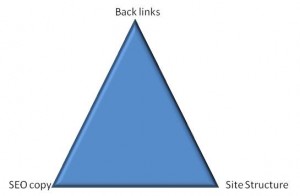 All three elements are essential if you want your website to be found online. But you must remember that SEO is an ongoing process. You have to constantly review your keywords, constantly tweak and update your content to get the optimium amount of traffic and conversions and you must continually build back links.
Your competitors will be doing all of this, so if you stop you’ll gradually become invisible to online customers.
July 12th, 2010 — copywriter, freelance copywriter, keywords, search engine optimisation
 When people think about search engine optimisation, they immediately start thinking about keywords and search engine rankings. There’s nothing wrong with that, but if you spend every waking hour worrying about that, you might be missing something more concerning; something that could be happening right now.
Every website owner should use Google Analytics. This small powerhouse of stats and graphs will show you how your website is performing. Information such as which keywords bring you the most traffic, sources of your traffic, which pages get the most hits and the geographical spread of your visitors is all at your finger tips. But one of the key stats that will show how effective your website is, is the bounce rate.
What is bounce rate?
The bounce rate is a figure that shows the percentage of visitors to your website that leave within the first 10 seconds. And that’s not good. If visitors are leaving that soon it shows that they haven’t found what they were looking for. A site with a low bounce rate (say below 30%) will be a website that is converting its visitors into customers. A site with a bounce rate of 50% and higher is one that isn’t converting – it’s failing.
If your rate is 50% and above, its time to take a look at your SEO.
Factors affecting bounce rate
Traffic to your website comes from a number of different sources:
- organic search results
- backlinks from referal sites
- repeat visitors
- social bookmarking traffic
- PPC traffic
The source with the lowest bounce rate should be your PPC traffic – if you use pay per click. If the highest rate comes from your organic traffic this would suggest that you have a mismatch with your keywords.
As a freelance copywriter it won’t come as any surprise that that is one of my keywords. So if people Google freelance copywriter they’ll find me. But what if I’d targeted something like marketing agency and they were looking for a company to deal with all their design and branding needs? When they land on my home page they’d find great information about my freelance copywriting services but no mention of design or branding. The result would be that they would click away from my site which would lead to a high bounce rate.
Therefore it is essential you ensure your keyword selection truly reflects what you do. Shed loads of traffic is useless without conversions.
But it might not be just down to your keywords. Here are other factors that may be causing people to click away from you site:
- too much advertising – this could be making your site look messy with too many messages
- videos and music – especially if they are on auto play as soon as your website is opened. The can be really annoying
- navigation choices – too many and your visitors will get confused, too few and they won’t know where to go next
- slow loading speed – peopel don’t like hanging around waiting for websites to load
- excessive corporate speak and jargon in your copy will be a huge turn off
- bad design – if you site looks unattractive it won’t encourage people to stay
So, if you are experiencing high bounce rates take a look at your site and compare it with the list above. Take another look at your keywords – are they really reflecting what your site is about?
If you can bring down your bounce rate you’ll boost your conversations.